

determined (Koharudin et al. 2008). It is frequent that EEMs have multifunctional
health benefits, for example recently Liu et al. (2013a, b) found that the ‘‘broom
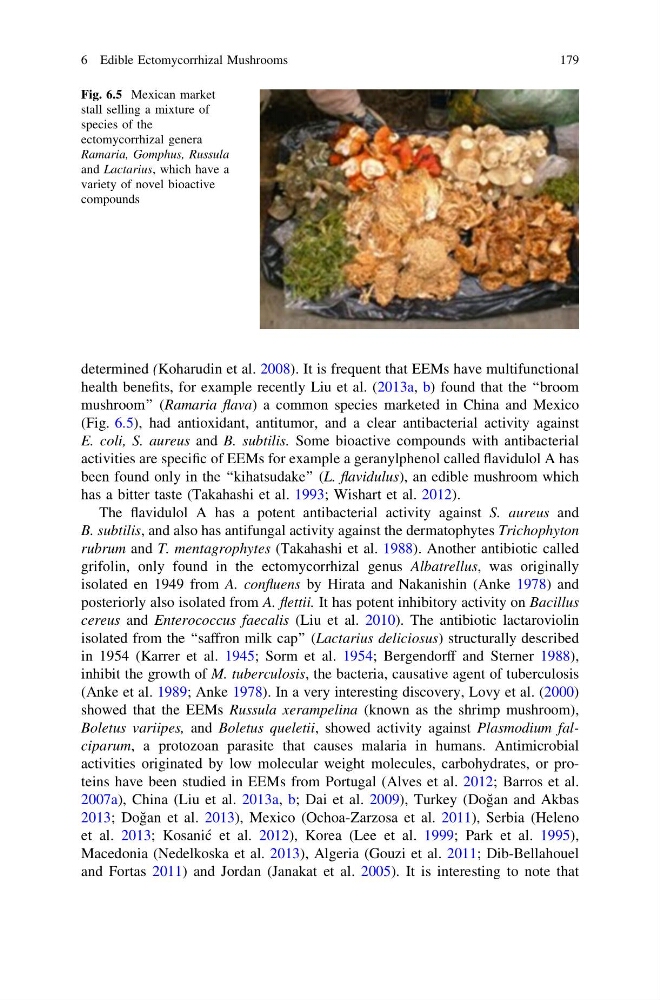
mushroom’’ (Ramaria flava) a common species marketed in China and Mexico
(Fig. 6.5), had antioxidant, antitumor, and a clear antibacterial activity against
E. coli, S. aureus and B. subtilis. Some bioactive compounds with antibacterial
activities are specific of EEMs for example a geranylphenol called flavidulol A has
been found only in the ‘‘kihatsudake’’ (L. flavidulus), an edible mushroom which
has a bitter taste (Takahashi et al. 1993; Wishart et al. 2012).
The flavidulol A has a potent antibacterial activity against S. aureus and
B. subtilis, and also has antifungal activity against the dermatophytes Trichophyton
rubrum and T. mentagrophytes (Takahashi et al. 1988). Another antibiotic called
grifolin, only found in the ectomycorrhizal genus Albatrellus, was originally
isolated en 1949 from A. confluens by Hirata and Nakanishin (Anke 1978) and
posteriorly also isolated from A. flettii. It has potent inhibitory activity on Bacillus
cereus and Enterococcus faecalis (Liu et al. 2010). The antibiotic lactaroviolin
isolated from the ‘‘saffron milk cap’’ (Lactarius deliciosus) structurally described
in 1954 (Karrer et al. 1945; Sorm et al. 1954; Bergendorff and Sterner 1988),
inhibit the growth of M. tuberculosis, the bacteria, causative agent of tuberculosis
(Anke et al. 1989; Anke 1978). In a very interesting discovery, Lovy et al. (2000)
showed that the EEMs Russula xerampelina (known as the shrimp mushroom),
Boletus variipes, and Boletus queletii, showed activity against Plasmodium falciparum, a protozoan parasite that causes malaria in humans. Antimicrobial
activities originated by low molecular weight molecules, carbohydrates, or proteins have been studied in EEMs from Portugal (Alves et al. 2012; Barros et al.
2007a), China (Liu et al. 2013a, b; Dai et al. 2009), Turkey (Dog ˘an and Akbas
2013; Dog ˘an et al. 2013), Mexico (Ochoa-Zarzosa et al. 2011), Serbia (Heleno
et al. 2013; Kosanic ´ et al. 2012), Korea (Lee et al. 1999; Park et al. 1995),
Macedonia (Nedelkoska et al. 2013), Algeria (Gouzi et al. 2011; Dib-Bellahouel
and Fortas 2011) and Jordan (Janakat et al. 2005). It is interesting to note that
Fig. 6.5 Mexican market
stall selling a mixture of
species of the
ectomycorrhizal genera
Ramaria, Gomphus, Russula
and Lactarius, which have a
variety of novel bioactive
compounds
6 Edible Ectomycorrhizal Mushrooms
179
health benefits, for example recently Liu et al. (2013a, b) found that the ‘‘broom
mushroom’’ (Ramaria flava) a common species marketed in China and Mexico
(Fig. 6.5), had antioxidant, antitumor, and a clear antibacterial activity against
E. coli, S. aureus and B. subtilis. Some bioactive compounds with antibacterial
activities are specific of EEMs for example a geranylphenol called flavidulol A has
been found only in the ‘‘kihatsudake’’ (L. flavidulus), an edible mushroom which
has a bitter taste (Takahashi et al. 1993; Wishart et al. 2012).
The flavidulol A has a potent antibacterial activity against S. aureus and
B. subtilis, and also has antifungal activity against the dermatophytes Trichophyton
rubrum and T. mentagrophytes (Takahashi et al. 1988). Another antibiotic called
grifolin, only found in the ectomycorrhizal genus Albatrellus, was originally
isolated en 1949 from A. confluens by Hirata and Nakanishin (Anke 1978) and
posteriorly also isolated from A. flettii. It has potent inhibitory activity on Bacillus
cereus and Enterococcus faecalis (Liu et al. 2010). The antibiotic lactaroviolin
isolated from the ‘‘saffron milk cap’’ (Lactarius deliciosus) structurally described
in 1954 (Karrer et al. 1945; Sorm et al. 1954; Bergendorff and Sterner 1988),
inhibit the growth of M. tuberculosis, the bacteria, causative agent of tuberculosis
(Anke et al. 1989; Anke 1978). In a very interesting discovery, Lovy et al. (2000)
showed that the EEMs Russula xerampelina (known as the shrimp mushroom),
Boletus variipes, and Boletus queletii, showed activity against Plasmodium falciparum, a protozoan parasite that causes malaria in humans. Antimicrobial
activities originated by low molecular weight molecules, carbohydrates, or proteins have been studied in EEMs from Portugal (Alves et al. 2012; Barros et al.
2007a), China (Liu et al. 2013a, b; Dai et al. 2009), Turkey (Dog ˘an and Akbas
2013; Dog ˘an et al. 2013), Mexico (Ochoa-Zarzosa et al. 2011), Serbia (Heleno
et al. 2013; Kosanic ´ et al. 2012), Korea (Lee et al. 1999; Park et al. 1995),
Macedonia (Nedelkoska et al. 2013), Algeria (Gouzi et al. 2011; Dib-Bellahouel
and Fortas 2011) and Jordan (Janakat et al. 2005). It is interesting to note that
Fig. 6.5 Mexican market
stall selling a mixture of
species of the
ectomycorrhizal genera
Ramaria, Gomphus, Russula
and Lactarius, which have a
variety of novel bioactive
compounds
6 Edible Ectomycorrhizal Mushrooms
179