

quantity, and for the production of several entomophaga this makes up the major
investment. Since the biggest companies consume thousands of kilograms of this
factitious prey/host (e.g.: Nagaraja 2013), their future depends on lowering their
use in order to save money which is the only way to keep competitive in the
market with the actual low prices of the predators. Some other advantages of using
artificial diets eliminating part of the consummation of Ephestia, other than
reducing costs, is a simplification of the production line, higher flexibility, and
reduction of allergy problems generated by moth scales. One example of flexibility
is related with the problem of overproductions, which is a common practice so that
surges in demand can be met. Since both beneficials and most of the preys used to
feed them are short life products that cannot be stored during longtime, the
elimination of any arthropod food can contribute to a higher flexibility of
productions.
Several reviews have been published about the scientific literature pertaining to
factitious preys and artificial diets, to mention three fine ones: Thompson (1999),
Thompson and Hagen (1999), both covering papers until 1998, and Riddick (2009),
examining data from 1999 to 2007. Even that many works have been published by
academic researchers, very few examples have been transferred to commercial
industry. The most cited exception is the production of Trichogramma produced on
artificial eggs. After several decades of work on the subject (Cabello et al. 1984;
Cabello 1985), with only partial success in USA (Parra 2010), the production of this
parasitoid was achieved efficiently using artificial diet in China (Liu et al. 1995;
Parra 2010) and South America (Parra 2010; Consoli and Grenier 2010); in China
Rearing systems of
natural enemies
‘IN VITRO’
‘IN VIVO’
Factitious
prey/host
Natural prey/host
(Pest species)
Artificial diet of
natural enemy
Plant
Artificial diet of
factitious prey/host
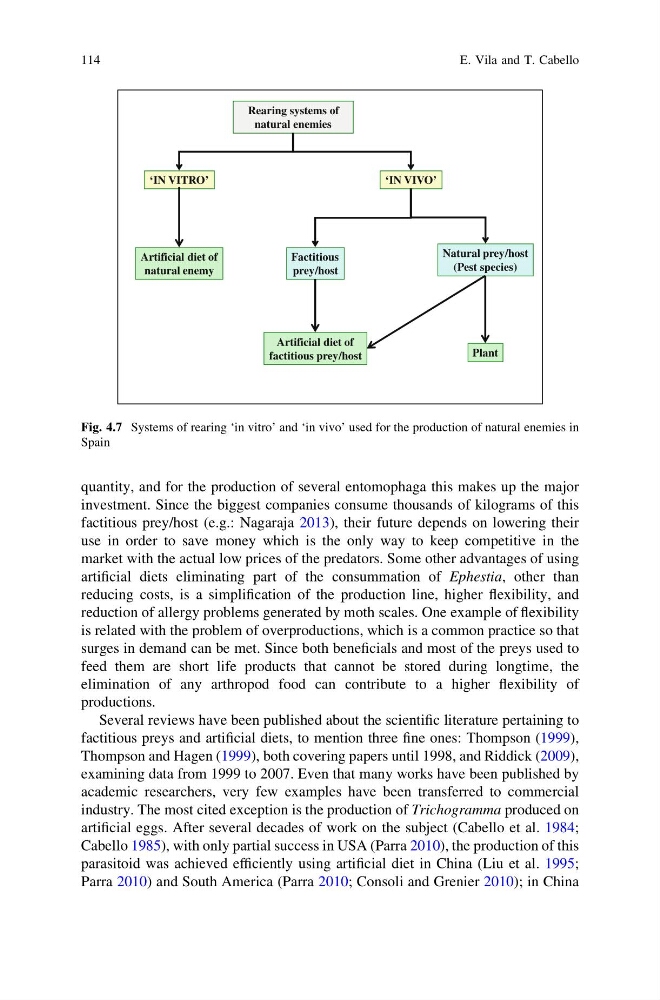
Fig. 4.7 Systems of rearing ‘in vitro’ and ‘in vivo’ used for the production of natural enemies in
Spain
114
E. Vila and T. Cabello
investment. Since the biggest companies consume thousands of kilograms of this
factitious prey/host (e.g.: Nagaraja 2013), their future depends on lowering their
use in order to save money which is the only way to keep competitive in the
market with the actual low prices of the predators. Some other advantages of using
artificial diets eliminating part of the consummation of Ephestia, other than
reducing costs, is a simplification of the production line, higher flexibility, and
reduction of allergy problems generated by moth scales. One example of flexibility
is related with the problem of overproductions, which is a common practice so that
surges in demand can be met. Since both beneficials and most of the preys used to
feed them are short life products that cannot be stored during longtime, the
elimination of any arthropod food can contribute to a higher flexibility of
productions.
Several reviews have been published about the scientific literature pertaining to
factitious preys and artificial diets, to mention three fine ones: Thompson (1999),
Thompson and Hagen (1999), both covering papers until 1998, and Riddick (2009),
examining data from 1999 to 2007. Even that many works have been published by
academic researchers, very few examples have been transferred to commercial
industry. The most cited exception is the production of Trichogramma produced on
artificial eggs. After several decades of work on the subject (Cabello et al. 1984;
Cabello 1985), with only partial success in USA (Parra 2010), the production of this
parasitoid was achieved efficiently using artificial diet in China (Liu et al. 1995;
Parra 2010) and South America (Parra 2010; Consoli and Grenier 2010); in China
Rearing systems of
natural enemies
‘IN VITRO’
‘IN VIVO’
Factitious
prey/host
Natural prey/host
(Pest species)
Artificial diet of
natural enemy
Plant
Artificial diet of
factitious prey/host
Fig. 4.7 Systems of rearing ‘in vitro’ and ‘in vivo’ used for the production of natural enemies in
Spain
114
E. Vila and T. Cabello