

et al. 2012). Also they can be moved out of the crop when chemical treatments are
applied so that a part of the natural enemies can be recovered when reintroducing
the plants. In the Spanish cucumbers, for instance, A. cucumeris and A. swirskii are
the two phytoseid predators used to control the thrips, which are the main pest, but
despite being effective the frequent use of fungicides to control powdery mildew in
autumn can considerably reduce their populations (Vila and Cabello 2012).
There are few developments that have used refuge plants to favor conservation
and development of predatory bugs in the greenhouses, as the mirid M. pygmaeus
(Rambur) (Hem.: Miridae) (Arno et al. 2000), during longtime misidentified as
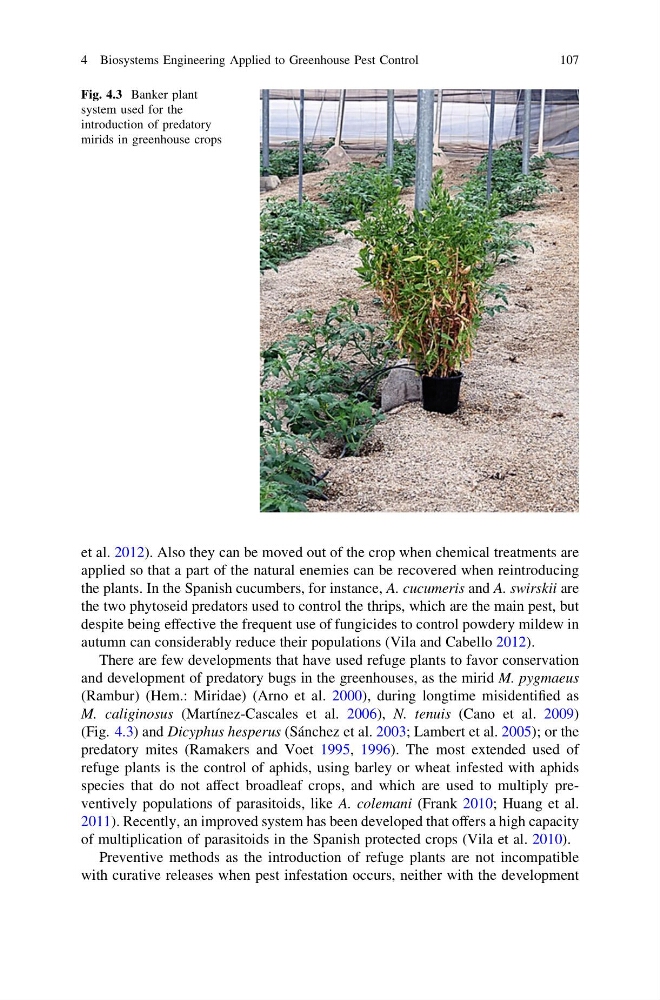
M. caliginosus (Martínez-Cascales et al. 2006), N. tenuis (Cano et al. 2009)
(Fig. 4.3) and Dicyphus hesperus (Sánchez et al. 2003; Lambert et al. 2005); or the
predatory mites (Ramakers and Voet 1995, 1996). The most extended used of
refuge plants is the control of aphids, using barley or wheat infested with aphids
species that do not affect broadleaf crops, and which are used to multiply preventively populations of parasitoids, like A. colemani (Frank 2010; Huang et al.
2011). Recently, an improved system has been developed that offers a high capacity
of multiplication of parasitoids in the Spanish protected crops (Vila et al. 2010).
Preventive methods as the introduction of refuge plants are not incompatible
with curative releases when pest infestation occurs, neither with the development
Fig. 4.3 Banker plant
system used for the
introduction of predatory
mirids in greenhouse crops
4 Biosystems Engineering Applied to Greenhouse Pest Control
107
applied so that a part of the natural enemies can be recovered when reintroducing
the plants. In the Spanish cucumbers, for instance, A. cucumeris and A. swirskii are
the two phytoseid predators used to control the thrips, which are the main pest, but
despite being effective the frequent use of fungicides to control powdery mildew in
autumn can considerably reduce their populations (Vila and Cabello 2012).
There are few developments that have used refuge plants to favor conservation
and development of predatory bugs in the greenhouses, as the mirid M. pygmaeus
(Rambur) (Hem.: Miridae) (Arno et al. 2000), during longtime misidentified as
M. caliginosus (Martínez-Cascales et al. 2006), N. tenuis (Cano et al. 2009)
(Fig. 4.3) and Dicyphus hesperus (Sánchez et al. 2003; Lambert et al. 2005); or the
predatory mites (Ramakers and Voet 1995, 1996). The most extended used of
refuge plants is the control of aphids, using barley or wheat infested with aphids
species that do not affect broadleaf crops, and which are used to multiply preventively populations of parasitoids, like A. colemani (Frank 2010; Huang et al.
2011). Recently, an improved system has been developed that offers a high capacity
of multiplication of parasitoids in the Spanish protected crops (Vila et al. 2010).
Preventive methods as the introduction of refuge plants are not incompatible
with curative releases when pest infestation occurs, neither with the development
Fig. 4.3 Banker plant
system used for the
introduction of predatory
mirids in greenhouse crops
4 Biosystems Engineering Applied to Greenhouse Pest Control
107