

368
S. S. Karimova and M. Gade
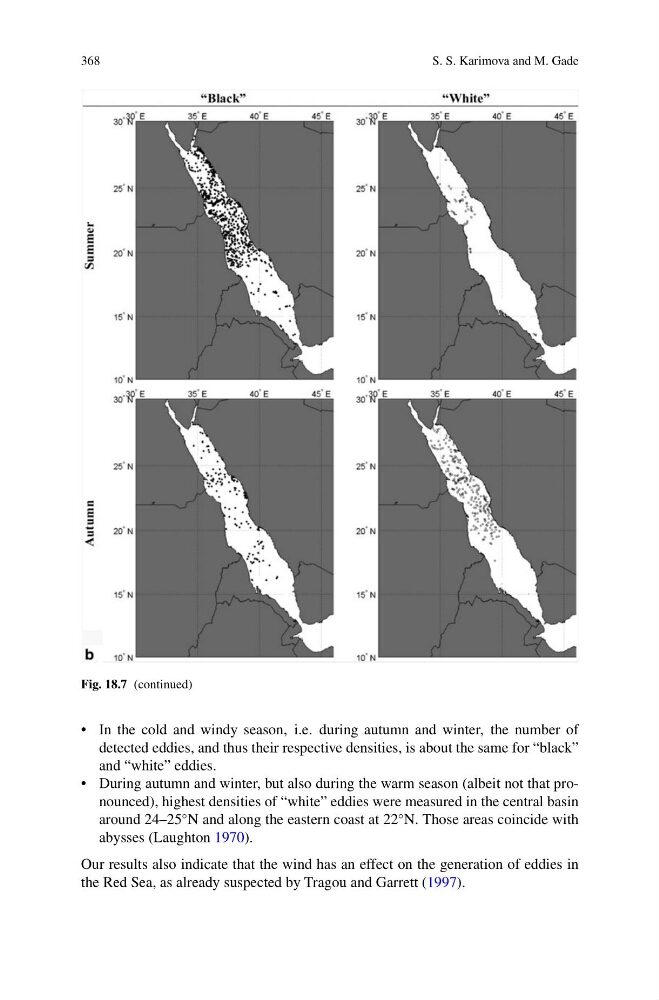
Fig. 18.7 (continued)
• In the cold and windy season, i.e. during autumn and winter, the number of
detected eddies, and thus their respective densities, is about the same for “black”
and “white” eddies.
• During autumn and winter, but also during the warm season (albeit not that pronounced), highest densities of “white” eddies were measured in the central basin
around 24–25
◦ N and along the eastern coast at 22
◦ N. Those areas coincide with
abysses (Laughton 1970).
Our results also indicate that the wind has an effect on the generation of eddies in
the Red Sea, as already suspected by Tragou and Garrett (1997).
S. S. Karimova and M. Gade
Fig. 18.7 (continued)
• In the cold and windy season, i.e. during autumn and winter, the number of
detected eddies, and thus their respective densities, is about the same for “black”
and “white” eddies.
• During autumn and winter, but also during the warm season (albeit not that pronounced), highest densities of “white” eddies were measured in the central basin
around 24–25
◦ N and along the eastern coast at 22
◦ N. Those areas coincide with
abysses (Laughton 1970).
Our results also indicate that the wind has an effect on the generation of eddies in
the Red Sea, as already suspected by Tragou and Garrett (1997).