

360
S. S. Karimova and M. Gade
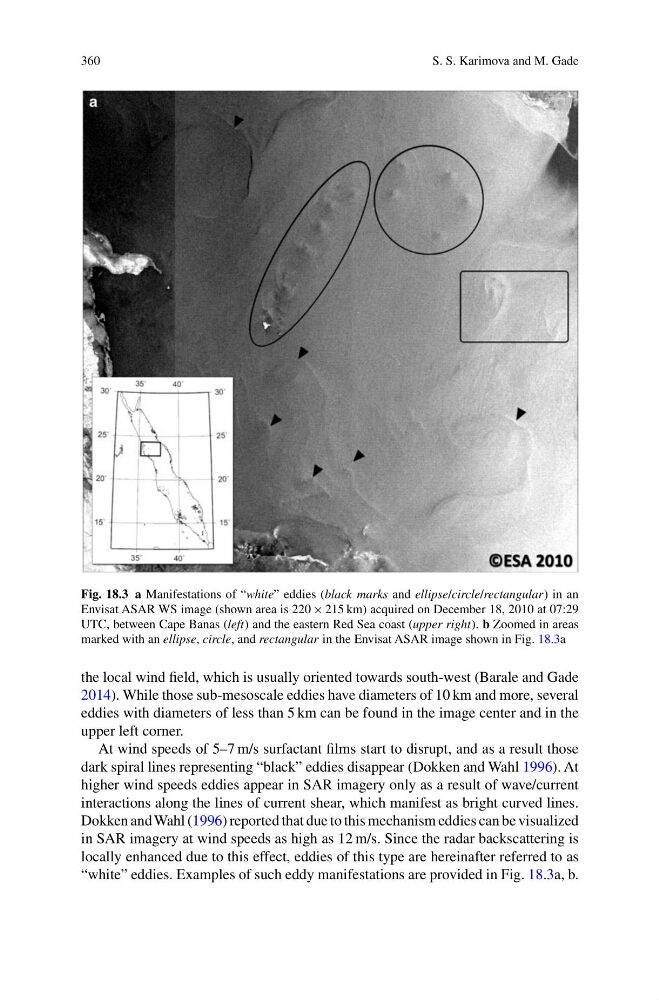
Fig. 18.3 a Manifestations of “white” eddies (black marks and ellipse/circle/rectangular) in an
Envisat ASAR WS image (shown area is 220 × 215 km) acquired on December 18, 2010 at 07:29
UTC, between Cape Banas (left) and the eastern Red Sea coast (upper right). b Zoomed in areas
marked with an ellipse, circle, and rectangular in the Envisat ASAR image shown in Fig. 18.3a
the local wind field, which is usually oriented towards south-west (Barale and Gade
2014). While those sub-mesoscale eddies have diameters of 10 km and more, several
eddies with diameters of less than 5 km can be found in the image center and in the
upper left corner.
At wind speeds of 5–7 m/s surfactant films start to disrupt, and as a result those
dark spiral lines representing “black” eddies disappear (Dokken and Wahl 1996). At
higher wind speeds eddies appear in SAR imagery only as a result of wave/current
interactions along the lines of current shear, which manifest as bright curved lines.
Dokken and Wahl (1996) reported that due to this mechanism eddies can be visualized
in SAR imagery at wind speeds as high as 12 m/s. Since the radar backscattering is
locally enhanced due to this effect, eddies of this type are hereinafter referred to as
“white” eddies. Examples of such eddy manifestations are provided in Fig. 18.3a, b.
S. S. Karimova and M. Gade
Fig. 18.3 a Manifestations of “white” eddies (black marks and ellipse/circle/rectangular) in an
Envisat ASAR WS image (shown area is 220 × 215 km) acquired on December 18, 2010 at 07:29
UTC, between Cape Banas (left) and the eastern Red Sea coast (upper right). b Zoomed in areas
marked with an ellipse, circle, and rectangular in the Envisat ASAR image shown in Fig. 18.3a
the local wind field, which is usually oriented towards south-west (Barale and Gade
2014). While those sub-mesoscale eddies have diameters of 10 km and more, several
eddies with diameters of less than 5 km can be found in the image center and in the
upper left corner.
At wind speeds of 5–7 m/s surfactant films start to disrupt, and as a result those
dark spiral lines representing “black” eddies disappear (Dokken and Wahl 1996). At
higher wind speeds eddies appear in SAR imagery only as a result of wave/current
interactions along the lines of current shear, which manifest as bright curved lines.
Dokken and Wahl (1996) reported that due to this mechanism eddies can be visualized
in SAR imagery at wind speeds as high as 12 m/s. Since the radar backscattering is
locally enhanced due to this effect, eddies of this type are hereinafter referred to as
“white” eddies. Examples of such eddy manifestations are provided in Fig. 18.3a, b.