

308
S. Lehner et al.
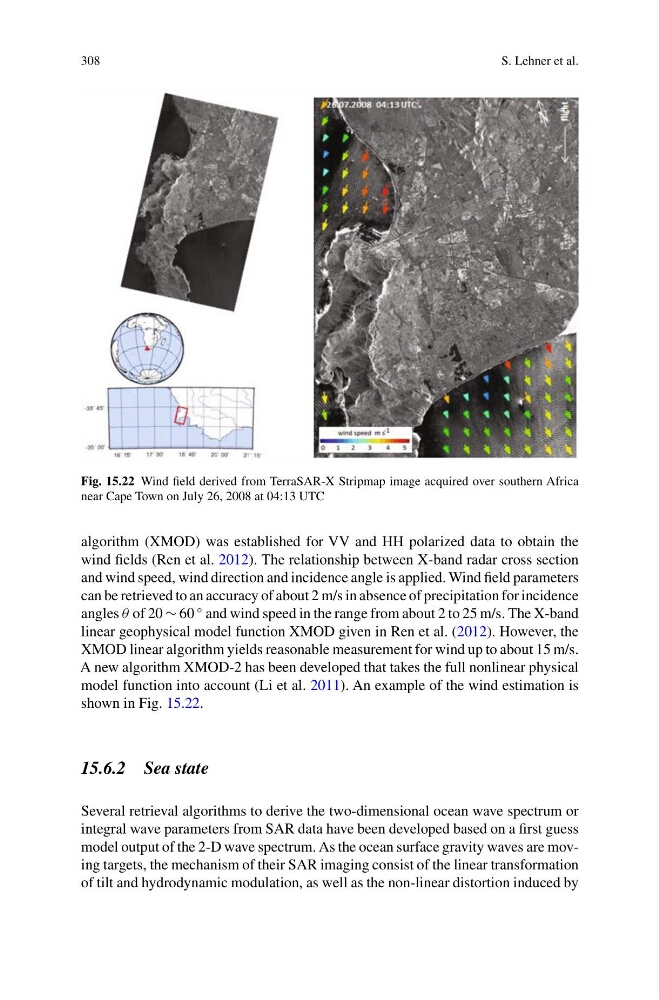
Fig. 15.22 Wind field derived from TerraSAR-X Stripmap image acquired over southern Africa
near Cape Town on July 26, 2008 at 04:13 UTC
algorithm (XMOD) was established for VV and HH polarized data to obtain the
wind fields (Ren et al. 2012). The relationship between X-band radar cross section
and wind speed, wind direction and incidence angle is applied. Wind field parameters
can be retrieved to an accuracy of about 2 m/s in absence of precipitation for incidence
angles θ of 20 ∼ 60
◦ and wind speed in the range from about 2 to 25 m/s. The X-band
linear geophysical model function XMOD given in Ren et al. (2012). However, the
XMOD linear algorithm yields reasonable measurement for wind up to about 15 m/s.
A new algorithm XMOD-2 has been developed that takes the full nonlinear physical
model function into account (Li et al. 2011). An example of the wind estimation is
shown in Fig. 15.22.
15.6.2 Sea state
Several retrieval algorithms to derive the two-dimensional ocean wave spectrum or
integral wave parameters from SAR data have been developed based on a first guess
model output of the 2-D wave spectrum. As the ocean surface gravity waves are moving targets, the mechanism of their SAR imaging consist of the linear transformation
of tilt and hydrodynamic modulation, as well as the non-linear distortion induced by
S. Lehner et al.
Fig. 15.22 Wind field derived from TerraSAR-X Stripmap image acquired over southern Africa
near Cape Town on July 26, 2008 at 04:13 UTC
algorithm (XMOD) was established for VV and HH polarized data to obtain the
wind fields (Ren et al. 2012). The relationship between X-band radar cross section
and wind speed, wind direction and incidence angle is applied. Wind field parameters
can be retrieved to an accuracy of about 2 m/s in absence of precipitation for incidence
angles θ of 20 ∼ 60
◦ and wind speed in the range from about 2 to 25 m/s. The X-band
linear geophysical model function XMOD given in Ren et al. (2012). However, the
XMOD linear algorithm yields reasonable measurement for wind up to about 15 m/s.
A new algorithm XMOD-2 has been developed that takes the full nonlinear physical
model function into account (Li et al. 2011). An example of the wind estimation is
shown in Fig. 15.22.
15.6.2 Sea state
Several retrieval algorithms to derive the two-dimensional ocean wave spectrum or
integral wave parameters from SAR data have been developed based on a first guess
model output of the 2-D wave spectrum. As the ocean surface gravity waves are moving targets, the mechanism of their SAR imaging consist of the linear transformation
of tilt and hydrodynamic modulation, as well as the non-linear distortion induced by