

15 Ship Surveillance with High Resolution TerraSAR-X Satellite in African Waters
291
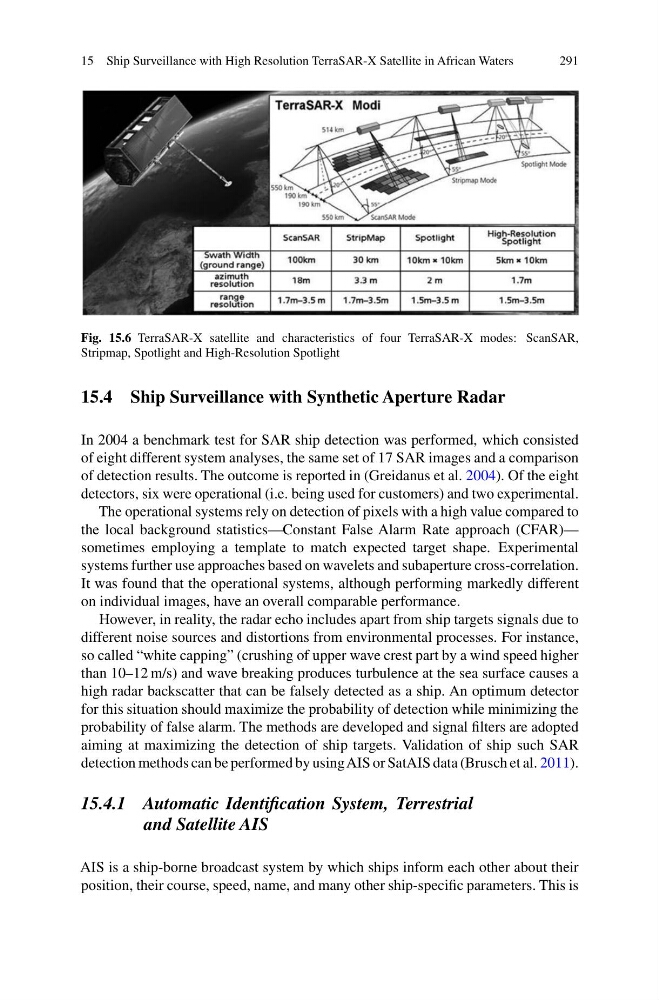
Fig. 15.6 TerraSAR-X satellite and characteristics of four TerraSAR-X modes: ScanSAR,
Stripmap, Spotlight and High-Resolution Spotlight
15.4 Ship Surveillance with Synthetic Aperture Radar
In 2004 a benchmark test for SAR ship detection was performed, which consisted
of eight different system analyses, the same set of 17 SAR images and a comparison
of detection results. The outcome is reported in (Greidanus et al. 2004). Of the eight
detectors, six were operational (i.e. being used for customers) and two experimental.
The operational systems rely on detection of pixels with a high value compared to
the local background statistics—Constant False Alarm Rate approach (CFAR)—
sometimes employing a template to match expected target shape. Experimental
systems further use approaches based on wavelets and subaperture cross-correlation.
It was found that the operational systems, although performing markedly different
on individual images, have an overall comparable performance.
However, in reality, the radar echo includes apart from ship targets signals due to
different noise sources and distortions from environmental processes. For instance,
so called “white capping” (crushing of upper wave crest part by a wind speed higher
than 10–12 m/s) and wave breaking produces turbulence at the sea surface causes a
high radar backscatter that can be falsely detected as a ship. An optimum detector
for this situation should maximize the probability of detection while minimizing the
probability of false alarm. The methods are developed and signal filters are adopted
aiming at maximizing the detection of ship targets. Validation of ship such SAR
detection methods can be performed by usingAIS or SatAIS data (Brusch et al. 2011).
15.4.1 Automatic Identification System, Terrestrial
and Satellite AIS
AIS is a ship-borne broadcast system by which ships inform each other about their
position, their course, speed, name, and many other ship-specific parameters. This is
291
Fig. 15.6 TerraSAR-X satellite and characteristics of four TerraSAR-X modes: ScanSAR,
Stripmap, Spotlight and High-Resolution Spotlight
15.4 Ship Surveillance with Synthetic Aperture Radar
In 2004 a benchmark test for SAR ship detection was performed, which consisted
of eight different system analyses, the same set of 17 SAR images and a comparison
of detection results. The outcome is reported in (Greidanus et al. 2004). Of the eight
detectors, six were operational (i.e. being used for customers) and two experimental.
The operational systems rely on detection of pixels with a high value compared to
the local background statistics—Constant False Alarm Rate approach (CFAR)—
sometimes employing a template to match expected target shape. Experimental
systems further use approaches based on wavelets and subaperture cross-correlation.
It was found that the operational systems, although performing markedly different
on individual images, have an overall comparable performance.
However, in reality, the radar echo includes apart from ship targets signals due to
different noise sources and distortions from environmental processes. For instance,
so called “white capping” (crushing of upper wave crest part by a wind speed higher
than 10–12 m/s) and wave breaking produces turbulence at the sea surface causes a
high radar backscatter that can be falsely detected as a ship. An optimum detector
for this situation should maximize the probability of detection while minimizing the
probability of false alarm. The methods are developed and signal filters are adopted
aiming at maximizing the detection of ship targets. Validation of ship such SAR
detection methods can be performed by usingAIS or SatAIS data (Brusch et al. 2011).
15.4.1 Automatic Identification System, Terrestrial
and Satellite AIS
AIS is a ship-borne broadcast system by which ships inform each other about their
position, their course, speed, name, and many other ship-specific parameters. This is