

286
S. Lehner et al.
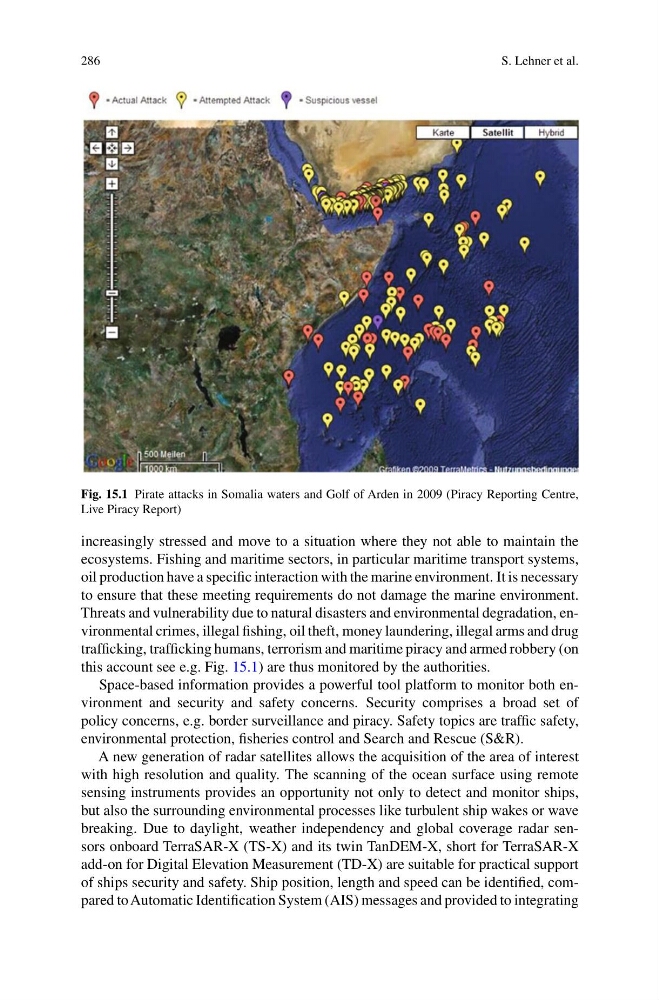
Fig. 15.1 Pirate attacks in Somalia waters and Golf of Arden in 2009 (Piracy Reporting Centre,
Live Piracy Report)
increasingly stressed and move to a situation where they not able to maintain the
ecosystems. Fishing and maritime sectors, in particular maritime transport systems,
oil production have a specific interaction with the marine environment. It is necessary
to ensure that these meeting requirements do not damage the marine environment.
Threats and vulnerability due to natural disasters and environmental degradation, environmental crimes, illegal fishing, oil theft, money laundering, illegal arms and drug
trafficking, trafficking humans, terrorism and maritime piracy and armed robbery (on
this account see e.g. Fig. 15.1) are thus monitored by the authorities.
Space-based information provides a powerful tool platform to monitor both environment and security and safety concerns. Security comprises a broad set of
policy concerns, e.g. border surveillance and piracy. Safety topics are traffic safety,
environmental protection, fisheries control and Search and Rescue (S&R).
A new generation of radar satellites allows the acquisition of the area of interest
with high resolution and quality. The scanning of the ocean surface using remote
sensing instruments provides an opportunity not only to detect and monitor ships,
but also the surrounding environmental processes like turbulent ship wakes or wave
breaking. Due to daylight, weather independency and global coverage radar sensors onboard TerraSAR-X (TS-X) and its twin TanDEM-X, short for TerraSAR-X
add-on for Digital Elevation Measurement (TD-X) are suitable for practical support
of ships security and safety. Ship position, length and speed can be identified, compared to Automatic Identification System (AIS) messages and provided to integrating
S. Lehner et al.
Fig. 15.1 Pirate attacks in Somalia waters and Golf of Arden in 2009 (Piracy Reporting Centre,
Live Piracy Report)
increasingly stressed and move to a situation where they not able to maintain the
ecosystems. Fishing and maritime sectors, in particular maritime transport systems,
oil production have a specific interaction with the marine environment. It is necessary
to ensure that these meeting requirements do not damage the marine environment.
Threats and vulnerability due to natural disasters and environmental degradation, environmental crimes, illegal fishing, oil theft, money laundering, illegal arms and drug
trafficking, trafficking humans, terrorism and maritime piracy and armed robbery (on
this account see e.g. Fig. 15.1) are thus monitored by the authorities.
Space-based information provides a powerful tool platform to monitor both environment and security and safety concerns. Security comprises a broad set of
policy concerns, e.g. border surveillance and piracy. Safety topics are traffic safety,
environmental protection, fisheries control and Search and Rescue (S&R).
A new generation of radar satellites allows the acquisition of the area of interest
with high resolution and quality. The scanning of the ocean surface using remote
sensing instruments provides an opportunity not only to detect and monitor ships,
but also the surrounding environmental processes like turbulent ship wakes or wave
breaking. Due to daylight, weather independency and global coverage radar sensors onboard TerraSAR-X (TS-X) and its twin TanDEM-X, short for TerraSAR-X
add-on for Digital Elevation Measurement (TD-X) are suitable for practical support
of ships security and safety. Ship position, length and speed can be identified, compared to Automatic Identification System (AIS) messages and provided to integrating