

9 The Upwelling Area Off Namibia, the Northern Part of the Benguela Current System
179
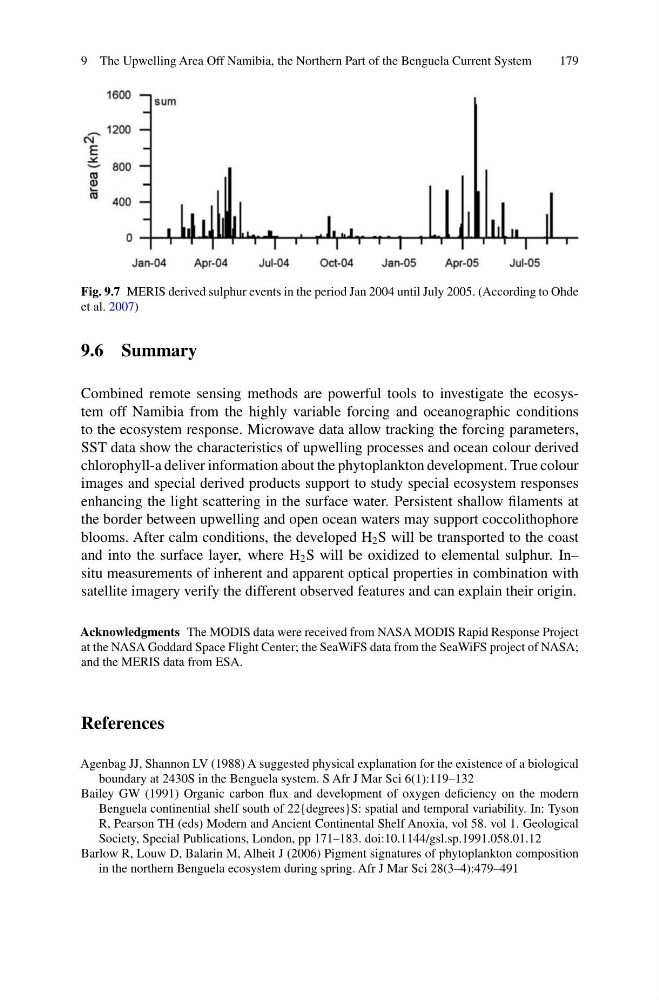
Fig. 9.7 MERIS derived sulphur events in the period Jan 2004 until July 2005. (According to Ohde
et al. 2007)
9.6 Summary
Combined remote sensing methods are powerful tools to investigate the ecosystem off Namibia from the highly variable forcing and oceanographic conditions
to the ecosystem response. Microwave data allow tracking the forcing parameters,
SST data show the characteristics of upwelling processes and ocean colour derived
chlorophyll-a deliver information about the phytoplankton development. True colour
images and special derived products support to study special ecosystem responses
enhancing the light scattering in the surface water. Persistent shallow filaments at
the border between upwelling and open ocean waters may support coccolithophore
blooms. After calm conditions, the developed H 2 S will be transported to the coast
and into the surface layer, where H 2 S will be oxidized to elemental sulphur. In–
situ measurements of inherent and apparent optical properties in combination with
satellite imagery verify the different observed features and can explain their origin.
Acknowledgments The MODIS data were received from NASA MODIS Rapid Response Project
at the NASA Goddard Space Flight Center; the SeaWiFS data from the SeaWiFS project of NASA;
and the MERIS data from ESA.
References
Agenbag JJ, Shannon LV (1988) A suggested physical explanation for the existence of a biological
boundary at 2430S in the Benguela system. S Afr J Mar Sci 6(1):119–132
Bailey GW (1991) Organic carbon flux and development of oxygen deficiency on the modern
Benguela continential shelf south of 22{degrees}S: spatial and temporal variability. In: Tyson
R, Pearson TH (eds) Modern and Ancient Continental Shelf Anoxia, vol 58. vol 1. Geological
Society, Special Publications, London, pp 171–183. doi:10.1144/gsl.sp.1991.058.01.12
Barlow R, Louw D, Balarin M, Alheit J (2006) Pigment signatures of phytoplankton composition
in the northern Benguela ecosystem during spring. Afr J Mar Sci 28(3–4):479–491
179
Fig. 9.7 MERIS derived sulphur events in the period Jan 2004 until July 2005. (According to Ohde
et al. 2007)
9.6 Summary
Combined remote sensing methods are powerful tools to investigate the ecosystem off Namibia from the highly variable forcing and oceanographic conditions
to the ecosystem response. Microwave data allow tracking the forcing parameters,
SST data show the characteristics of upwelling processes and ocean colour derived
chlorophyll-a deliver information about the phytoplankton development. True colour
images and special derived products support to study special ecosystem responses
enhancing the light scattering in the surface water. Persistent shallow filaments at
the border between upwelling and open ocean waters may support coccolithophore
blooms. After calm conditions, the developed H 2 S will be transported to the coast
and into the surface layer, where H 2 S will be oxidized to elemental sulphur. In–
situ measurements of inherent and apparent optical properties in combination with
satellite imagery verify the different observed features and can explain their origin.
Acknowledgments The MODIS data were received from NASA MODIS Rapid Response Project
at the NASA Goddard Space Flight Center; the SeaWiFS data from the SeaWiFS project of NASA;
and the MERIS data from ESA.
References
Agenbag JJ, Shannon LV (1988) A suggested physical explanation for the existence of a biological
boundary at 2430S in the Benguela system. S Afr J Mar Sci 6(1):119–132
Bailey GW (1991) Organic carbon flux and development of oxygen deficiency on the modern
Benguela continential shelf south of 22{degrees}S: spatial and temporal variability. In: Tyson
R, Pearson TH (eds) Modern and Ancient Continental Shelf Anoxia, vol 58. vol 1. Geological
Society, Special Publications, London, pp 171–183. doi:10.1144/gsl.sp.1991.058.01.12
Barlow R, Louw D, Balarin M, Alheit J (2006) Pigment signatures of phytoplankton composition
in the northern Benguela ecosystem during spring. Afr J Mar Sci 28(3–4):479–491