

178
H. Siegel et al.
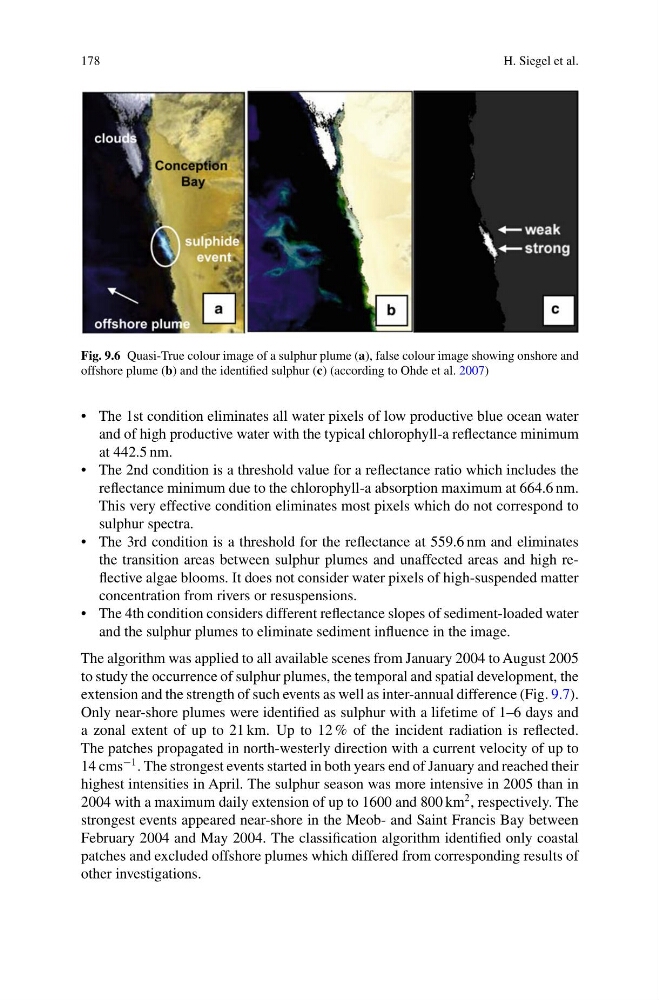
Fig. 9.6 Quasi-True colour image of a sulphur plume (a), false colour image showing onshore and
offshore plume (b) and the identified sulphur (c) (according to Ohde et al. 2007)
• The 1st condition eliminates all water pixels of low productive blue ocean water
and of high productive water with the typical chlorophyll-a reflectance minimum
at 442.5 nm.
• The 2nd condition is a threshold value for a reflectance ratio which includes the
reflectance minimum due to the chlorophyll-a absorption maximum at 664.6 nm.
This very effective condition eliminates most pixels which do not correspond to
sulphur spectra.
• The 3rd condition is a threshold for the reflectance at 559.6 nm and eliminates
the transition areas between sulphur plumes and unaffected areas and high reflective algae blooms. It does not consider water pixels of high-suspended matter
concentration from rivers or resuspensions.
• The 4th condition considers different reflectance slopes of sediment-loaded water
and the sulphur plumes to eliminate sediment influence in the image.
The algorithm was applied to all available scenes from January 2004 to August 2005
to study the occurrence of sulphur plumes, the temporal and spatial development, the
extension and the strength of such events as well as inter-annual difference (Fig. 9.7).
Only near-shore plumes were identified as sulphur with a lifetime of 1–6 days and
a zonal extent of up to 21 km. Up to 12 % of the incident radiation is reflected.
The patches propagated in north-westerly direction with a current velocity of up to
14 cms
−1 . The strongest events started in both years end of January and reached their
highest intensities in April. The sulphur season was more intensive in 2005 than in
2004 with a maximum daily extension of up to 1600 and 800 km
2 , respectively. The
strongest events appeared near-shore in the Meob- and Saint Francis Bay between
February 2004 and May 2004. The classification algorithm identified only coastal
patches and excluded offshore plumes which differed from corresponding results of
other investigations.
H. Siegel et al.
Fig. 9.6 Quasi-True colour image of a sulphur plume (a), false colour image showing onshore and
offshore plume (b) and the identified sulphur (c) (according to Ohde et al. 2007)
• The 1st condition eliminates all water pixels of low productive blue ocean water
and of high productive water with the typical chlorophyll-a reflectance minimum
at 442.5 nm.
• The 2nd condition is a threshold value for a reflectance ratio which includes the
reflectance minimum due to the chlorophyll-a absorption maximum at 664.6 nm.
This very effective condition eliminates most pixels which do not correspond to
sulphur spectra.
• The 3rd condition is a threshold for the reflectance at 559.6 nm and eliminates
the transition areas between sulphur plumes and unaffected areas and high reflective algae blooms. It does not consider water pixels of high-suspended matter
concentration from rivers or resuspensions.
• The 4th condition considers different reflectance slopes of sediment-loaded water
and the sulphur plumes to eliminate sediment influence in the image.
The algorithm was applied to all available scenes from January 2004 to August 2005
to study the occurrence of sulphur plumes, the temporal and spatial development, the
extension and the strength of such events as well as inter-annual difference (Fig. 9.7).
Only near-shore plumes were identified as sulphur with a lifetime of 1–6 days and
a zonal extent of up to 21 km. Up to 12 % of the incident radiation is reflected.
The patches propagated in north-westerly direction with a current velocity of up to
14 cms
−1 . The strongest events started in both years end of January and reached their
highest intensities in April. The sulphur season was more intensive in 2005 than in
2004 with a maximum daily extension of up to 1600 and 800 km
2 , respectively. The
strongest events appeared near-shore in the Meob- and Saint Francis Bay between
February 2004 and May 2004. The classification algorithm identified only coastal
patches and excluded offshore plumes which differed from corresponding results of
other investigations.