

9 The Upwelling Area Off Namibia, the Northern Part of the Benguela Current System
175
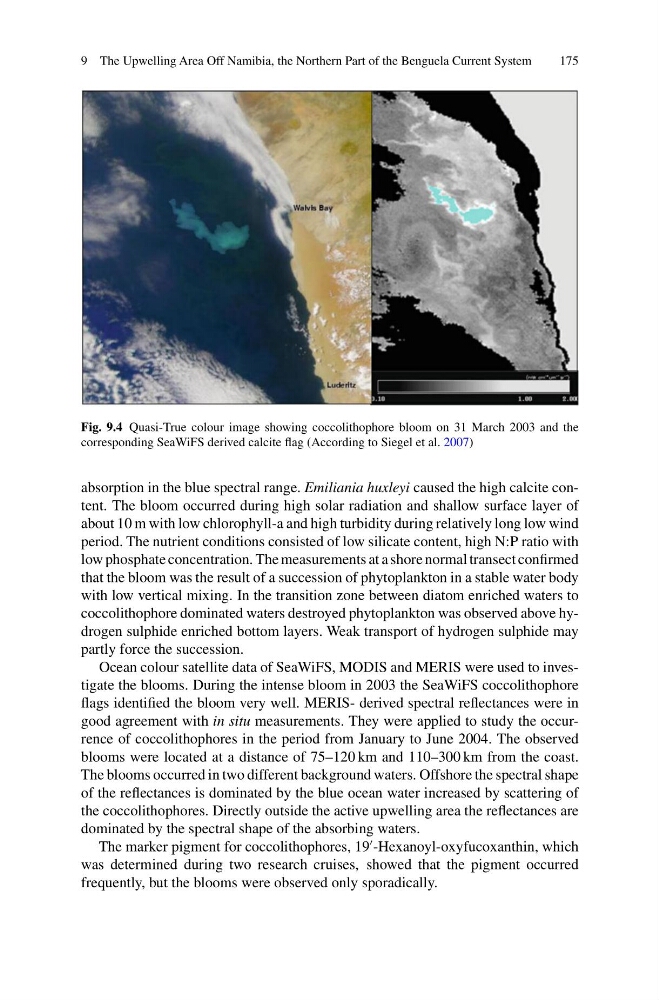
Fig. 9.4 Quasi-True colour image showing coccolithophore bloom on 31 March 2003 and the
corresponding SeaWiFS derived calcite flag (According to Siegel et al. 2007)
absorption in the blue spectral range. Emiliania huxleyi caused the high calcite content. The bloom occurred during high solar radiation and shallow surface layer of
about 10 m with low chlorophyll-a and high turbidity during relatively long low wind
period. The nutrient conditions consisted of low silicate content, high N:P ratio with
low phosphate concentration. The measurements at a shore normal transect confirmed
that the bloom was the result of a succession of phytoplankton in a stable water body
with low vertical mixing. In the transition zone between diatom enriched waters to
coccolithophore dominated waters destroyed phytoplankton was observed above hydrogen sulphide enriched bottom layers. Weak transport of hydrogen sulphide may
partly force the succession.
Ocean colour satellite data of SeaWiFS, MODIS and MERIS were used to investigate the blooms. During the intense bloom in 2003 the SeaWiFS coccolithophore
flags identified the bloom very well. MERIS- derived spectral reflectances were in
good agreement with in situ measurements. They were applied to study the occurrence of coccolithophores in the period from January to June 2004. The observed
blooms were located at a distance of 75–120 km and 110–300 km from the coast.
The blooms occurred in two different background waters. Offshore the spectral shape
of the reflectances is dominated by the blue ocean water increased by scattering of
the coccolithophores. Directly outside the active upwelling area the reflectances are
dominated by the spectral shape of the absorbing waters.
The marker pigment for coccolithophores, 19
-Hexanoyl-oxyfucoxanthin, which
was determined during two research cruises, showed that the pigment occurred
frequently, but the blooms were observed only sporadically.
175
Fig. 9.4 Quasi-True colour image showing coccolithophore bloom on 31 March 2003 and the
corresponding SeaWiFS derived calcite flag (According to Siegel et al. 2007)
absorption in the blue spectral range. Emiliania huxleyi caused the high calcite content. The bloom occurred during high solar radiation and shallow surface layer of
about 10 m with low chlorophyll-a and high turbidity during relatively long low wind
period. The nutrient conditions consisted of low silicate content, high N:P ratio with
low phosphate concentration. The measurements at a shore normal transect confirmed
that the bloom was the result of a succession of phytoplankton in a stable water body
with low vertical mixing. In the transition zone between diatom enriched waters to
coccolithophore dominated waters destroyed phytoplankton was observed above hydrogen sulphide enriched bottom layers. Weak transport of hydrogen sulphide may
partly force the succession.
Ocean colour satellite data of SeaWiFS, MODIS and MERIS were used to investigate the blooms. During the intense bloom in 2003 the SeaWiFS coccolithophore
flags identified the bloom very well. MERIS- derived spectral reflectances were in
good agreement with in situ measurements. They were applied to study the occurrence of coccolithophores in the period from January to June 2004. The observed
blooms were located at a distance of 75–120 km and 110–300 km from the coast.
The blooms occurred in two different background waters. Offshore the spectral shape
of the reflectances is dominated by the blue ocean water increased by scattering of
the coccolithophores. Directly outside the active upwelling area the reflectances are
dominated by the spectral shape of the absorbing waters.
The marker pigment for coccolithophores, 19
-Hexanoyl-oxyfucoxanthin, which
was determined during two research cruises, showed that the pigment occurred
frequently, but the blooms were observed only sporadically.