

152
A. G. Kostianoy et al.
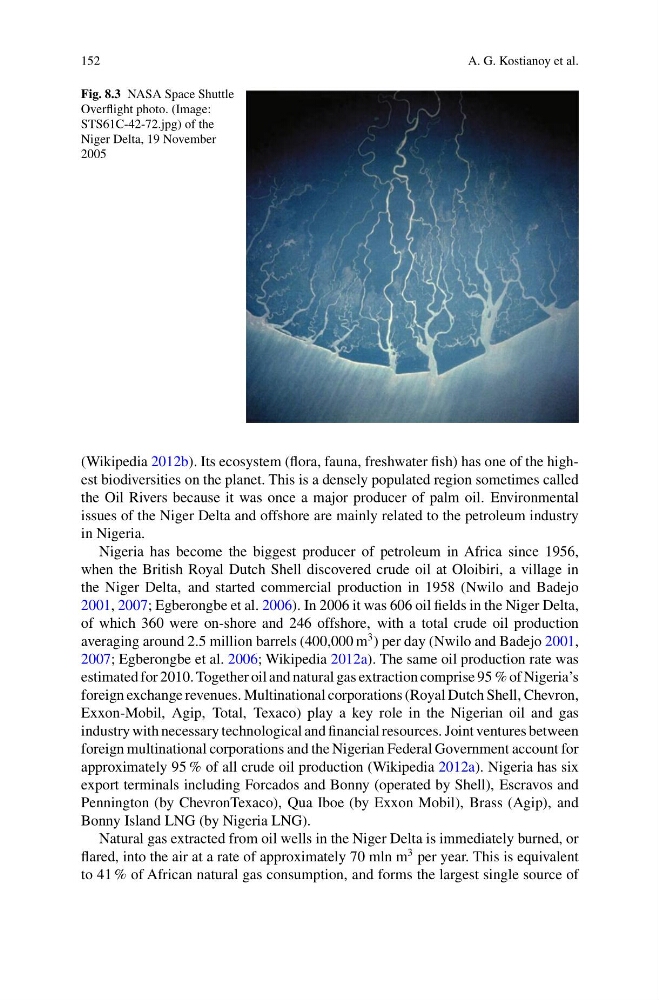
Fig. 8.3 NASA Space Shuttle
Overflight photo. (Image:
STS61C-42-72.jpg) of the
Niger Delta, 19 November
2005
(Wikipedia 2012b). Its ecosystem (flora, fauna, freshwater fish) has one of the highest biodiversities on the planet. This is a densely populated region sometimes called
the Oil Rivers because it was once a major producer of palm oil. Environmental
issues of the Niger Delta and offshore are mainly related to the petroleum industry
in Nigeria.
Nigeria has become the biggest producer of petroleum in Africa since 1956,
when the British Royal Dutch Shell discovered crude oil at Oloibiri, a village in
the Niger Delta, and started commercial production in 1958 (Nwilo and Badejo
2001, 2007; Egberongbe et al. 2006). In 2006 it was 606 oil fields in the Niger Delta,
of which 360 were on-shore and 246 offshore, with a total crude oil production
averaging around 2.5 million barrels (400,000 m
3 ) per day (Nwilo and Badejo 2001,
2007; Egberongbe et al. 2006; Wikipedia 2012a). The same oil production rate was
estimated for 2010. Together oil and natural gas extraction comprise 95 % of Nigeria’s
foreign exchange revenues. Multinational corporations (Royal Dutch Shell, Chevron,
Exxon-Mobil, Agip, Total, Texaco) play a key role in the Nigerian oil and gas
industry with necessary technological and financial resources. Joint ventures between
foreign multinational corporations and the Nigerian Federal Government account for
approximately 95 % of all crude oil production (Wikipedia 2012a). Nigeria has six
export terminals including Forcados and Bonny (operated by Shell), Escravos and
Pennington (by ChevronTexaco), Qua Iboe (by Exxon Mobil), Brass (Agip), and
Bonny Island LNG (by Nigeria LNG).
Natural gas extracted from oil wells in the Niger Delta is immediately burned, or
flared, into the air at a rate of approximately 70 mln m
3 per year. This is equivalent
to 41 % of African natural gas consumption, and forms the largest single source of
A. G. Kostianoy et al.
Fig. 8.3 NASA Space Shuttle
Overflight photo. (Image:
STS61C-42-72.jpg) of the
Niger Delta, 19 November
2005
(Wikipedia 2012b). Its ecosystem (flora, fauna, freshwater fish) has one of the highest biodiversities on the planet. This is a densely populated region sometimes called
the Oil Rivers because it was once a major producer of palm oil. Environmental
issues of the Niger Delta and offshore are mainly related to the petroleum industry
in Nigeria.
Nigeria has become the biggest producer of petroleum in Africa since 1956,
when the British Royal Dutch Shell discovered crude oil at Oloibiri, a village in
the Niger Delta, and started commercial production in 1958 (Nwilo and Badejo
2001, 2007; Egberongbe et al. 2006). In 2006 it was 606 oil fields in the Niger Delta,
of which 360 were on-shore and 246 offshore, with a total crude oil production
averaging around 2.5 million barrels (400,000 m
3 ) per day (Nwilo and Badejo 2001,
2007; Egberongbe et al. 2006; Wikipedia 2012a). The same oil production rate was
estimated for 2010. Together oil and natural gas extraction comprise 95 % of Nigeria’s
foreign exchange revenues. Multinational corporations (Royal Dutch Shell, Chevron,
Exxon-Mobil, Agip, Total, Texaco) play a key role in the Nigerian oil and gas
industry with necessary technological and financial resources. Joint ventures between
foreign multinational corporations and the Nigerian Federal Government account for
approximately 95 % of all crude oil production (Wikipedia 2012a). Nigeria has six
export terminals including Forcados and Bonny (operated by Shell), Escravos and
Pennington (by ChevronTexaco), Qua Iboe (by Exxon Mobil), Brass (Agip), and
Bonny Island LNG (by Nigeria LNG).
Natural gas extracted from oil wells in the Niger Delta is immediately burned, or
flared, into the air at a rate of approximately 70 mln m
3 per year. This is equivalent
to 41 % of African natural gas consumption, and forms the largest single source of