

4.2. Sensitiv ity Analysis
67
appea r at periodic intervals in the popu lation. Whether to include natural
birth and de ath pro cesses dep ends on whethe r there are differences in
birth and death rates among the subpopulations of SUSCEPTIBLE, INFECTED and IMMUNE individuals. If such differences exist in the population you are dealing with, then they should be reflected in your model. The
model of Section 4.1 that excludes these processes is a special case of the
one develop ed here, and its results are entirely consistent with the ones
found after introdu cing the natural birth and death processes, the model to
choose entirely dep ends on the question you wish to address, and the system at hand.
There is not a lone criterion that tells you to stop includin g new features
into the model. The general rule, though , is to strive for a model that is simple enough to capture all relevant aspects of a system while avoiding errors
of exclusion, yet rich enough to gene rate new questions and find new answers while avoiding errors of inclusion. The model of Section 4.1 surely
fulfills that requirement.
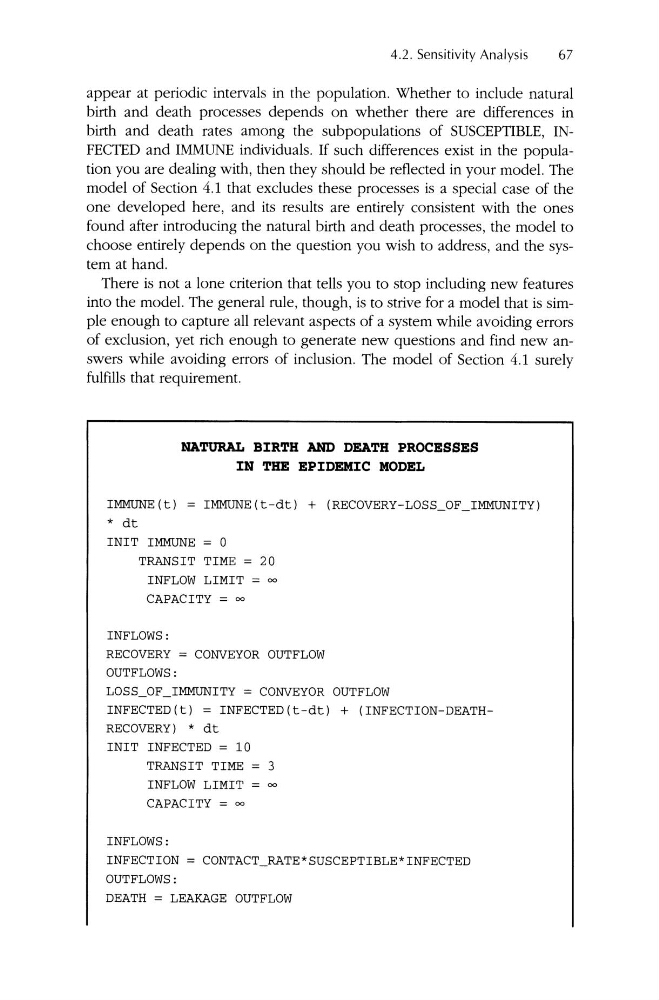
NATURAL BIRTH AND DEATH PROCESSES
IN THE EPIDEMIC MODEL
I MMUNE ( t) = I MMUNE ( t- d t) + (RECOVERY- LOSS_OF_ I MMUNITY)
* d t
INI T IMMUNE = 0
TRANSIT TIME = 20
INFLOW LIMI T = 00
CAPACI TY = 00
I NFLOWS:
RECOVERY = CONVEYOR OUTFLOW
OUTFLOWS:
LOSS_OF_IMMUNITY = CONVEYOR OUTFLOW
INFECTED (t) = INFECTED ( t - dt) + (INFECTI ON-DEATHRECOVERY) * dt
INIT INFECTED = 10
TRANSIT TIME = 3
INFLOW LIMI T =
CAPACITY = 00
INFLOWS:
INFECTION = CONTACT_RATE*SUSCEPTIBLE *INFECTED
OUTFLOWS:
DEATH = LEAKAGE OUTFLOW
67
appea r at periodic intervals in the popu lation. Whether to include natural
birth and de ath pro cesses dep ends on whethe r there are differences in
birth and death rates among the subpopulations of SUSCEPTIBLE, INFECTED and IMMUNE individuals. If such differences exist in the population you are dealing with, then they should be reflected in your model. The
model of Section 4.1 that excludes these processes is a special case of the
one develop ed here, and its results are entirely consistent with the ones
found after introdu cing the natural birth and death processes, the model to
choose entirely dep ends on the question you wish to address, and the system at hand.
There is not a lone criterion that tells you to stop includin g new features
into the model. The general rule, though , is to strive for a model that is simple enough to capture all relevant aspects of a system while avoiding errors
of exclusion, yet rich enough to gene rate new questions and find new answers while avoiding errors of inclusion. The model of Section 4.1 surely
fulfills that requirement.
NATURAL BIRTH AND DEATH PROCESSES
IN THE EPIDEMIC MODEL
I MMUNE ( t) = I MMUNE ( t- d t) + (RECOVERY- LOSS_OF_ I MMUNITY)
* d t
INI T IMMUNE = 0
TRANSIT TIME = 20
INFLOW LIMI T = 00
CAPACI TY = 00
I NFLOWS:
RECOVERY = CONVEYOR OUTFLOW
OUTFLOWS:
LOSS_OF_IMMUNITY = CONVEYOR OUTFLOW
INFECTED (t) = INFECTED ( t - dt) + (INFECTI ON-DEATHRECOVERY) * dt
INIT INFECTED = 10
TRANSIT TIME = 3
INFLOW LIMI T =
CAPACITY = 00
INFLOWS:
INFECTION = CONTACT_RATE*SUSCEPTIBLE *INFECTED
OUTFLOWS:
DEATH = LEAKAGE OUTFLOW