

44
3. Predator-Prey Dynamics
(2) dS/dt is the change in the stock of prey, S, over a small time interval, dt.
You may want to think of Was a population of whales and S as the sand
lance (Amodytes americanus) on which they feed . In short, dW/dt and
dS/dt are appreviated with a dot over the symbol for the respective state
variable. Both of these equations are differential equations. From our discussion in Chapter 2 it should be clear that using these equations to specify
our STELLA model will necessitate the use of a small DT.
In equation (1) F is the reproduction rate of predators per prey eaten, A
is a predation rate coefficient or a measure of search efficiency, and Q is the
predator mortality rate. In equation (2) R is the intrinsic rate of increase for
the prey . The reproduction rate F of whales may be measured in whales
per whale per year per tons of sand lance consumed. The predation rate
coefficient A may be measured as l /whales/year, the stock of sand lance
may be in tons of sand lance biomass, and Q in whales per whale per year.
Similarly, the reproduction rate R of sand lance may be measured in tons of
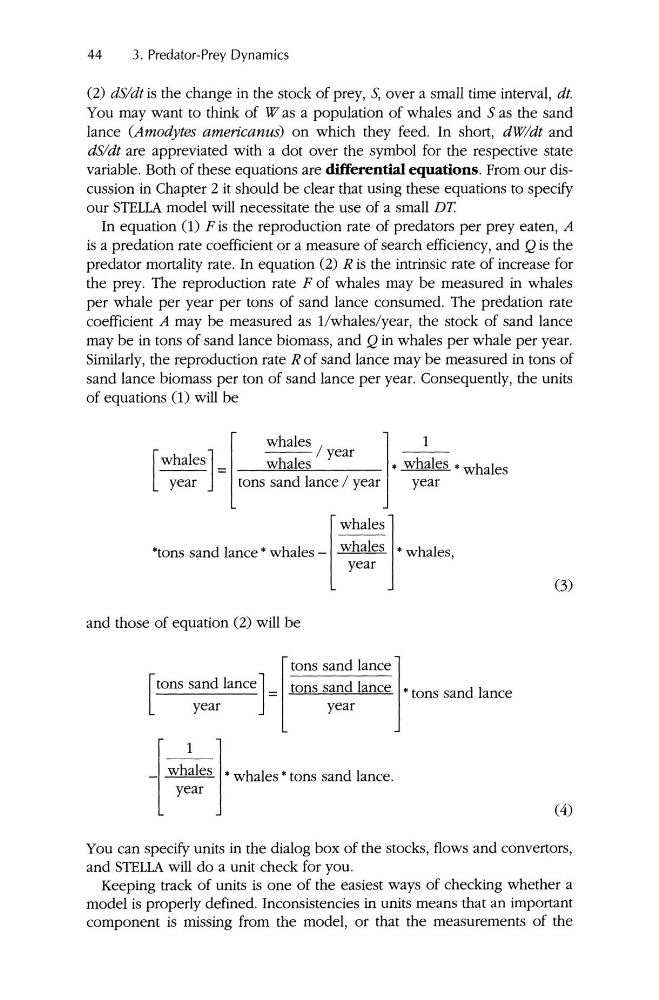
sand lance biomass per ton of sand lance per year. Consequently, the units
of equations (1) will be
]
1
• whales.
year
whales
[ year]
whales / year
=
whales
[ tons sand lance / year
Whales]
"tons sand lance." whales - whales • whales ,
[ year
h I
and those of equation (2) will be
tons sand lance]
[
tons sand lance] = tons sand lance • tons san d I ance
year
[
year
-[
• whales • tons sand lance.
year
(4)
You can specify units in the dialog box of the stocks, flows and convertors ,
and STELLA will do a unit check for you.
Keeping track of units is one of the easiest ways of checking whether a
model is properly defined . Inconsistencies in units means that an important
component is missing from the model, or that the measurements of the
3. Predator-Prey Dynamics
(2) dS/dt is the change in the stock of prey, S, over a small time interval, dt.
You may want to think of Was a population of whales and S as the sand
lance (Amodytes americanus) on which they feed . In short, dW/dt and
dS/dt are appreviated with a dot over the symbol for the respective state
variable. Both of these equations are differential equations. From our discussion in Chapter 2 it should be clear that using these equations to specify
our STELLA model will necessitate the use of a small DT.
In equation (1) F is the reproduction rate of predators per prey eaten, A
is a predation rate coefficient or a measure of search efficiency, and Q is the
predator mortality rate. In equation (2) R is the intrinsic rate of increase for
the prey . The reproduction rate F of whales may be measured in whales
per whale per year per tons of sand lance consumed. The predation rate
coefficient A may be measured as l /whales/year, the stock of sand lance
may be in tons of sand lance biomass, and Q in whales per whale per year.
Similarly, the reproduction rate R of sand lance may be measured in tons of
sand lance biomass per ton of sand lance per year. Consequently, the units
of equations (1) will be
]
1
• whales.
year
whales
[ year]
whales / year
=
whales
[ tons sand lance / year
Whales]
"tons sand lance." whales - whales • whales ,
[ year
h I
and those of equation (2) will be
tons sand lance]
[
tons sand lance] = tons sand lance • tons san d I ance
year
[
year
-[
• whales • tons sand lance.
year
(4)
You can specify units in the dialog box of the stocks, flows and convertors ,
and STELLA will do a unit check for you.
Keeping track of units is one of the easiest ways of checking whether a
model is properly defined . Inconsistencies in units means that an important
component is missing from the model, or that the measurements of the