

386
17. An Age-structured Model of Fish Popul ation Enhancement
1: NET PROFITS
1: 3500000OO.00
2: NET PROFITS
3: NET PROFITS
1: 1500000oo .00
IA
\j W\J v
1
A.
"
fc,
A
I
A
3_ _
1- 2-:3
1: -50000000.00
25.00
Years
0.00
12.50
37.50
50.00
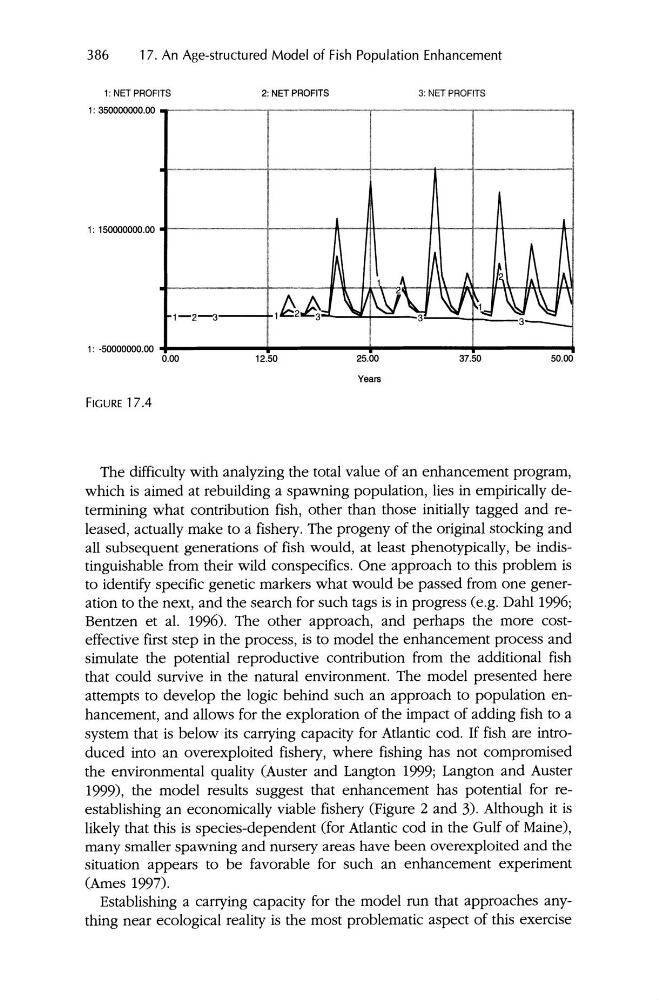
FIGURE 17.4
The difficulty with analyzing the total value of an enhancement program,
which is aimed at rebuilding a spawning popul ation , lies in empirically determining what contribution fish, other than those initially tagged and released, actually make to a fishery . The progeny of the original stocking and
all subsequent generations of fish wou ld, at least phenotypically, be indistinguishable from their wild conspecifics. One approach to this problem is
to identify specific genetic markers what would be passed from one generation to the next, and the search for such tags is in progress (e.g. Dahl 1996;
Bentzen et al. 1996). The other approach, and perhaps the more costeffective first step in the process, is to model the enhancement process and
simulate the potential reproductive contribution from the additional fish
that could survive in the natural environment. The model prese nted here
attempts to develop the logic be hind such an approa ch to population enhancement , and allows for the exploration of the impac t of addi ng fish to a
system that is below its carrying capacity for Atlantic cod. If fish are introduced into an overexploited fishery, where fishing has not compromised
the environmental quality (Auster and Langton 1999; Langton and Auster
1999), the model results suggest that enhancement has potentia l for reestablishing an economica lly viable fishery (Figure 2 and 3). Although it is
likely that this is species-dependent (for Atlantic cod in the Gulf of Maine),
many smaller spawning and nursery areas have been overexploited and the
situation appears to be favorable for such an enhancement experiment
(Ames 1997).
Establishing a carrying capacity for the model run that approaches anything near ecological reality is the most problematic aspect of this exercise
17. An Age-structured Model of Fish Popul ation Enhancement
1: NET PROFITS
1: 3500000OO.00
2: NET PROFITS
3: NET PROFITS
1: 1500000oo .00
IA
\j W\J v
1
A.
"
fc,
A
I
A
3_ _
1- 2-:3
1: -50000000.00
25.00
Years
0.00
12.50
37.50
50.00
FIGURE 17.4
The difficulty with analyzing the total value of an enhancement program,
which is aimed at rebuilding a spawning popul ation , lies in empirically determining what contribution fish, other than those initially tagged and released, actually make to a fishery . The progeny of the original stocking and
all subsequent generations of fish wou ld, at least phenotypically, be indistinguishable from their wild conspecifics. One approach to this problem is
to identify specific genetic markers what would be passed from one generation to the next, and the search for such tags is in progress (e.g. Dahl 1996;
Bentzen et al. 1996). The other approach, and perhaps the more costeffective first step in the process, is to model the enhancement process and
simulate the potential reproductive contribution from the additional fish
that could survive in the natural environment. The model prese nted here
attempts to develop the logic be hind such an approa ch to population enhancement , and allows for the exploration of the impac t of addi ng fish to a
system that is below its carrying capacity for Atlantic cod. If fish are introduced into an overexploited fishery, where fishing has not compromised
the environmental quality (Auster and Langton 1999; Langton and Auster
1999), the model results suggest that enhancement has potentia l for reestablishing an economica lly viable fishery (Figure 2 and 3). Although it is
likely that this is species-dependent (for Atlantic cod in the Gulf of Maine),
many smaller spawning and nursery areas have been overexploited and the
situation appears to be favorable for such an enhancement experiment
(Ames 1997).
Establishing a carrying capacity for the model run that approaches anything near ecological reality is the most problematic aspect of this exercise