

1: HAT AGE 1
2: NAT AGE 1
3 JUV AGE 2
17.8. Discussion
385
4: TO MATUR E
5: SUM MATUR E
1:
45000.00
2: 2OOOOOOOOOO.00
3: 350000000o.00
1OOOOOOOO.00
1:
2:
3:
0.00
0.00
0.00
0.00
1
0.00
_ 3 _
50.00
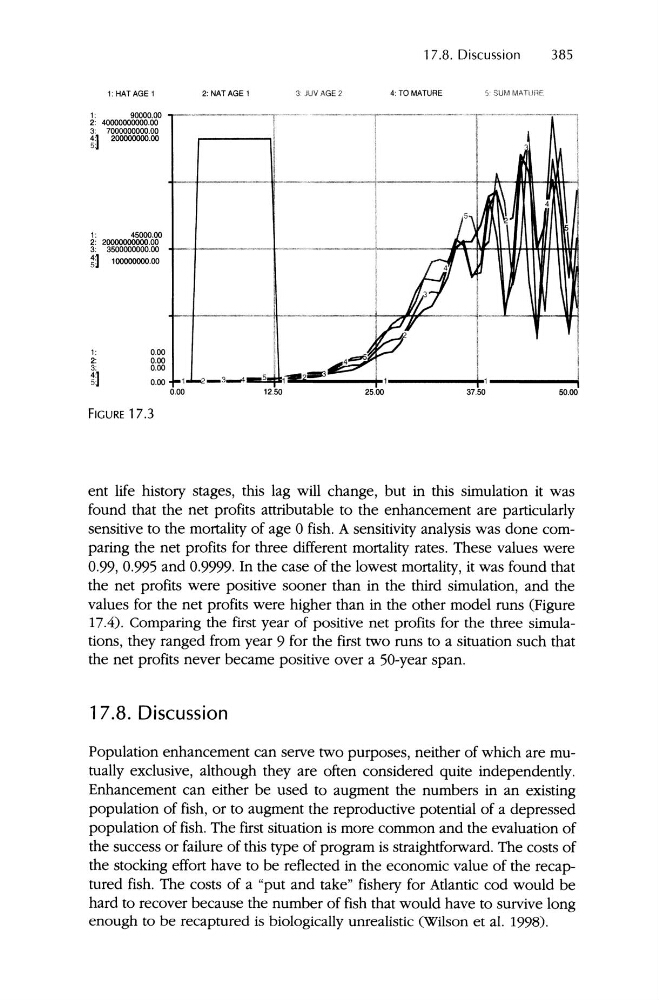
FIGURE 17.3
ent life history stages, this lag will change, but in this simulation it was
found that the net profits attributable to the enhancement are particularly
sensitive to the mortality of age 0 fish. A sensitivity analysis was done comparing the net profits for three different mortality rates. These values were
0.99, 0.995 and 0.9999. In the case of the lowest mortality, it was found that
the net profits were positive sooner than in the third simulation, and the
values for the net profits were higher than in the other model runs (Figure
17.4). Comparing the first year of positive net profits for the three simulations, they ranged from year 9 for the first two runs to a situation such that
the net profits never became positive over a 50-year span.
17.8. Discussion
Population enhancement can serve two purposes, neither of which are mutually exclusive, although they are often considered quite independently.
Enhancement can either be used to augment the numbers in an existing
population of fish, or to augment the reproductive potential of a depressed
population of fish. The first situation is more common and the evaluation of
the success or failure of this type of program is straightforward . The costs of
the stocking effort have to be reflected in the economic value of the recaptured fish. The costs of a "put and take" fishery for Atlantic cod would be
hard to recover because the number of fish that would have to survive long
enough to be recaptured is biologically unrealistic (Wilson et al. 1998).
2: NAT AGE 1
3 JUV AGE 2
17.8. Discussion
385
4: TO MATUR E
5: SUM MATUR E
1:
45000.00
2: 2OOOOOOOOOO.00
3: 350000000o.00
1OOOOOOOO.00
1:
2:
3:
0.00
0.00
0.00
0.00
1
0.00
_ 3 _
50.00
FIGURE 17.3
ent life history stages, this lag will change, but in this simulation it was
found that the net profits attributable to the enhancement are particularly
sensitive to the mortality of age 0 fish. A sensitivity analysis was done comparing the net profits for three different mortality rates. These values were
0.99, 0.995 and 0.9999. In the case of the lowest mortality, it was found that
the net profits were positive sooner than in the third simulation, and the
values for the net profits were higher than in the other model runs (Figure
17.4). Comparing the first year of positive net profits for the three simulations, they ranged from year 9 for the first two runs to a situation such that
the net profits never became positive over a 50-year span.
17.8. Discussion
Population enhancement can serve two purposes, neither of which are mutually exclusive, although they are often considered quite independently.
Enhancement can either be used to augment the numbers in an existing
population of fish, or to augment the reproductive potential of a depressed
population of fish. The first situation is more common and the evaluation of
the success or failure of this type of program is straightforward . The costs of
the stocking effort have to be reflected in the economic value of the recaptured fish. The costs of a "put and take" fishery for Atlantic cod would be
hard to recover because the number of fish that would have to survive long
enough to be recaptured is biologically unrealistic (Wilson et al. 1998).