

16.4. Results
369
1: Fe
2: Fd
3: Fe
iJ
1.00
i 1
3.00
I
!
i
6.00
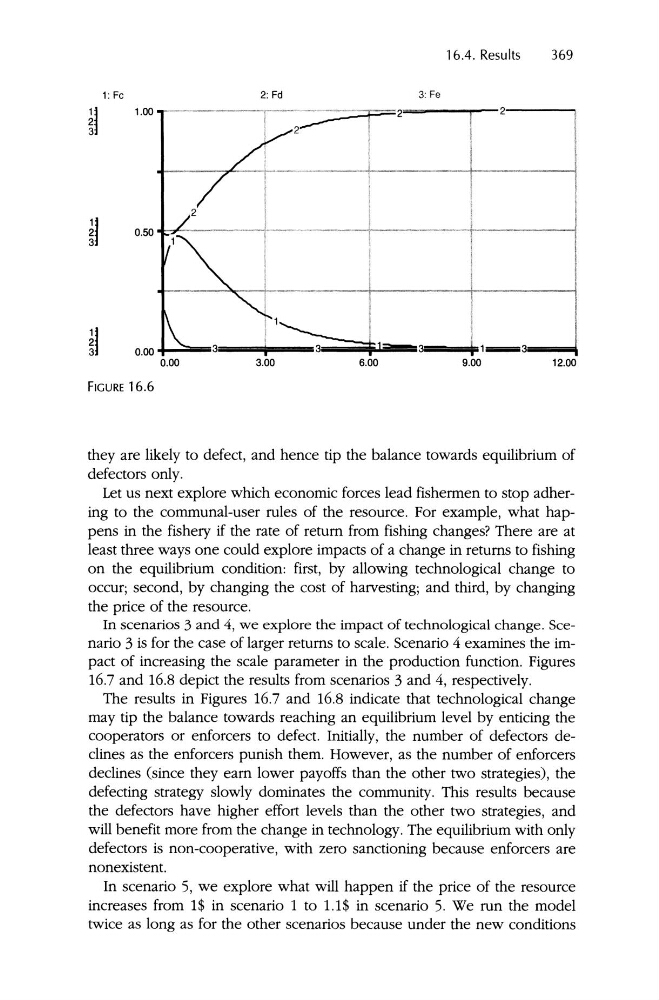
FIGURE 16.6
they are likely to defect , and hence tip the balance towards equilibrium of
defectors only.
Let us next explore which economic forces lead fishermen to stop adhering to the communal-user rules of the resource. For example, what happens in the fishery if the rate of return from fishing changes? There are at
least three ways one could explore impacts of a change in returns to fishing
on the equilibrium condition: first, by allowing technological change to
occur; second, by changing the cost of harvesting ; and third , by changing
the price of the resource.
In scenarios 3 and 4, we explore the impact of technological change. Scenario 3 is for the case of larger returns to scale. Scenario 4 examines the impact of increasing the scale parameter in the production function . Figures
16.7 and 16.8 depict the results from scenarios 3 and 4, respectively .
The results in Figures 16.7 and 16.8 indicate that technological change
may tip the balance towards reaching an equilibrium level by enticing the
cooperators or enforcers to defect. Initially, the number of defectors declines as the enforcers punish them. However, as the number of enforcers
declines (since they earn lower payoffs than the other two strategies), the
defecting strategy slowly dominates the community. This results because
the defectors have higher effort levels than the other two strategies, and
will benefit more from the change in technology. The equilibrium with only
defectors is non-cooperative, with zero sanctioning because enforcers are
nonexistent.
In scenario 5, we explore what will happen if the price of the resource
increases from 1$ in scenario 1 to 1.1$ in scenario 5. We run the model
twice as long as for the other scenarios because under the new conditions
369
1: Fe
2: Fd
3: Fe
iJ
1.00
i 1
3.00
I
!
i
6.00
FIGURE 16.6
they are likely to defect , and hence tip the balance towards equilibrium of
defectors only.
Let us next explore which economic forces lead fishermen to stop adhering to the communal-user rules of the resource. For example, what happens in the fishery if the rate of return from fishing changes? There are at
least three ways one could explore impacts of a change in returns to fishing
on the equilibrium condition: first, by allowing technological change to
occur; second, by changing the cost of harvesting ; and third , by changing
the price of the resource.
In scenarios 3 and 4, we explore the impact of technological change. Scenario 3 is for the case of larger returns to scale. Scenario 4 examines the impact of increasing the scale parameter in the production function . Figures
16.7 and 16.8 depict the results from scenarios 3 and 4, respectively .
The results in Figures 16.7 and 16.8 indicate that technological change
may tip the balance towards reaching an equilibrium level by enticing the
cooperators or enforcers to defect. Initially, the number of defectors declines as the enforcers punish them. However, as the number of enforcers
declines (since they earn lower payoffs than the other two strategies), the
defecting strategy slowly dominates the community. This results because
the defectors have higher effort levels than the other two strategies, and
will benefit more from the change in technology. The equilibrium with only
defectors is non-cooperative, with zero sanctioning because enforcers are
nonexistent.
In scenario 5, we explore what will happen if the price of the resource
increases from 1$ in scenario 1 to 1.1$ in scenario 5. We run the model
twice as long as for the other scenarios because under the new conditions