

368
16. Management of the Commons
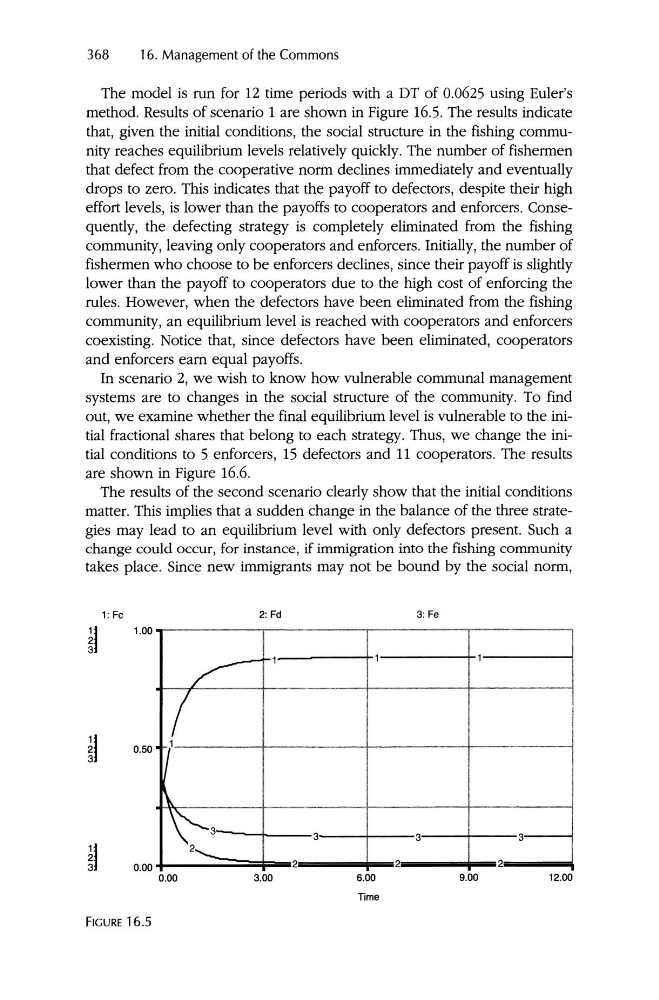
The model is run for 12 time periods with a DT of 0.0625 using Euler's
method . Results of scenario 1 are shown in Figure 165. The results indicate
that, given the initial conditions, the social structure in the fishing community reaches equilibrium levels relatively quickly. The number of fishermen
that defect from the cooperative norm declines immediately and eventually
drops to zero. This indicates that the payoff to defectors, despite their high
effort levels, is lower than the payoffs to cooperators and enforcers. Consequently , the defecting strategy is completely eliminated from the fishing
community, leaving only cooperators and enforcers. Initially, the number of
fishermen who choose to be enforcers declines, since their payoff is slightly
lower than the payoff to cooperators due to the high cost of enforcing the
rules. However, when the defectors have been eliminated from the fishing
community, an equilibrium level is reached with cooperators and enforcers
coexisting. Notice that, since defectors have been eliminated, cooperators
and enforcers earn equal payoffs.
In scenario 2, we wish to know how vulnerable communal management
systems are to changes in the social structure of the community. To find
out, we examine whether the final equilibrium level is vulnerable to the initial fractional shares that belong to each strategy. Thus, we change the initial conditions to 5 enforcers, 15 defectors and 11 cooperators. The results
are shown in Figure 16.6.
The results of the second scenario clearly show that the initial conditions
matter. This implies that a sudden change in the balance of the three strategies may lead to an equilibrium level with only defectors present. Such a
change could occur, for instance, if immigration into the fishing community
takes place. Since new immigrants may not be bound by the social norm,
3: Fe
2:Fd
1
1
1
1: Fe
1.00
0.50
/
Ii
\.
2
3
3
3
0.00
0.00
2
3.00
2
6.00
2
9.00
12.00
Time
FIGURE 16.5
16. Management of the Commons
The model is run for 12 time periods with a DT of 0.0625 using Euler's
method . Results of scenario 1 are shown in Figure 165. The results indicate
that, given the initial conditions, the social structure in the fishing community reaches equilibrium levels relatively quickly. The number of fishermen
that defect from the cooperative norm declines immediately and eventually
drops to zero. This indicates that the payoff to defectors, despite their high
effort levels, is lower than the payoffs to cooperators and enforcers. Consequently , the defecting strategy is completely eliminated from the fishing
community, leaving only cooperators and enforcers. Initially, the number of
fishermen who choose to be enforcers declines, since their payoff is slightly
lower than the payoff to cooperators due to the high cost of enforcing the
rules. However, when the defectors have been eliminated from the fishing
community, an equilibrium level is reached with cooperators and enforcers
coexisting. Notice that, since defectors have been eliminated, cooperators
and enforcers earn equal payoffs.
In scenario 2, we wish to know how vulnerable communal management
systems are to changes in the social structure of the community. To find
out, we examine whether the final equilibrium level is vulnerable to the initial fractional shares that belong to each strategy. Thus, we change the initial conditions to 5 enforcers, 15 defectors and 11 cooperators. The results
are shown in Figure 16.6.
The results of the second scenario clearly show that the initial conditions
matter. This implies that a sudden change in the balance of the three strategies may lead to an equilibrium level with only defectors present. Such a
change could occur, for instance, if immigration into the fishing community
takes place. Since new immigrants may not be bound by the social norm,
3: Fe
2:Fd
1
1
1
1: Fe
1.00
0.50
/
Ii
\.
2
3
3
3
0.00
0.00
2
3.00
2
6.00
2
9.00
12.00
Time
FIGURE 16.5