

362
16. Management of the Commons
A
0====={
Beta
p
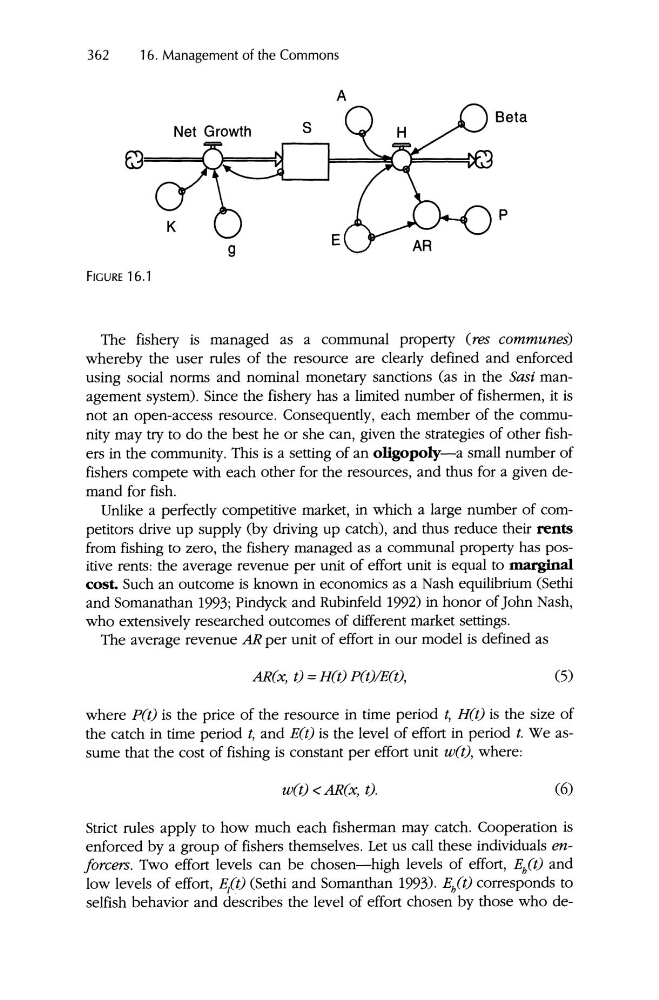
FIGURE 16.1
The fishery is managed as a communal property ( res communes)
whereby the user rules of the resource are clearly defined and enforced
using social norms and nominal monetary sanctions (as in the Sasi management system). Since the fishery has a limited number of fishermen, it is
not an open-access resource. Consequently, each member of the community may try to do the best he or she can, given the strategies of other fishers in the community. This is a setting of an oligopoly-a small number of
fishers compete with each other for the resources, and thus for a given demand for fish.
Unlike a perfectly competitive market, in which a large number of competitors drive up supply (by driving up catch), and thus reduce their rents
from fishing to zero, the fishery managed as a communal property has positive rents: the average revenue per unit of effort unit is equ al to marginal
cost. Such an outcome is known in economics as a Nash equilibrium (Sethi
and Somanathan 1993; Pindyck and Rubinfeld 1992) in honor of John Nash,
who extensively researched outcomes of different market settings.
The average revenue AR per unit of effort in our model is defined as
AR(x , 0 =H(tJ P(t)lE(tJ,
(5)
where P(tJ is the price of the resource in time period t, H(tJ is the size of
the catch in time period t, and E(tJ is the level of effort in period t. We assume that the cost of fishing is constant per effort unit w(tJ, where :
w (tJ < AR(x, 0.
(6)
Strict rules appl y to how much each fisherman may catch . Cooperation is
enforced by a group of fishers themselves. Let us call these individuals enf orcers. Two effort levels can be chosen-high levels of effort, Eh(tJ and
low levels of effort, El O (Sethi and Somanthan 1993). Eh(tJ corresponds to
selfish behavior and describes the level of effort chose n by those who de-
16. Management of the Commons
A
0====={
Beta
p
FIGURE 16.1
The fishery is managed as a communal property ( res communes)
whereby the user rules of the resource are clearly defined and enforced
using social norms and nominal monetary sanctions (as in the Sasi management system). Since the fishery has a limited number of fishermen, it is
not an open-access resource. Consequently, each member of the community may try to do the best he or she can, given the strategies of other fishers in the community. This is a setting of an oligopoly-a small number of
fishers compete with each other for the resources, and thus for a given demand for fish.
Unlike a perfectly competitive market, in which a large number of competitors drive up supply (by driving up catch), and thus reduce their rents
from fishing to zero, the fishery managed as a communal property has positive rents: the average revenue per unit of effort unit is equ al to marginal
cost. Such an outcome is known in economics as a Nash equilibrium (Sethi
and Somanathan 1993; Pindyck and Rubinfeld 1992) in honor of John Nash,
who extensively researched outcomes of different market settings.
The average revenue AR per unit of effort in our model is defined as
AR(x , 0 =H(tJ P(t)lE(tJ,
(5)
where P(tJ is the price of the resource in time period t, H(tJ is the size of
the catch in time period t, and E(tJ is the level of effort in period t. We assume that the cost of fishing is constant per effort unit w(tJ, where :
w (tJ < AR(x, 0.
(6)
Strict rules appl y to how much each fisherman may catch . Cooperation is
enforced by a group of fishers themselves. Let us call these individuals enf orcers. Two effort levels can be chosen-high levels of effort, Eh(tJ and
low levels of effort, El O (Sethi and Somanthan 1993). Eh(tJ corresponds to
selfish behavior and describes the level of effort chose n by those who de-