

344
15. Fish Population Responses to Sea Floor Habitat Alteratio n
Ultimately, the goal of research on the effects of trawling on the sea floor
is to pred ict the range of impac ts on fish popul ations given particular manageme nt protocols (Auster & Langton 1999), and to evaluate the effects of
trawling on the environment and overall biodiversity. In this chapter, we
present a dynamic model of early benthic-phase juvenile cod survivorship
that captures patterns in survivorship as a function of habitat-mediated predation for a continuous patch of pebble-cobble bottom, and examine fish
population responses to habitat management through the use of MPAs.
Mode ls such as the one we present here, that scale-up results from one
eco logical level to anothe r, can involve errors of extrapolation and interpo -
lation. However, by focusing on the examination of different system trajectories, and the relative contributions of key parameters to system dynamics
rather than specific pred ictions, models such as this can improve current
understanding of ecological relations gained from studies at small spatial
scales to a level where the implications of a variety of management measures can be investigated, and their corresponding effect on fish popul ations evaluated.
15.2. The Model
The simple popul ation model (Lindholm et a!' 1998, 2000) simulates a population subdivided into n regions, where each region is represented by a
particular level of habitat complexity (Figure 15.1). We interpret habitat
complexity as a measure of the vertical relief and cover from predation provided by a pa rticular substrat um (e.g. boulder, pebble-cobble, sand) and
any associate d emergent epifauna (e.g. sponges, amphipod tubes , cerianthid anemones, shell deposits, bioge nic depressions, and burrows).
Habitat complexity is assumed to be uniform within any region i. Each region is either an MPA, in which no fishing disturbance occurs , or is outside
an MPA and altered by fishing activity. We run the model at a monthly time
step for 12 months. Juvenile fish settle to the sea floor in the first period and
are then subject to density-dependent natural mortality, depending on the
region they moved to or settled.
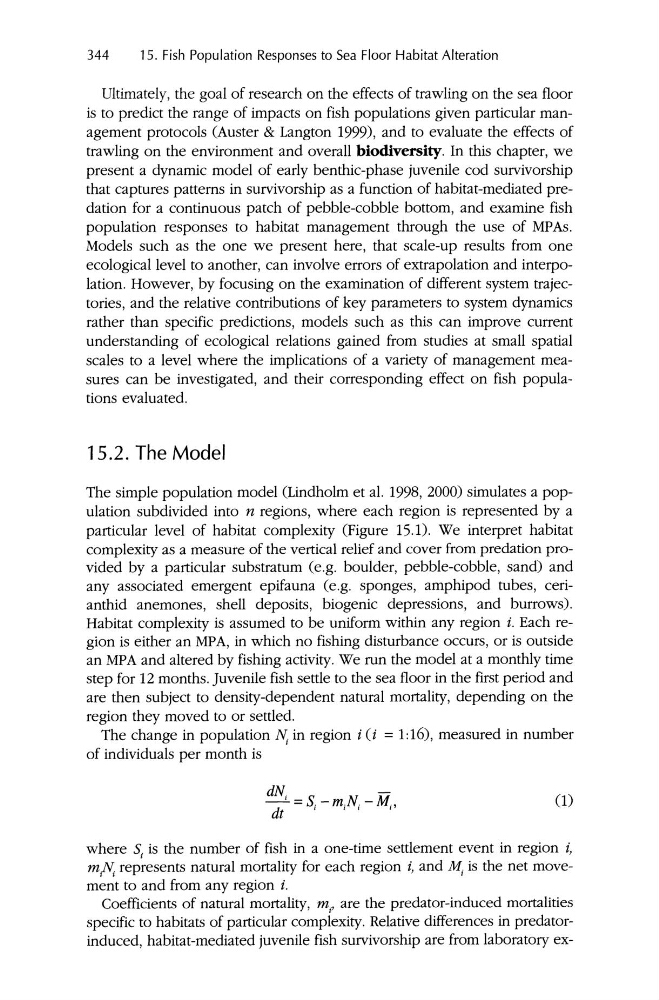
The change in population N, in region i Ci =1:16), measured in number
of individuals per month is
(1)
where S, is the num ber of fish in a one-time settlement event in region i,
mN, represents natural mortality for each region i, and M j is the net movement to and from any region i.
Coefficients of natural mortality, m i
, are the predator-induced mortalities
specific to habitats of particular complexity. Relative differences in preda torinduced, habitat-mediated juvenile fish survivorship are from laboratory ex-
15. Fish Population Responses to Sea Floor Habitat Alteratio n
Ultimately, the goal of research on the effects of trawling on the sea floor
is to pred ict the range of impac ts on fish popul ations given particular manageme nt protocols (Auster & Langton 1999), and to evaluate the effects of
trawling on the environment and overall biodiversity. In this chapter, we
present a dynamic model of early benthic-phase juvenile cod survivorship
that captures patterns in survivorship as a function of habitat-mediated predation for a continuous patch of pebble-cobble bottom, and examine fish
population responses to habitat management through the use of MPAs.
Mode ls such as the one we present here, that scale-up results from one
eco logical level to anothe r, can involve errors of extrapolation and interpo -
lation. However, by focusing on the examination of different system trajectories, and the relative contributions of key parameters to system dynamics
rather than specific pred ictions, models such as this can improve current
understanding of ecological relations gained from studies at small spatial
scales to a level where the implications of a variety of management measures can be investigated, and their corresponding effect on fish popul ations evaluated.
15.2. The Model
The simple popul ation model (Lindholm et a!' 1998, 2000) simulates a population subdivided into n regions, where each region is represented by a
particular level of habitat complexity (Figure 15.1). We interpret habitat
complexity as a measure of the vertical relief and cover from predation provided by a pa rticular substrat um (e.g. boulder, pebble-cobble, sand) and
any associate d emergent epifauna (e.g. sponges, amphipod tubes , cerianthid anemones, shell deposits, bioge nic depressions, and burrows).
Habitat complexity is assumed to be uniform within any region i. Each region is either an MPA, in which no fishing disturbance occurs , or is outside
an MPA and altered by fishing activity. We run the model at a monthly time
step for 12 months. Juvenile fish settle to the sea floor in the first period and
are then subject to density-dependent natural mortality, depending on the
region they moved to or settled.
The change in population N, in region i Ci =1:16), measured in number
of individuals per month is
(1)
where S, is the num ber of fish in a one-time settlement event in region i,
mN, represents natural mortality for each region i, and M j is the net movement to and from any region i.
Coefficients of natural mortality, m i
, are the predator-induced mortalities
specific to habitats of particular complexity. Relative differences in preda torinduced, habitat-mediated juvenile fish survivorship are from laboratory ex-