

14.2. The Mod el
317
The first term in Eq. (4) is the number of 0- to l-year-olds that hatched from
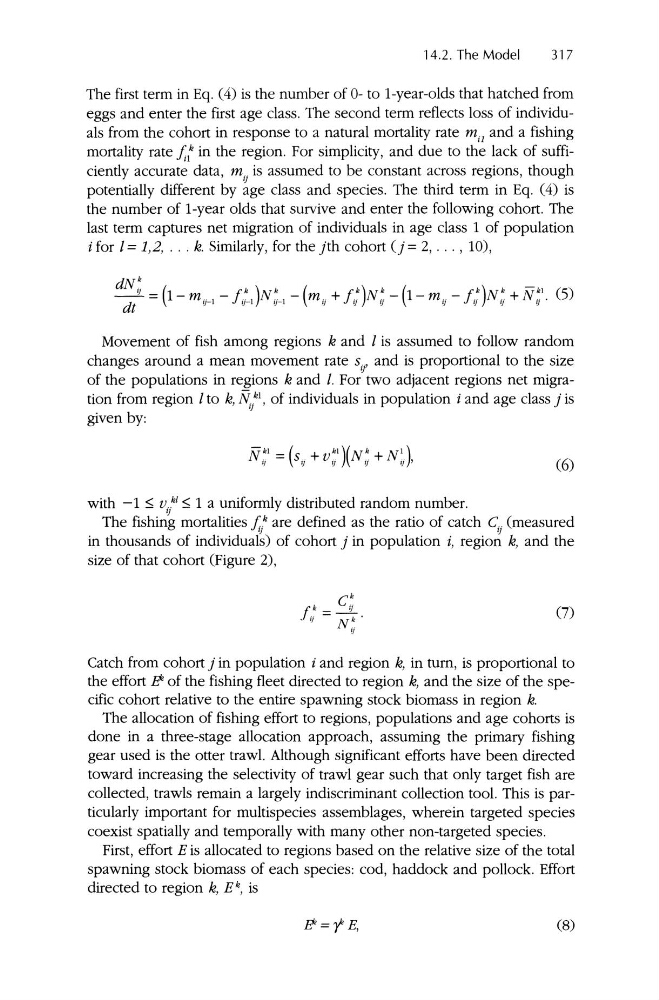
eggs and enter the first age class. The second term reflects loss of individuals from the cohort in response to a natural mortality rate mil and a fishing
mortality rate J;l k in the region . For simplicity, and due to the lack of sufficiently accurate data , m ij is assumed to be constant across regions, though
potentially different by age class and species. The third term in Eq. (4) is
the number of I-year olds that survive and enter the following cohort. The
last term captures net migration of individuals in age class 1 of population
i for 1= 1,2, . . . k. Similarly, for the jth cohort Cj = 2, . . . , 10),
k
z::« =(1dN
dt
m ij - I _f k )N k -(
ij - l
y- l
m tj . +f k)N k_(I_m_f k)N k+R kl (5)
if
iJ
iJ
tj
iJ
1) •
Movement of fish among regions k and 1is assumed to follow random
changes around a mean movement rate sif and is proportional to the size
of the populations in regions k and I. For two adjacent regions net migration from region 1to k, «/1,of individuals in population i and age class j is
given by:
(6)
/
lJ
with -1 v..
k
1 a uniformly distributed random number.
The fishing mortalities t . k are defined as the ratio of catch C (measured
J ij
lJ
in thousands of individuals) of cohort j in population i, region k, and the
size of that cohort (Figure 2),
(7)
Catch from cohort j in population i and region k, in turn, is proportional to
the effort If< of the fishing fleet directed to region k, and the size of the specific cohort relative to the entire spawning stock biomass in region k.
The allocation of fishing effort to regions, populations and age cohorts is
done in a three-stage allocation approach, assuming the primary fishing
gear used is the otter trawl. Although significant efforts have been directed
toward increasing the selectivity of trawl gear such that only target fish are
collected, trawls remain a largely indiscriminant collection tool. This is particularly important for multispecies assemblages, wherein targeted species
coexist spatially and temporally with many other non-targeted species.
First, effort E is allocated to regions based on the relative size of the total
spawning stock biomass of each species: cod , haddock and pollock. Effort
directed to region k, E k, is
If<=1'E,
(8)
317
The first term in Eq. (4) is the number of 0- to l-year-olds that hatched from
eggs and enter the first age class. The second term reflects loss of individuals from the cohort in response to a natural mortality rate mil and a fishing
mortality rate J;l k in the region . For simplicity, and due to the lack of sufficiently accurate data , m ij is assumed to be constant across regions, though
potentially different by age class and species. The third term in Eq. (4) is
the number of I-year olds that survive and enter the following cohort. The
last term captures net migration of individuals in age class 1 of population
i for 1= 1,2, . . . k. Similarly, for the jth cohort Cj = 2, . . . , 10),
k
z::« =(1dN
dt
m ij - I _f k )N k -(
ij - l
y- l
m tj . +f k)N k_(I_m_f k)N k+R kl (5)
if
iJ
iJ
tj
iJ
1) •
Movement of fish among regions k and 1is assumed to follow random
changes around a mean movement rate sif and is proportional to the size
of the populations in regions k and I. For two adjacent regions net migration from region 1to k, «/1,of individuals in population i and age class j is
given by:
(6)
/
lJ
with -1 v..
k
1 a uniformly distributed random number.
The fishing mortalities t . k are defined as the ratio of catch C (measured
J ij
lJ
in thousands of individuals) of cohort j in population i, region k, and the
size of that cohort (Figure 2),
(7)
Catch from cohort j in population i and region k, in turn, is proportional to
the effort If< of the fishing fleet directed to region k, and the size of the specific cohort relative to the entire spawning stock biomass in region k.
The allocation of fishing effort to regions, populations and age cohorts is
done in a three-stage allocation approach, assuming the primary fishing
gear used is the otter trawl. Although significant efforts have been directed
toward increasing the selectivity of trawl gear such that only target fish are
collected, trawls remain a largely indiscriminant collection tool. This is particularly important for multispecies assemblages, wherein targeted species
coexist spatially and temporally with many other non-targeted species.
First, effort E is allocated to regions based on the relative size of the total
spawning stock biomass of each species: cod , haddock and pollock. Effort
directed to region k, E k, is
If<=1'E,
(8)