

13.3. Model Behavior
277
...... longest successful
management regime
350
3Xl
"iii'
1;'250
'C
-0.
..
II)
C
150
II)
Cl
III
a100
::E
50
- 1 - - - - - - - - - - - - - - - - - - - - - - 1 Unrealistic haplochromine 1-:,-_1dominated system
- . . .
0
0
0.1
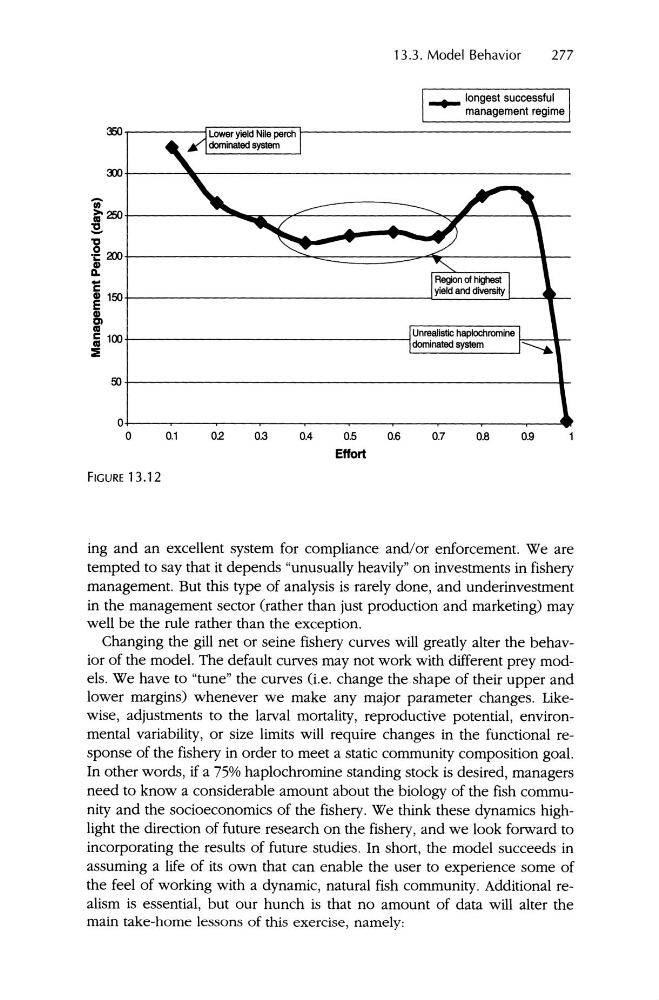
FIGURE 13.12
0.5
0.8
0.6
0.7
0.9
Effort
0.4
0.3
02
ing and an excellent system for compliance and/or enforcement. We are
tempted to say that it depends "unusually heavily" on investments in fishery
management. But this type of analysis is rarely done, and underinvestment
in the management sector (rather than just production and marketing) may
well be the rule rather than the exception.
Changing the gill net or seine fishery curves will greatly alter the behavior of the model. The default curves may not work with different prey models. We have to "tune" the curves (i.e. change the shape of their upper and
lower margins) whenever we make any major parameter changes. Likewise, adjustments to the larval mortality, reproductive potential , environmental variability, or size limits will require changes in the functional response of the fishery in order to meet a static community composition goal.
In other words, if a 75% haplochromine standing stock is desired, managers
need to know a considerable amount about the biology of the fish community and the socioeconomics of the fishery. We think these dynamics highlight the direction of future research on the fishery, and we look forward to
incorporating the results of future studies . In short, the model succeeds in
assuming a life of its own that can enable the user to experience some of
the feel of working with a dynamic, natural fish community. Additional realism is essential, but our hunch is that no amount of data will alter the
main take-home lessons of this exercise, namely:
277
...... longest successful
management regime
350
3Xl
"iii'
1;'250
'C
-0.
..
II)
C
150
II)
Cl
III
a100
::E
50
- 1 - - - - - - - - - - - - - - - - - - - - - - 1 Unrealistic haplochromine 1-:,-_1dominated system
- . . .
0
0
0.1
FIGURE 13.12
0.5
0.8
0.6
0.7
0.9
Effort
0.4
0.3
02
ing and an excellent system for compliance and/or enforcement. We are
tempted to say that it depends "unusually heavily" on investments in fishery
management. But this type of analysis is rarely done, and underinvestment
in the management sector (rather than just production and marketing) may
well be the rule rather than the exception.
Changing the gill net or seine fishery curves will greatly alter the behavior of the model. The default curves may not work with different prey models. We have to "tune" the curves (i.e. change the shape of their upper and
lower margins) whenever we make any major parameter changes. Likewise, adjustments to the larval mortality, reproductive potential , environmental variability, or size limits will require changes in the functional response of the fishery in order to meet a static community composition goal.
In other words, if a 75% haplochromine standing stock is desired, managers
need to know a considerable amount about the biology of the fish community and the socioeconomics of the fishery. We think these dynamics highlight the direction of future research on the fishery, and we look forward to
incorporating the results of future studies . In short, the model succeeds in
assuming a life of its own that can enable the user to experience some of
the feel of working with a dynamic, natural fish community. Additional realism is essential, but our hunch is that no amount of data will alter the
main take-home lessons of this exercise, namely: