

276
13. Nile Perch Population Dynamics in Lake Victoria :
-Cl Ii
.E If
"t:l
G:i
:;: If
' ii I
N
<0
N ...
Mea
... II)
II);'bM
Relative
... N
Fishing Effort
<0 c;;
less
,
Ihan
1105 1
, 510
' 25 10 25
8 100 100 Size Classes (kg)
plus
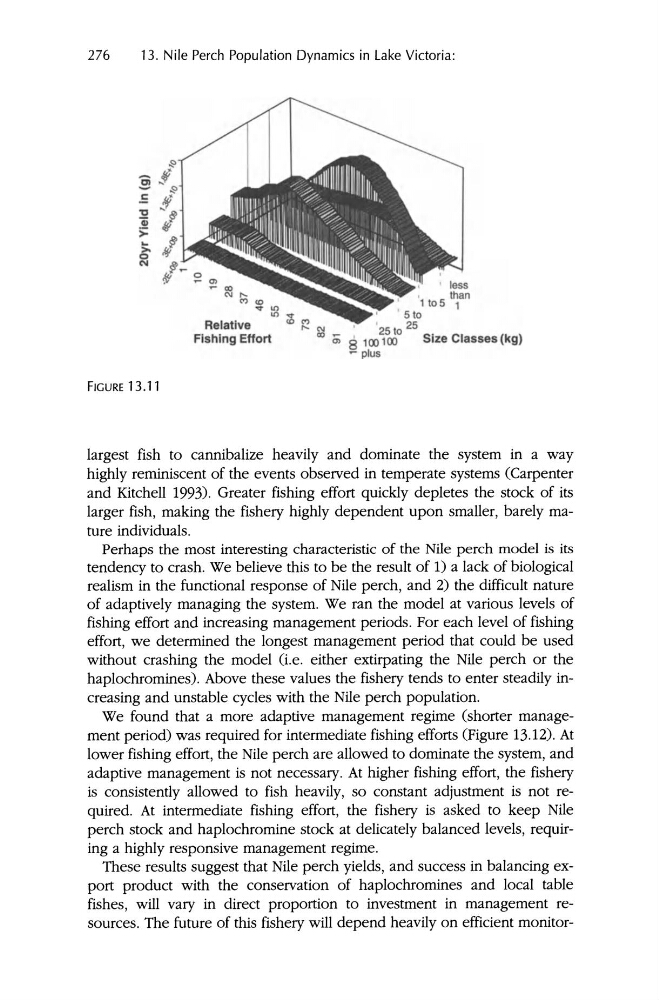
FIGURE 13.11
largest fish to cannibalize heavily and dominate the system in a way
highly reminiscent of the events observed in temperate systems (Carpenter
and Kitchell 1993). Greater fishing effort quickly depletes the stock of its
larger fish, making the fishery highly dependent upon smaller, barely mature individuals .
Perhaps the most interesting characteristic of the Nile perch model is its
tendency to crash . We believe this to be the result of 1) a lack of biological
realism in the functional response of Nile perch, and 2) the difficult nature
of adaptively managing the system. We ran the model at various levels of
fishing effort and increasing management periods . For each level of fishing
effort, we determined the longest management period that could be used
without crashing the model (i.e. either extirpating the Nile perch or the
haplochromines). Above these values the fishery tends to enter steadily increasing and unstable cycles with the Nile perch population.
We found that a more adaptive management regime (shorter management period) was required for intermediate fishing efforts (Figure 13.12). At
lower fishing effort, the Nile perch are allowed to dominate the system, and
adaptive management is not necessary. At higher fishing effort, the fishery
is consistently allowed to fish heavily, so constant adjustment is not required. At intermediate fishing effort, the fishery is asked to keep Nile
perch stock and haplochromine stock at delicately balanced levels, requiring a highly responsive management regime .
These results suggest that Nile perch yields, and success in balancing export product with the conservation of haplochromines and local table
fishes, will vary in direct proportion to investment in management resources. The future of this fishery will depend heavily on efficient monitor-
13. Nile Perch Population Dynamics in Lake Victoria :
-Cl Ii
.E If
"t:l
G:i
:;: If
' ii I
N
<0
N ...
Mea
... II)
II);'bM
Relative
... N
Fishing Effort
<0 c;;
less
,
Ihan
1105 1
, 510
' 25 10 25
8 100 100 Size Classes (kg)
plus
FIGURE 13.11
largest fish to cannibalize heavily and dominate the system in a way
highly reminiscent of the events observed in temperate systems (Carpenter
and Kitchell 1993). Greater fishing effort quickly depletes the stock of its
larger fish, making the fishery highly dependent upon smaller, barely mature individuals .
Perhaps the most interesting characteristic of the Nile perch model is its
tendency to crash . We believe this to be the result of 1) a lack of biological
realism in the functional response of Nile perch, and 2) the difficult nature
of adaptively managing the system. We ran the model at various levels of
fishing effort and increasing management periods . For each level of fishing
effort, we determined the longest management period that could be used
without crashing the model (i.e. either extirpating the Nile perch or the
haplochromines). Above these values the fishery tends to enter steadily increasing and unstable cycles with the Nile perch population.
We found that a more adaptive management regime (shorter management period) was required for intermediate fishing efforts (Figure 13.12). At
lower fishing effort, the Nile perch are allowed to dominate the system, and
adaptive management is not necessary. At higher fishing effort, the fishery
is consistently allowed to fish heavily, so constant adjustment is not required. At intermediate fishing effort, the fishery is asked to keep Nile
perch stock and haplochromine stock at delicately balanced levels, requiring a highly responsive management regime .
These results suggest that Nile perch yields, and success in balancing export product with the conservation of haplochromines and local table
fishes, will vary in direct proportion to investment in management resources. The future of this fishery will depend heavily on efficient monitor-