

13.2. The Model
269
any cohort is a simple function of the total mass of the cohort divided by its
number of fish.
Numbers of fish are removed from cohorts by fishing mortality, or predation. The number of fish in anyone cohort can only increase when that cohort is born . Fish mass can be removed by fishing, predation (cannibalism),
or spawning . Fish mass increases when fish feed or when a cohort is born .
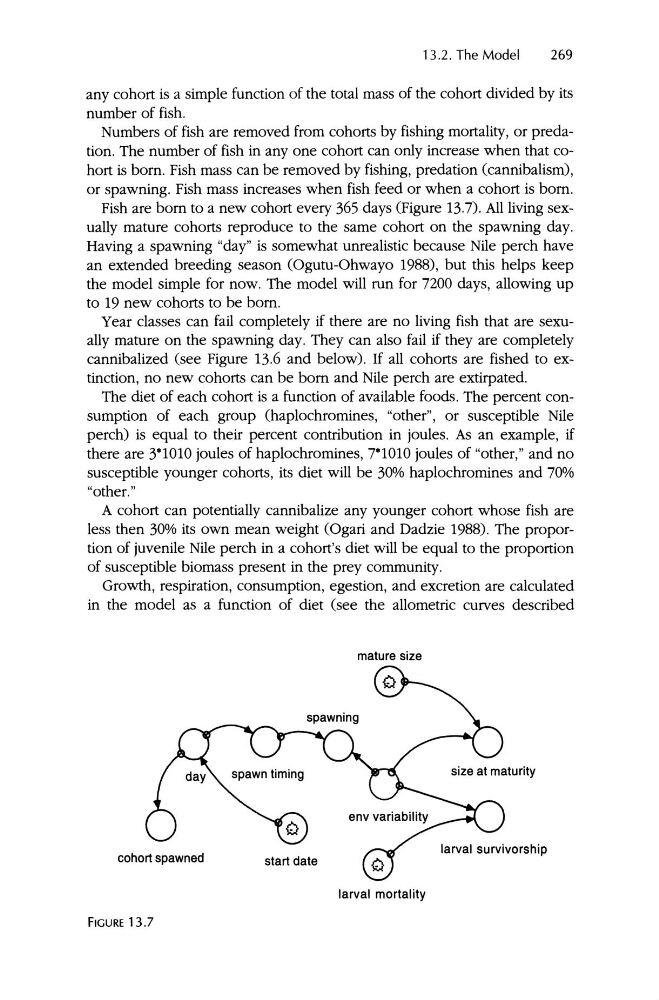
Fish are born to a new cohort every 365 days (Figure 13.7). All living sexually mature cohorts reproduce to the same cohort on the spawning day.
Having a spawning "day" is somewhat unrealistic because Nile perch have
an extended breeding season (Ogutu-Ohwayo 1988), but this helps keep
the model simple for now. The model will run for 7200 days, allowing up
to 19 new cohorts to be born .
Year classes can fail completely if there are no living fish that are sexually mature on the spawning day. They can also fail if they are completely
cannibalized (see Figure 13.6 and below) . If all cohorts are fished to extinction, no new cohorts can be born and Nile perch are extirpated .
The diet of each cohort is a function of available foods. The percent consumption of each group (haplochromines, "other", or susceptible Nile
perch) is equal to their percent contribution in joules. As an example, if
there are 3·1010 joules of haplochromines, 7·1010 joules of "other," and no
susceptible younger cohorts, its diet will be 30% haplochromines and 70%
"other."
A cohort can potentially cannibalize any younger cohort whose fish are
less then 30% its own mean weight (Ogari and Dadzie 1988). The proportion of juvenile Nile perch in a cohort's diet will be equal to the proportion
of susceptible biomass present in the prey community.
Growth, respiration, consumption, egestion, and excretion are calculated
in the model as a function of diet (see the allometric curves described
mature size
larval survivorship
cohort spawned
larval mortality
FIGURE 13.7
269
any cohort is a simple function of the total mass of the cohort divided by its
number of fish.
Numbers of fish are removed from cohorts by fishing mortality, or predation. The number of fish in anyone cohort can only increase when that cohort is born . Fish mass can be removed by fishing, predation (cannibalism),
or spawning . Fish mass increases when fish feed or when a cohort is born .
Fish are born to a new cohort every 365 days (Figure 13.7). All living sexually mature cohorts reproduce to the same cohort on the spawning day.
Having a spawning "day" is somewhat unrealistic because Nile perch have
an extended breeding season (Ogutu-Ohwayo 1988), but this helps keep
the model simple for now. The model will run for 7200 days, allowing up
to 19 new cohorts to be born .
Year classes can fail completely if there are no living fish that are sexually mature on the spawning day. They can also fail if they are completely
cannibalized (see Figure 13.6 and below) . If all cohorts are fished to extinction, no new cohorts can be born and Nile perch are extirpated .
The diet of each cohort is a function of available foods. The percent consumption of each group (haplochromines, "other", or susceptible Nile
perch) is equal to their percent contribution in joules. As an example, if
there are 3·1010 joules of haplochromines, 7·1010 joules of "other," and no
susceptible younger cohorts, its diet will be 30% haplochromines and 70%
"other."
A cohort can potentially cannibalize any younger cohort whose fish are
less then 30% its own mean weight (Ogari and Dadzie 1988). The proportion of juvenile Nile perch in a cohort's diet will be equal to the proportion
of susceptible biomass present in the prey community.
Growth, respiration, consumption, egestion, and excretion are calculated
in the model as a function of diet (see the allometric curves described
mature size
larval survivorship
cohort spawned
larval mortality
FIGURE 13.7