

13.2. The Model
265
1 0 . 050
- - ta
.....
I
QJ
C
- -
i3
I
1 0 . 000
-0 .500
-0.500
Ideal_hap_community-(hap_stand...
IJIilJ
I. 0.357
0.500
FIGURE 13.3
changes in Nile perch populations. The shape of the curves determines
whether the fishery has a tendency to fish the Nile perch to extinction or
allow its populations to explode.
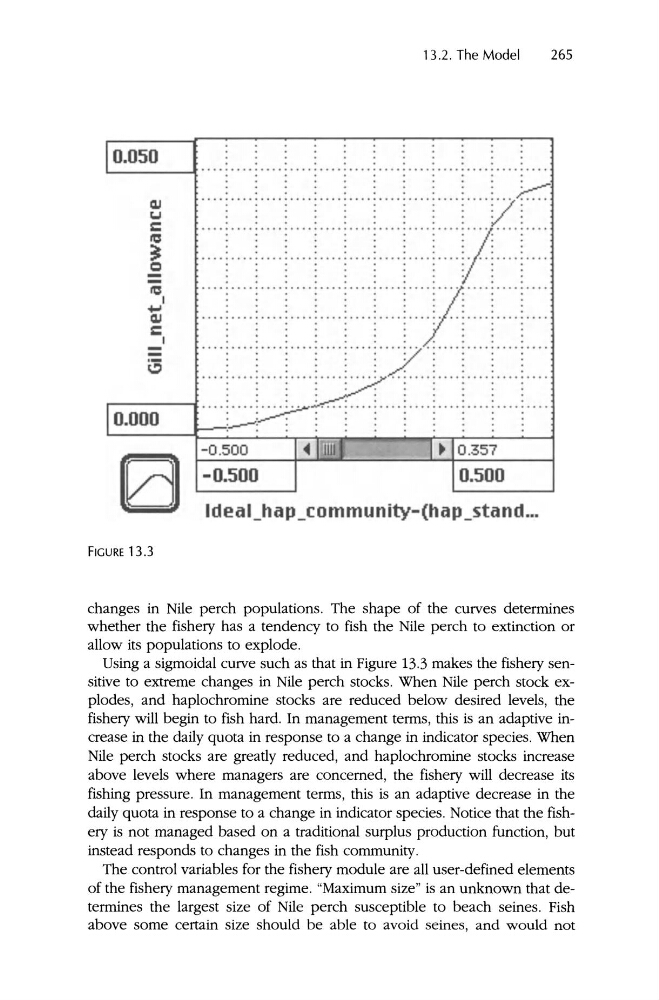
Using a sigmoidal curve such as that in Figure 13.3 makes the fishery sensitive to extreme changes in Nile perch stocks . When Nile perch stock explodes, and haplochromine stocks are reduced below desired levels, the
fishery will begin to fish hard. In management terms, this is an adaptive increase in the daily quota in response to a change in indicator species . When
Nile perch stocks are greatly reduced, and haplochromine stocks increase
above levels where managers are concerned, the fishery will decrease its
fishing pressure. In management terms, this is an adaptive decrease in the
daily quota in response to a change in indicator species . Notice that the fishery is not managed based on a traditional surplus production function, but
instead responds to changes in the fish community.
The control variables for the fishery module are all user-defined elements
of the fishery management regime . "Maximum size" is an unknown that determines the largest size of Nile perch susceptible to beach seines. Fish
above some certain size should be able to avoid seines, and would not
265
1 0 . 050
- - ta
.....
I
QJ
C
- -
i3
I
1 0 . 000
-0 .500
-0.500
Ideal_hap_community-(hap_stand...
IJIilJ
I. 0.357
0.500
FIGURE 13.3
changes in Nile perch populations. The shape of the curves determines
whether the fishery has a tendency to fish the Nile perch to extinction or
allow its populations to explode.
Using a sigmoidal curve such as that in Figure 13.3 makes the fishery sensitive to extreme changes in Nile perch stocks . When Nile perch stock explodes, and haplochromine stocks are reduced below desired levels, the
fishery will begin to fish hard. In management terms, this is an adaptive increase in the daily quota in response to a change in indicator species . When
Nile perch stocks are greatly reduced, and haplochromine stocks increase
above levels where managers are concerned, the fishery will decrease its
fishing pressure. In management terms, this is an adaptive decrease in the
daily quota in response to a change in indicator species . Notice that the fishery is not managed based on a traditional surplus production function, but
instead responds to changes in the fish community.
The control variables for the fishery module are all user-defined elements
of the fishery management regime . "Maximum size" is an unknown that determines the largest size of Nile perch susceptible to beach seines. Fish
above some certain size should be able to avoid seines, and would not