

12.3. Results
241
600000.00 ..-- - - - --r-..--- .. -. . ..,..---- - --,-- --- - -,
1: Urchins 5155
2: Urchins 5660
3: Urchins 60plus
iJ
I
300000.00 of-- - - --T--t-- - - - - -+- - - - - -f- - - - - --I
I
0.00 -I-.:::=~=:;:;;*==_.3;;;;;;;a_~~2_3_ _ 1- 2- 3 , - - -t
0.00
15.00
30.00
45.00
60.00
Months
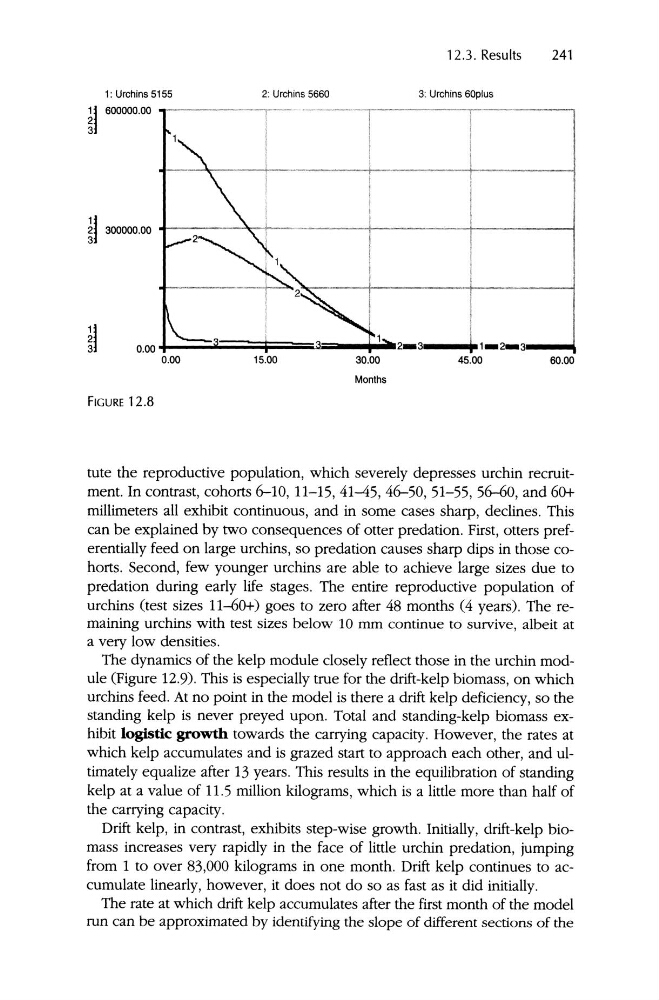
FIGURE 12.8
tute the reproductive population, which severely depresses urchin recruitment. In contrast, cohorts 6-10, 11- 15,41-45,46-50,51-55,56-60, and 60+
millimeters all exh ibit continuo us , and in so me cases sharp, declines. This
can be explained by two conseque nces of otter predation. First, otters preferentially feed on large urchins, so predation causes sharp dips in thos e cohorts. Second, few younger urchins are able to achieve large sizes due to
pred ation du ring ea rly life stages. The entire reproductive population of
urchins (test sizes 11-60+) goes to zero after 48 months (4 years). The remaining urchins with test sizes be low 10 mm continue to survive , albe it at
a very low densities.
The dynamics of the kelp module closely reflect those in the urchin module (Figure 12.9) . This is especially true for the drift-kelp biom ass, on which
urchins fee d . At no point in the model is there a drift kelp deficien cy, so the
stand ing kelp is never preyed upon. Total and standing-kel p biomass exhibit logistic growth toward s the carrying capacity . However , the rates at
which kelp accumulates and is graze d start to approach each othe r, and ultimately equa lize after 13 yea rs. This results in the equil ibration of standing
kelp at a value of 11.5 million kilograms, which is a little more than half of
the carrying capacity.
Drift kelp , in contrast, exhibits step-Wise growt h . Initially, drift-kelp biomass increases very rapidly in the face of little urch in predation, jumping
from 1 to ove r 83,000 kilograms in one month. Drift kelp continues to accumulate linearly, however , it does not do so as fast as it did initially.
The rate at which drift kelp accumulates after the first mon th of the model
run can be approximated by identifying the slope of different sectio ns of the
241
600000.00 ..-- - - - --r-..--- .. -. . ..,..---- - --,-- --- - -,
1: Urchins 5155
2: Urchins 5660
3: Urchins 60plus
iJ
I
300000.00 of-- - - --T--t-- - - - - -+- - - - - -f- - - - - --I
I
0.00 -I-.:::=~=:;:;;*==_.3;;;;;;;a_~~2_3_ _ 1- 2- 3 , - - -t
0.00
15.00
30.00
45.00
60.00
Months
FIGURE 12.8
tute the reproductive population, which severely depresses urchin recruitment. In contrast, cohorts 6-10, 11- 15,41-45,46-50,51-55,56-60, and 60+
millimeters all exh ibit continuo us , and in so me cases sharp, declines. This
can be explained by two conseque nces of otter predation. First, otters preferentially feed on large urchins, so predation causes sharp dips in thos e cohorts. Second, few younger urchins are able to achieve large sizes due to
pred ation du ring ea rly life stages. The entire reproductive population of
urchins (test sizes 11-60+) goes to zero after 48 months (4 years). The remaining urchins with test sizes be low 10 mm continue to survive , albe it at
a very low densities.
The dynamics of the kelp module closely reflect those in the urchin module (Figure 12.9) . This is especially true for the drift-kelp biom ass, on which
urchins fee d . At no point in the model is there a drift kelp deficien cy, so the
stand ing kelp is never preyed upon. Total and standing-kel p biomass exhibit logistic growth toward s the carrying capacity . However , the rates at
which kelp accumulates and is graze d start to approach each othe r, and ultimately equa lize after 13 yea rs. This results in the equil ibration of standing
kelp at a value of 11.5 million kilograms, which is a little more than half of
the carrying capacity.
Drift kelp , in contrast, exhibits step-Wise growt h . Initially, drift-kelp biomass increases very rapidly in the face of little urch in predation, jumping
from 1 to ove r 83,000 kilograms in one month. Drift kelp continues to accumulate linearly, however , it does not do so as fast as it did initially.
The rate at which drift kelp accumulates after the first mon th of the model
run can be approximated by identifying the slope of different sectio ns of the