

11 .3. M odel Structur e and Assumpti on s
219
CARRYING CAPACITY
BIRTH SUCCESS
ADULT CRABS
BIRD PREDATION
TOTALADULT CRABS
EGGS PER BIRD
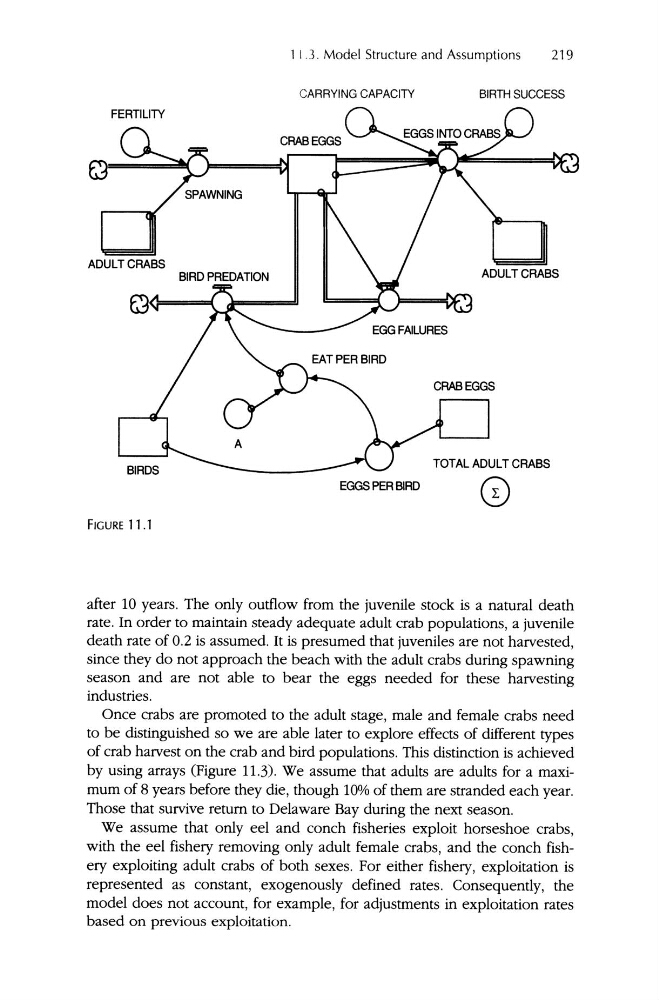
FIGURE 11 .1
after 10 years. The only outflow from the juvenile stock is a natural death
rate. In order to maintain stead y adequate adult crab populations, a juvenile
death rate of 0.2 is assumed. It is presumed that juveniles are not harvested,
since they do not approach the beach with the adult crabs during spawning
season and are not able to bear the eggs needed for these harvesting
industries.
Once crabs are promoted to the adult stage, male and female crabs need
to be distinguished so we are able later to explore effects of different types
of crab harvest on the crab and bird populations. This distinction is achieved
by using arrays (Figure 11.3). We assume that adults are adults for a maximum of 8 years before they die, though 100!oof them are stranded each year.
Those that survive return to Delaware Bay during the next season.
We assume that only eel and conch fishe ries exploit horseshoe crabs,
with the eel fishery removing only adult female crabs, and the conch fishery exploiting adult crabs of both sexes. For either fishe ry, exploitation is
represented as constant , exogenously defined rates. Consequently, the
model does not account , for example , for adjustments in exploitation rates
based on previous exploitation .
219
CARRYING CAPACITY
BIRTH SUCCESS
ADULT CRABS
BIRD PREDATION
TOTALADULT CRABS
EGGS PER BIRD
FIGURE 11 .1
after 10 years. The only outflow from the juvenile stock is a natural death
rate. In order to maintain stead y adequate adult crab populations, a juvenile
death rate of 0.2 is assumed. It is presumed that juveniles are not harvested,
since they do not approach the beach with the adult crabs during spawning
season and are not able to bear the eggs needed for these harvesting
industries.
Once crabs are promoted to the adult stage, male and female crabs need
to be distinguished so we are able later to explore effects of different types
of crab harvest on the crab and bird populations. This distinction is achieved
by using arrays (Figure 11.3). We assume that adults are adults for a maximum of 8 years before they die, though 100!oof them are stranded each year.
Those that survive return to Delaware Bay during the next season.
We assume that only eel and conch fishe ries exploit horseshoe crabs,
with the eel fishery removing only adult female crabs, and the conch fishery exploiting adult crabs of both sexes. For either fishe ry, exploitation is
represented as constant , exogenously defined rates. Consequently, the
model does not account , for example , for adjustments in exploitation rates
based on previous exploitation .