

21 8
11. Horseshoe Crabs and Shorebirds
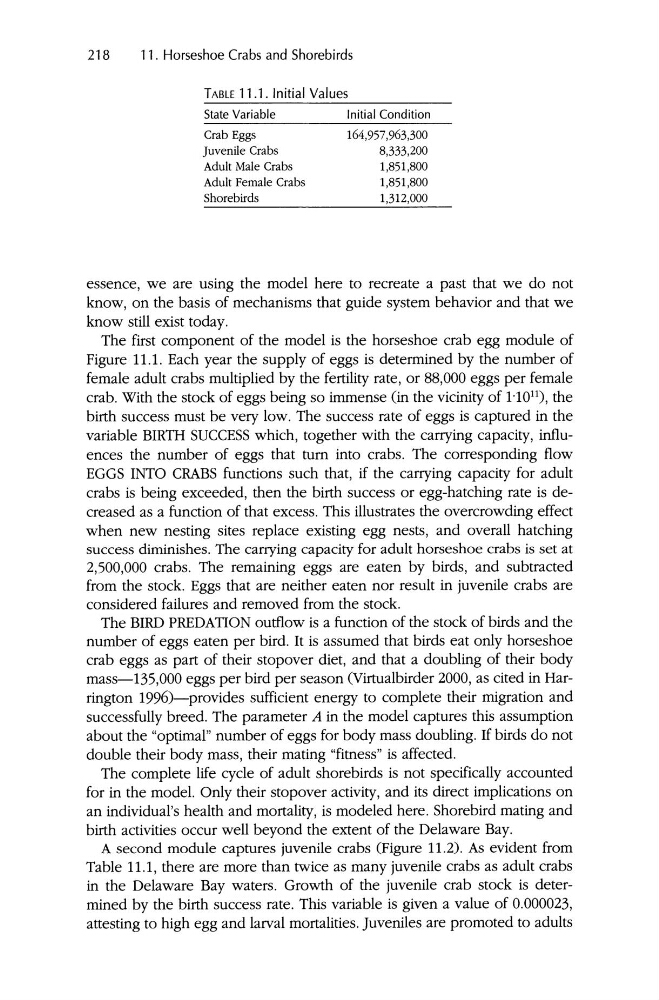
T ABLE 11.1. Initial Values
State Var iable
Crab Eggs
Juve nile Crabs
Adul t Male Crabs
Adu lt Fema le Crabs
Sho rebi rds
Initial Cond ition
164,957,963,300
8,333 ,200
1,851 ,800
1,851,800
1,312,000
essence, we are using the mod el here to recreate a past that we do not
kno w, on the basis of mechanisms that guide system behavior and that we
know still exist today.
The first component of the model is the horseshoe crab egg module of
Figure 11.1. Each year the supply of eggs is determined by the number of
female adult crabs multiplied by the fertility rate, or 88,000 eggs per female
crab. With the stock of eggs being so immense (in the vicinity of 1'10
11
) , the
birth success must be very low. The success rate of eggs is captured in the
variable BIRTH SUCCESS which , together with the carrying capacity, influences the number of eggs that turn into crabs. The correspo nding flow
EGGS INTO CRABS functions such that, if the carrying capacity for adult
crabs is being exce eded , then the birth success or egg-hatching rate is decreased as a function of that excess . This illustrates the overcrowding effect
when new nesting sites replace existing egg nests, and overall hatchin g
success diminishes. The carrying capacity for adult horseshoe crabs is set at
2,500,000 crabs. The remaining eggs are eaten by birds, and subtracted
from the stock. Eggs that are neither eaten nor result in juvenile crabs are
conside red failures and removed from the stock.
The BIRD PREDATION outflow is a function of the stock of birds and the
number of eggs eaten per bird. It is assumed that birds eat only horseshoe
crab eggs as part of their stopove r diet, and that a doubling of their body
mass-135,000 eggs per bird per season (Virtualbirder 2000, as cited in Harrington 1996)-provides sufficient energy to complete their migration and
successfully breed. The parameter A in the model captures this assumption
about the "optimal" number of eggs for body mass doubling. If birds do not
doubl e their body mass, their mating "fitness" is affected .
The complete life cycle of adult shorebirds is not specifically accounted
for in the model. Only their stopover activity, and its direct implications on
an individual's health and mortality, is modeled here . Shorebird mating and
birth activities occur well beyond the extent of the Delaware Bay.
A second modul e captures juvenile crabs (Figure 11.2). As evident from
Table 11.1, there are more than twice as many juvenile crabs as adult crabs
in the Delaware Bay waters. Growth of the juvenile crab stock is determined by the birth success rate. This variable is given a value of 0.000023,
attesting to high egg and larval mortalities. Juveniles are promoted to adults
11. Horseshoe Crabs and Shorebirds
T ABLE 11.1. Initial Values
State Var iable
Crab Eggs
Juve nile Crabs
Adul t Male Crabs
Adu lt Fema le Crabs
Sho rebi rds
Initial Cond ition
164,957,963,300
8,333 ,200
1,851 ,800
1,851,800
1,312,000
essence, we are using the mod el here to recreate a past that we do not
kno w, on the basis of mechanisms that guide system behavior and that we
know still exist today.
The first component of the model is the horseshoe crab egg module of
Figure 11.1. Each year the supply of eggs is determined by the number of
female adult crabs multiplied by the fertility rate, or 88,000 eggs per female
crab. With the stock of eggs being so immense (in the vicinity of 1'10
11
) , the
birth success must be very low. The success rate of eggs is captured in the
variable BIRTH SUCCESS which , together with the carrying capacity, influences the number of eggs that turn into crabs. The correspo nding flow
EGGS INTO CRABS functions such that, if the carrying capacity for adult
crabs is being exce eded , then the birth success or egg-hatching rate is decreased as a function of that excess . This illustrates the overcrowding effect
when new nesting sites replace existing egg nests, and overall hatchin g
success diminishes. The carrying capacity for adult horseshoe crabs is set at
2,500,000 crabs. The remaining eggs are eaten by birds, and subtracted
from the stock. Eggs that are neither eaten nor result in juvenile crabs are
conside red failures and removed from the stock.
The BIRD PREDATION outflow is a function of the stock of birds and the
number of eggs eaten per bird. It is assumed that birds eat only horseshoe
crab eggs as part of their stopove r diet, and that a doubling of their body
mass-135,000 eggs per bird per season (Virtualbirder 2000, as cited in Harrington 1996)-provides sufficient energy to complete their migration and
successfully breed. The parameter A in the model captures this assumption
about the "optimal" number of eggs for body mass doubling. If birds do not
doubl e their body mass, their mating "fitness" is affected .
The complete life cycle of adult shorebirds is not specifically accounted
for in the model. Only their stopover activity, and its direct implications on
an individual's health and mortality, is modeled here . Shorebird mating and
birth activities occur well beyond the extent of the Delaware Bay.
A second modul e captures juvenile crabs (Figure 11.2). As evident from
Table 11.1, there are more than twice as many juvenile crabs as adult crabs
in the Delaware Bay waters. Growth of the juvenile crab stock is determined by the birth success rate. This variable is given a value of 0.000023,
attesting to high egg and larval mortalities. Juveniles are promoted to adults