

9.5. Concl usio n
181
duced light causes average leaf length to increase, as show n in Figure 9.14.
Previous research has suggested that increase in leaf length durin g low-light
conditions appears to be a morphological adaptation of the plants to reduced light intensity (Short et al. 1995). In essence, rather than expe nding
energy on produ cing new leaves, energy is allocated to elongating existing
leaves in an effort to reach a depth where light is more available.
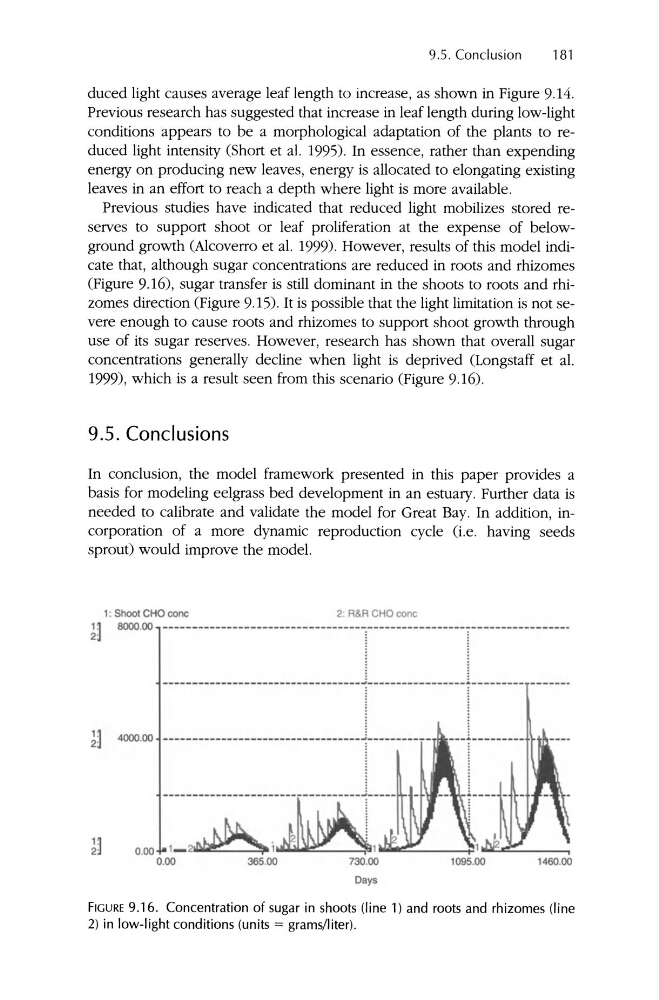
Previous studies have indicated that redu ced light mobilizes stored reserves to suppo rt shoot or leaf proliferation at the expense of belowground growth (Alcoverro et al. 1999), However, results of this model indicate that, although sugar concentrations are redu ced in roots and rhizomes
(Figure 9.16), sugar transfer is still dominant in the shoo ts to roots and rhizomes direction (Figure 9.15). It is possible that the light limitation is not severe enough to cause roots and rhizomes to suppo rt shoo t growth through
use of its sugar reserves. However, research has shown that overall sugar
concentrations generally decline when light is depr ived (Longstaff et al.
1999), which is a result see n from this scenario (Figure 9.16).
9.5. Conclusions
In conclusion, the model framework presented in this paper provides a
basis for modeling eelgrass bed development in an estuary. Further data is
needed to calibrate and validate the model for Great Bay. In addition, incorpo ration of a more dynamic rep rodu ction cycle (i.e. having seeds
spro ut) wo uld improve the mode l.
1: Shool CHO cone
2' R&R CHO cone
8000 .00 ---------------------------------------------------------------------_ _ _ _ _ _ _ _ _ _ _ _ _ _ _ _ _ _ _ _ _ _ _ _ _ _ _ _ _ _ _ _ _ _ J .
.
_
_
.",..-::;. -
_ ---,
1460.00
0.00 10.00
----:::;wo
365.00
_ __t:l ,..:;c.::::_
1095.00
_
730.00
Days
1. ]
2'
4000.00
J
_
FIGURE 9.16 . Concentration of sugar in shoots (li ne 1) and roots and rhizomes (li ne
2) in low-l ight conditions (units = grams/li ter).
181
duced light causes average leaf length to increase, as show n in Figure 9.14.
Previous research has suggested that increase in leaf length durin g low-light
conditions appears to be a morphological adaptation of the plants to reduced light intensity (Short et al. 1995). In essence, rather than expe nding
energy on produ cing new leaves, energy is allocated to elongating existing
leaves in an effort to reach a depth where light is more available.
Previous studies have indicated that redu ced light mobilizes stored reserves to suppo rt shoot or leaf proliferation at the expense of belowground growth (Alcoverro et al. 1999), However, results of this model indicate that, although sugar concentrations are redu ced in roots and rhizomes
(Figure 9.16), sugar transfer is still dominant in the shoo ts to roots and rhizomes direction (Figure 9.15). It is possible that the light limitation is not severe enough to cause roots and rhizomes to suppo rt shoo t growth through
use of its sugar reserves. However, research has shown that overall sugar
concentrations generally decline when light is depr ived (Longstaff et al.
1999), which is a result see n from this scenario (Figure 9.16).
9.5. Conclusions
In conclusion, the model framework presented in this paper provides a
basis for modeling eelgrass bed development in an estuary. Further data is
needed to calibrate and validate the model for Great Bay. In addition, incorpo ration of a more dynamic rep rodu ction cycle (i.e. having seeds
spro ut) wo uld improve the mode l.
1: Shool CHO cone
2' R&R CHO cone
8000 .00 ---------------------------------------------------------------------_ _ _ _ _ _ _ _ _ _ _ _ _ _ _ _ _ _ _ _ _ _ _ _ _ _ _ _ _ _ _ _ _ _ J .
.
_
_
.",..-::;. -
_ ---,
1460.00
0.00 10.00
----:::;wo
365.00
_ __t:l ,..:;c.::::_
1095.00
_
730.00
Days
1. ]
2'
4000.00
J
_
FIGURE 9.16 . Concentration of sugar in shoots (li ne 1) and roots and rhizomes (li ne
2) in low-l ight conditions (units = grams/li ter).