

146
8. Impact of Dynamic Light and Nutrient Environments
Zit) =Mixed Layer Depth/2*O+SlN(2*Pl*TIMEILength ofRotation Period)).
0)
Both the Mixed Layer Depth and the Length of Rotation Period can be varied with time to reflect different mixing regimes. The Length of Rotation Period must be an integer in the model as it is relative to Julian date (TIME).
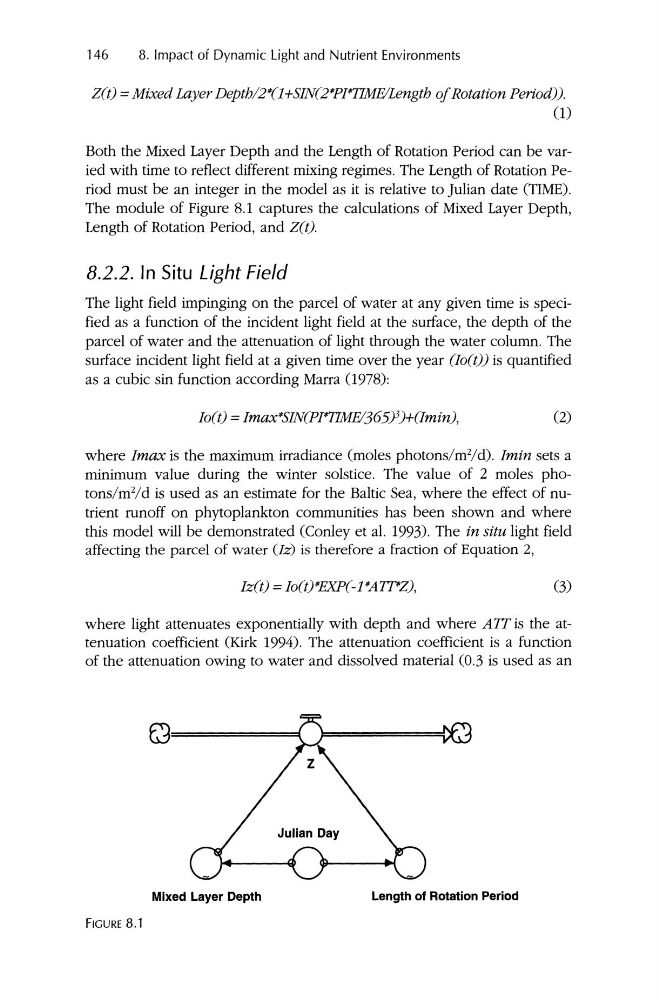
The module of Figure 8.1 captures the calculations of Mixed Layer Depth,
Length of Rotation Period, and Z(t).
8.2.2. In Situ Light Field
The light field impinging on the parcel of water at any given time is specified as a function of the incident light field at the surface, the depth of the
parcel of water and the attenuation of light through the water column. The
surface incident light field at a given time over the year (Io(O) is quantified
as a cubic sin function according Marra (978);
lo(t) =lmax*SlN(Pl*TIMEl365Y)+(Imin),
(2)
where lmax is the maximum irradiance (moles photons/mvd). Imin sets a
minimum value during the winter solstice. The value of 2 moles photons/mi/d is used as an estimate for the Baltic Sea, where the effect of nutrient runoff on phytoplankton communities has been shown and where
this model will be demonstrated (Conley et al. 1993). The in situ light field
affecting the parcel of water (Iz) is therefore a fraction of Equation 2,
lz(t) =10(t)*EXP(-1*A1T*Z),
(3)
where light attenuates exponentially with depth and where ATT is the attenuation coefficient (Kirk 1994). The attenuation coefficient is a function
of the attenuation owing to water and dissolved material (0.3 is used as an
Mixed Layer Depth
Length of Rotation Period
FIGURE 8.1
8. Impact of Dynamic Light and Nutrient Environments
Zit) =Mixed Layer Depth/2*O+SlN(2*Pl*TIMEILength ofRotation Period)).
0)
Both the Mixed Layer Depth and the Length of Rotation Period can be varied with time to reflect different mixing regimes. The Length of Rotation Period must be an integer in the model as it is relative to Julian date (TIME).
The module of Figure 8.1 captures the calculations of Mixed Layer Depth,
Length of Rotation Period, and Z(t).
8.2.2. In Situ Light Field
The light field impinging on the parcel of water at any given time is specified as a function of the incident light field at the surface, the depth of the
parcel of water and the attenuation of light through the water column. The
surface incident light field at a given time over the year (Io(O) is quantified
as a cubic sin function according Marra (978);
lo(t) =lmax*SlN(Pl*TIMEl365Y)+(Imin),
(2)
where lmax is the maximum irradiance (moles photons/mvd). Imin sets a
minimum value during the winter solstice. The value of 2 moles photons/mi/d is used as an estimate for the Baltic Sea, where the effect of nutrient runoff on phytoplankton communities has been shown and where
this model will be demonstrated (Conley et al. 1993). The in situ light field
affecting the parcel of water (Iz) is therefore a fraction of Equation 2,
lz(t) =10(t)*EXP(-1*A1T*Z),
(3)
where light attenuates exponentially with depth and where ATT is the attenuation coefficient (Kirk 1994). The attenuation coefficient is a function
of the attenuation owing to water and dissolved material (0.3 is used as an
Mixed Layer Depth
Length of Rotation Period
FIGURE 8.1