

136
7. Modeling Atmosphere-Ocean Interactions and Primary Productivity
1: Atmospheric PC02
2: Atmospheric PC02
350 .00 ----_.
3: Atmospheric PC02
4: Atmospheric PC02
1----1
1
V 2 ::::-------r--- I
2
2
5: Atmospheric PC0 2
1
2
3
4
5
-
4
'"
4_
340 .00
---330 .00
2250 .00
1500.00
3000 .00
Years
0.00
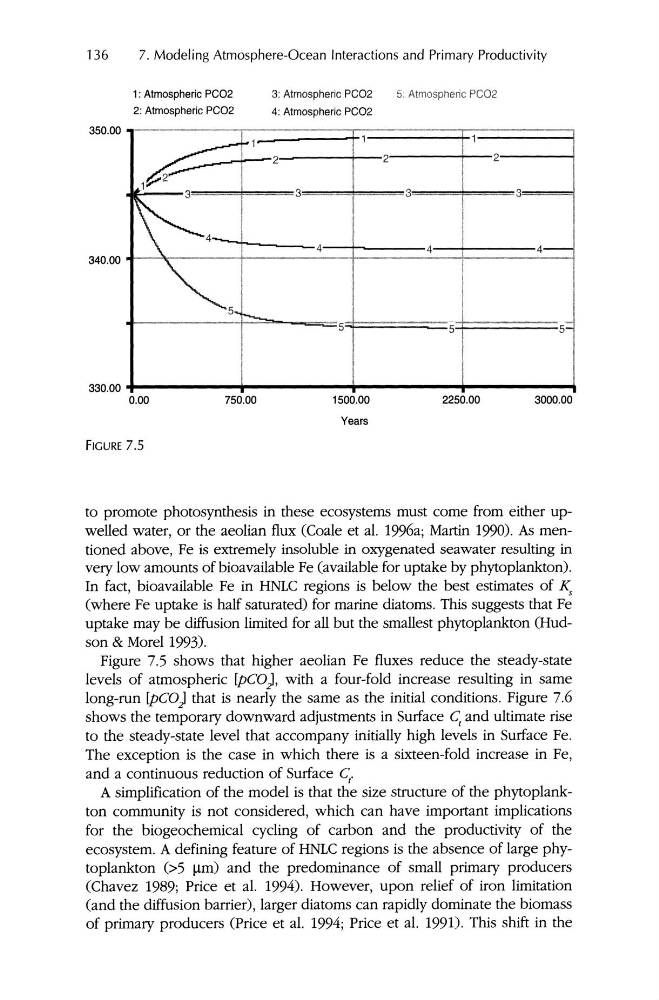
FIGURE 7.5
750 .00
to promote photosynthesis in these ecosystems must come from either upwelled water, or the aeolian flux (Coale et al. 1996a; Martin 1990). As mentioned above, Fe is extremely insoluble in oxygenated seawater resulting in
very low amounts of bioavailable Fe (available for uptake by phytoplankton).
In fact, bioavailable Fe in HNLC regions is below the best estimates of K.
(where Fe uptake is half saturated) for marine diatoms. This suggests that Fe
uptake may be diffusion limited for all but the smallest phytoplankton (Hudson & Morel 1993).
Figure 7.5 shows that higher aeolian Fe fluxes reduce the steady-state
levels of atmospheric [pCO), with a four-fold increase resulting in same
long-run [PCO) that is nearly the same as the initial conditions. Figure 7.6
shows the temporary downward adjustments in Surface C t and ultimate rise
to the steady-state level that accompany initially high levels in Surface Fe.
The exception is the case in which there is a sixteen-fold increase in Fe,
and a continuous reduction of Surface C;.
A simplification of the model is that the size structure of the phytoplankton community is not considered, which can have important implications
for the biogeochemical cycling of carbon and the productivity of the
ecosystem. A defining feature of HNLC regions is the absence of large phytoplankton (>5 urn) and the predominance of small primary producers
(Chavez 1989; Price et al. 1994). However, upon relief of iron limitation
(and the diffusion barrier), larger diatoms can rapidly dominate the biomass
of primary producers (Price et al. 1994; Price et al. 1991). This shift in the
7. Modeling Atmosphere-Ocean Interactions and Primary Productivity
1: Atmospheric PC02
2: Atmospheric PC02
350 .00 ----_.
3: Atmospheric PC02
4: Atmospheric PC02
1----1
1
V 2 ::::-------r--- I
2
2
5: Atmospheric PC0 2
1
2
3
4
5
-
4
'"
4_
340 .00
---330 .00
2250 .00
1500.00
3000 .00
Years
0.00
FIGURE 7.5
750 .00
to promote photosynthesis in these ecosystems must come from either upwelled water, or the aeolian flux (Coale et al. 1996a; Martin 1990). As mentioned above, Fe is extremely insoluble in oxygenated seawater resulting in
very low amounts of bioavailable Fe (available for uptake by phytoplankton).
In fact, bioavailable Fe in HNLC regions is below the best estimates of K.
(where Fe uptake is half saturated) for marine diatoms. This suggests that Fe
uptake may be diffusion limited for all but the smallest phytoplankton (Hudson & Morel 1993).
Figure 7.5 shows that higher aeolian Fe fluxes reduce the steady-state
levels of atmospheric [pCO), with a four-fold increase resulting in same
long-run [PCO) that is nearly the same as the initial conditions. Figure 7.6
shows the temporary downward adjustments in Surface C t and ultimate rise
to the steady-state level that accompany initially high levels in Surface Fe.
The exception is the case in which there is a sixteen-fold increase in Fe,
and a continuous reduction of Surface C;.
A simplification of the model is that the size structure of the phytoplankton community is not considered, which can have important implications
for the biogeochemical cycling of carbon and the productivity of the
ecosystem. A defining feature of HNLC regions is the absence of large phytoplankton (>5 urn) and the predominance of small primary producers
(Chavez 1989; Price et al. 1994). However, upon relief of iron limitation
(and the diffusion barrier), larger diatoms can rapidly dominate the biomass
of primary producers (Price et al. 1994; Price et al. 1991). This shift in the