

6
Spatial Fisheries Model
Matthias Ruth
There are some who can live without wild things, and some who
cannot.
Aldo Leopold, from A Sand CountyAlmanac
In this chapter you will:
• Learn how to spatially disaggregate a population and model movement
across space;
• Explore implications of changes in fishing effort in space and time for
population dynamics;
• Find conditions for stable limit cycles, damped and explosive
oscillations;
• Investigate the implications of reserves for the fishery; and
• Learn how to develop a user interface for your model to enhance its usefulness to non-modelers.
In the previous chapter, we explored one kind of direct influence that
human activities have on the dynamics of a marine population. We modeled fishing-induced alterations of the age and size structure of a fish population . Instead of disaggregating the population by age cohort and size, in
this chapter we disaggregate the population by region to investigate the
ramifications that the allocation of fishing effort in space and time has for
population dynamics.
6.1. Basic Model
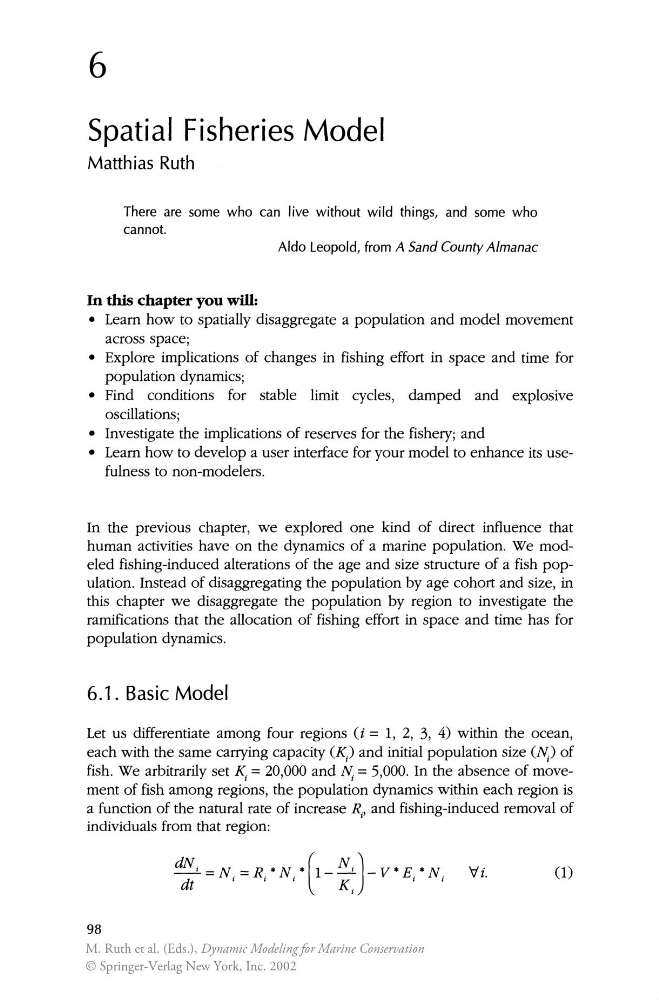
Let us differentiate among four regions (i = 1, 2, 3, 4) within the ocean,
each with the same carrying capacity (K) and initial population size (N) of
fish. We arbitrarily set I\ =20,000 and =5,000. In the absence of movement of fish among regions, the population dynamics within each region is
a function of the natural rate of increase R, and fishing-induced removal of
individuals from that region:
dN
i = N . = R.. N .(1- N i ) _ V· E· N "i/i.
K .
I
I
I
(1)
dt
I
I
I
98
M. Ruth et al. (Eds.), Dynamic Modeling for Marine Conservation
© Springer-Verlag New York, Inc. 2002
Spatial Fisheries Model
Matthias Ruth
There are some who can live without wild things, and some who
cannot.
Aldo Leopold, from A Sand CountyAlmanac
In this chapter you will:
• Learn how to spatially disaggregate a population and model movement
across space;
• Explore implications of changes in fishing effort in space and time for
population dynamics;
• Find conditions for stable limit cycles, damped and explosive
oscillations;
• Investigate the implications of reserves for the fishery; and
• Learn how to develop a user interface for your model to enhance its usefulness to non-modelers.
In the previous chapter, we explored one kind of direct influence that
human activities have on the dynamics of a marine population. We modeled fishing-induced alterations of the age and size structure of a fish population . Instead of disaggregating the population by age cohort and size, in
this chapter we disaggregate the population by region to investigate the
ramifications that the allocation of fishing effort in space and time has for
population dynamics.
6.1. Basic Model
Let us differentiate among four regions (i = 1, 2, 3, 4) within the ocean,
each with the same carrying capacity (K) and initial population size (N) of
fish. We arbitrarily set I\ =20,000 and =5,000. In the absence of movement of fish among regions, the population dynamics within each region is
a function of the natural rate of increase R, and fishing-induced removal of
individuals from that region:
dN
i = N . = R.. N .(1- N i ) _ V· E· N "i/i.
K .
I
I
I
(1)
dt
I
I
I
98
M. Ruth et al. (Eds.), Dynamic Modeling for Marine Conservation
© Springer-Verlag New York, Inc. 2002