

74
M. Holmer et al.
To enable assessment of changes in the monitored environmental attributes after
initiation of the aquaculture activities, the guidelines required collection of baseline
data before the start of the operations, so that these may be used as a reference against
which to compare data collected during monitoring. Collection of baseline data
would form part of the Environment Impact Assessment (EIA) as a requirement for
the granting of a development permit. Furthermore, the guidelines specified that an
environmental monitoring report, including all raw data collected, should be presented
to MEPA and the Directorate of Veterinary Services. Submission of reports to the latter
agency would ensure that appropriate practices in relation to health management of
fish stock and product quality are in operation.
Environmental monitoring at sites supporting sea bass and sea bream farms was
initiated around 1994, however, this was sporadic and certainly did not satisfy
MEPA’s guidelines to the full (Schembri et al. 2002). In some cases, the required
baseline survey for a specific fish farm was made (as this could not be avoided
since it formed part of the development application process), but no monitoring was
undertaken following initiation of the fish-farming activities, while other farms
claimed to have carried out monitoring of water quality at their own laboratories.
Apparently, no data on currents has been collected at any of the fish farm sites. As
a result of the irregular and incomplete environmental monitoring for sea bass and
sea bream farms, the data available for these operations is scanty.
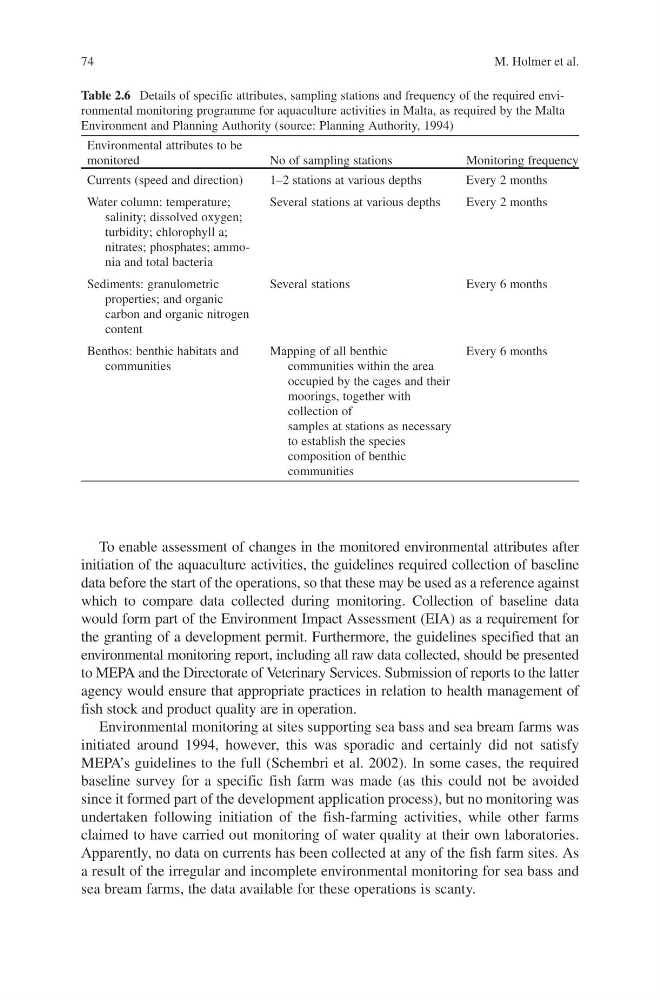
Table 2.6 Details of specific attributes, sampling stations and frequency of the required environmental monitoring programme for aquaculture activities in Malta, as required by the Malta
Environment and Planning Authority (source: Planning Authority, 1994)
Environmental attributes to be
monitored
No of sampling stations
Monitoring frequency
Currents (speed and direction)
1–2 stations at various depths
Every 2 months
Water column: temperature;
salinity; dissolved oxygen;
turbidity; chlorophyll a;
nitrates; phosphates; ammonia and total bacteria
Several stations at various depths
Every 2 months
Sediments: granulometric
properties; and organic
carbon and organic nitrogen
content
Several stations
Every 6 months
Benthos: benthic habitats and
communities
Mapping of all benthic
communities within the area
occupied by the cages and their
moorings, together with
collection of
samples at stations as necessary
to establish the species
composition of benthic
communities
Every 6 months
M. Holmer et al.
To enable assessment of changes in the monitored environmental attributes after
initiation of the aquaculture activities, the guidelines required collection of baseline
data before the start of the operations, so that these may be used as a reference against
which to compare data collected during monitoring. Collection of baseline data
would form part of the Environment Impact Assessment (EIA) as a requirement for
the granting of a development permit. Furthermore, the guidelines specified that an
environmental monitoring report, including all raw data collected, should be presented
to MEPA and the Directorate of Veterinary Services. Submission of reports to the latter
agency would ensure that appropriate practices in relation to health management of
fish stock and product quality are in operation.
Environmental monitoring at sites supporting sea bass and sea bream farms was
initiated around 1994, however, this was sporadic and certainly did not satisfy
MEPA’s guidelines to the full (Schembri et al. 2002). In some cases, the required
baseline survey for a specific fish farm was made (as this could not be avoided
since it formed part of the development application process), but no monitoring was
undertaken following initiation of the fish-farming activities, while other farms
claimed to have carried out monitoring of water quality at their own laboratories.
Apparently, no data on currents has been collected at any of the fish farm sites. As
a result of the irregular and incomplete environmental monitoring for sea bass and
sea bream farms, the data available for these operations is scanty.
Table 2.6 Details of specific attributes, sampling stations and frequency of the required environmental monitoring programme for aquaculture activities in Malta, as required by the Malta
Environment and Planning Authority (source: Planning Authority, 1994)
Environmental attributes to be
monitored
No of sampling stations
Monitoring frequency
Currents (speed and direction)
1–2 stations at various depths
Every 2 months
Water column: temperature;
salinity; dissolved oxygen;
turbidity; chlorophyll a;
nitrates; phosphates; ammonia and total bacteria
Several stations at various depths
Every 2 months
Sediments: granulometric
properties; and organic
carbon and organic nitrogen
content
Several stations
Every 6 months
Benthos: benthic habitats and
communities
Mapping of all benthic
communities within the area
occupied by the cages and their
moorings, together with
collection of
samples at stations as necessary
to establish the species
composition of benthic
communities
Every 6 months