

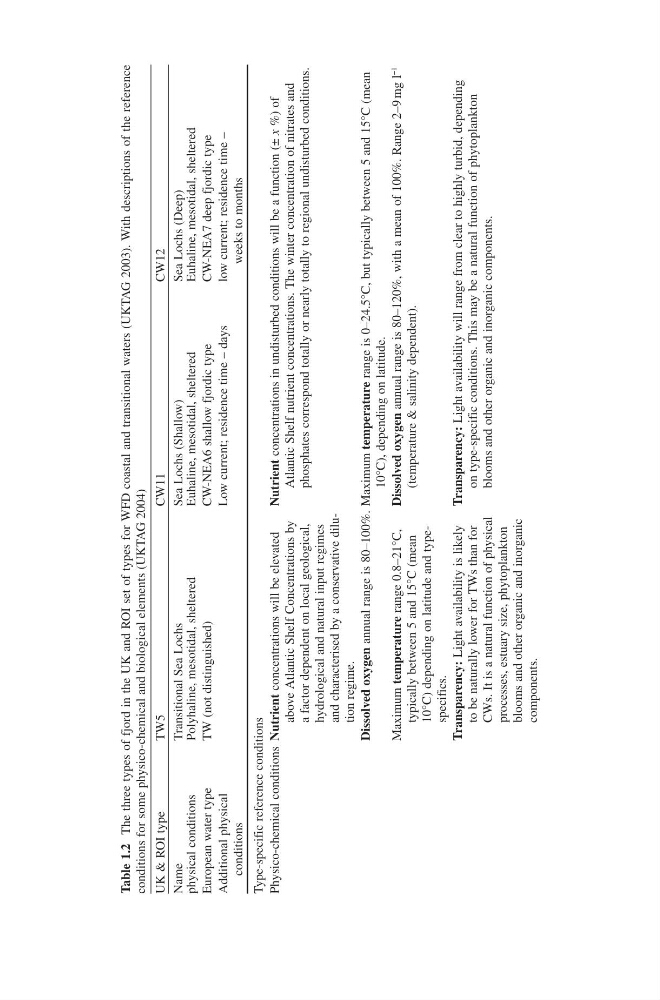
Table 1.2
The three types of fjord in the UK and ROI set of types for WFD coastal and transitional waters (UKTAG 2003). With descriptions of the reference
conditions for some physico-chemical and biological elements (UKTAG 2004)
UK & ROI type
TW5
CW11
CW12
Name
Transitional Sea Lochs
Sea Lochs (Shallow)
Sea Lochs (Deep)
physical conditions
Polyhaline, mesotidal, sheltered
Euhaline, mesotidal, sheltered
Euhaline, mesotidal, sheltered
European water type
TW (not distinguished)
CW-NEA6 shallow fjordic type
CW-NEA7 deep fjordic type
Additional physical
conditions
Low current; residence time – days
low current; residence time –
weeks to months
Type-specific reference conditions
Physico-chemical conditions Nutrient
concentrations will be elevated
above Atlantic Shelf Concentrations by
a factor dependent on local geological,
hydrological and natural input regimes
and characterised by a conservative dilution regime.
Nutrient
concentrations in undisturbed conditions will be a function (± x
%) of
Atlantic Shelf nutrient concentrations. The winter concentration of nitrates and
phosphates correspond totally or nearly totally to regional undisturbed conditions.
Dissolved oxygen
annual range is 80–100%. Maximum temperature
range is 0–24.5°C, but typically between 5 and 15°C (mean
10°C), depending on latitude.
Maximum temperature
range 0.8–21°C,
typically between 5 and 15°C (mean
10°C) depending on latitude and typespecifics.
Dissolved oxygen
annual range is 80–120%, with a mean of 100%. Range 2–9 mg l
−1
(temperature & salinity dependent).
Transparency:
Light availability is likely
to be naturally lower for TWs than for
CWs. It is a natural function of physical
processes, estuary size, phytoplankton
blooms and other organic and inorganic
components.
Transparency:
Light availability will range from clear to highly turbid, depending
on type-specific conditions. This may be a natural function of phytoplankton
blooms and other organic and inorganic components.
The three types of fjord in the UK and ROI set of types for WFD coastal and transitional waters (UKTAG 2003). With descriptions of the reference
conditions for some physico-chemical and biological elements (UKTAG 2004)
UK & ROI type
TW5
CW11
CW12
Name
Transitional Sea Lochs
Sea Lochs (Shallow)
Sea Lochs (Deep)
physical conditions
Polyhaline, mesotidal, sheltered
Euhaline, mesotidal, sheltered
Euhaline, mesotidal, sheltered
European water type
TW (not distinguished)
CW-NEA6 shallow fjordic type
CW-NEA7 deep fjordic type
Additional physical
conditions
Low current; residence time – days
low current; residence time –
weeks to months
Type-specific reference conditions
Physico-chemical conditions Nutrient
concentrations will be elevated
above Atlantic Shelf Concentrations by
a factor dependent on local geological,
hydrological and natural input regimes
and characterised by a conservative dilution regime.
Nutrient
concentrations in undisturbed conditions will be a function (± x
%) of
Atlantic Shelf nutrient concentrations. The winter concentration of nitrates and
phosphates correspond totally or nearly totally to regional undisturbed conditions.
Dissolved oxygen
annual range is 80–100%. Maximum temperature
range is 0–24.5°C, but typically between 5 and 15°C (mean
10°C), depending on latitude.
Maximum temperature
range 0.8–21°C,
typically between 5 and 15°C (mean
10°C) depending on latitude and typespecifics.
Dissolved oxygen
annual range is 80–120%, with a mean of 100%. Range 2–9 mg l
−1
(temperature & salinity dependent).
Transparency:
Light availability is likely
to be naturally lower for TWs than for
CWs. It is a natural function of physical
processes, estuary size, phytoplankton
blooms and other organic and inorganic
components.
Transparency:
Light availability will range from clear to highly turbid, depending
on type-specific conditions. This may be a natural function of phytoplankton
blooms and other organic and inorganic components.