

10 Status and Future Perspectives in Aquaculture
303
situation, there may be a need for a technological break-through to release the
resource constraint in a way that will also satisfy important stakeholders.
Technology for offshore mariculture may, for example, release the pressure on
coastal sites and may therefore be a solution that may satisfy both the industry and
the stakeholders involved. This solution may, however, involve new stakeholders
and conflicts and will depend strongly on technological innovations.
The above case is just one example of possible issues affecting aquaculture
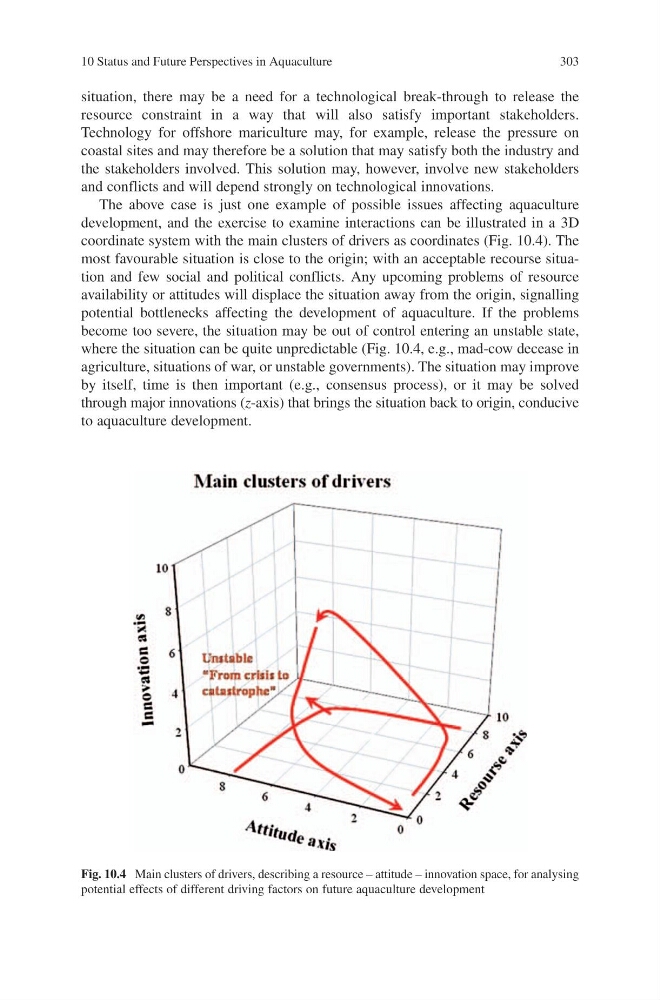
development, and the exercise to examine interactions can be illustrated in a 3D
coordinate system with the main clusters of drivers as coordinates (Fig. 10.4). The
most favourable situation is close to the origin; with an acceptable recourse situation and few social and political conflicts. Any upcoming problems of resource
availability or attitudes will displace the situation away from the origin, signalling
potential bottlenecks affecting the development of aquaculture. If the problems
become too severe, the situation may be out of control entering an unstable state,
where the situation can be quite unpredictable (Fig. 10.4, e.g., mad-cow decease in
agriculture, situations of war, or unstable governments). The situation may improve
by itself, time is then important (e.g., consensus process), or it may be solved
through major innovations (z-axis) that brings the situation back to origin, conducive
to aquaculture development.
Fig. 10.4 Main clusters of drivers, describing a resource – attitude – innovation space, for analysing
potential effects of different driving factors on future aquaculture development
303
situation, there may be a need for a technological break-through to release the
resource constraint in a way that will also satisfy important stakeholders.
Technology for offshore mariculture may, for example, release the pressure on
coastal sites and may therefore be a solution that may satisfy both the industry and
the stakeholders involved. This solution may, however, involve new stakeholders
and conflicts and will depend strongly on technological innovations.
The above case is just one example of possible issues affecting aquaculture
development, and the exercise to examine interactions can be illustrated in a 3D
coordinate system with the main clusters of drivers as coordinates (Fig. 10.4). The
most favourable situation is close to the origin; with an acceptable recourse situation and few social and political conflicts. Any upcoming problems of resource
availability or attitudes will displace the situation away from the origin, signalling
potential bottlenecks affecting the development of aquaculture. If the problems
become too severe, the situation may be out of control entering an unstable state,
where the situation can be quite unpredictable (Fig. 10.4, e.g., mad-cow decease in
agriculture, situations of war, or unstable governments). The situation may improve
by itself, time is then important (e.g., consensus process), or it may be solved
through major innovations (z-axis) that brings the situation back to origin, conducive
to aquaculture development.
Fig. 10.4 Main clusters of drivers, describing a resource – attitude – innovation space, for analysing
potential effects of different driving factors on future aquaculture development