

266
D. Whitmarsh and M.G. Palmieri
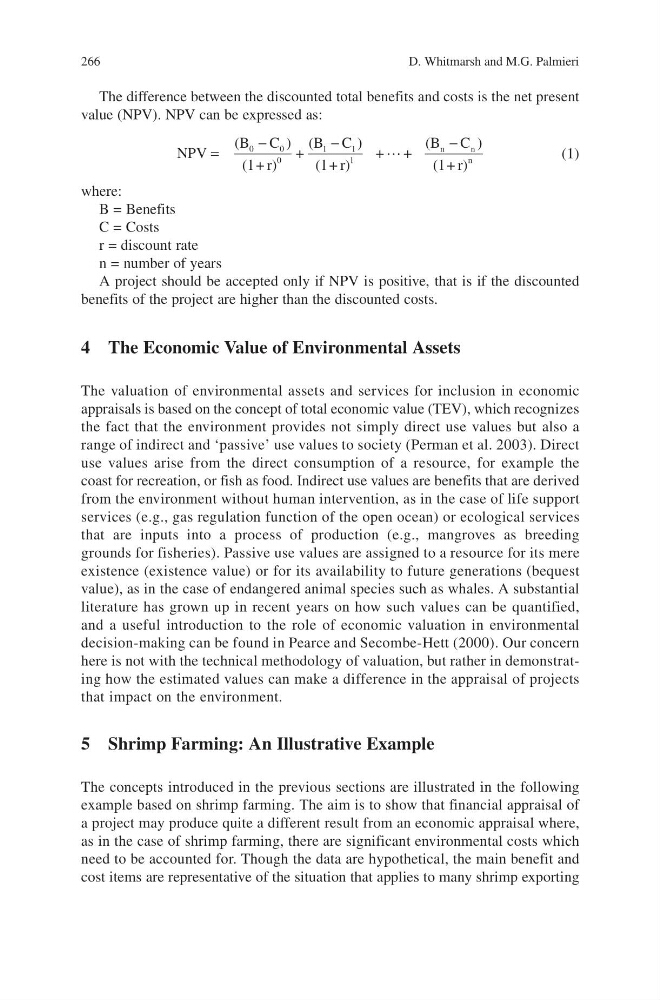
The difference between the discounted total benefits and costs is the net present
value (NPV). NPV can be expressed as:
NPV
(B C )
(1+ r)
+
(B C )
(1+ r)
+ +
(B C )
(1+ r)
0
0
0
1
1
1
n
n
n
=
−
−
−
(1)
where:
B = Benefits
C = Costs
r = discount rate
n = number of years
A project should be accepted only if NPV is positive, that is if the discounted
benefits of the project are higher than the discounted costs.
4 The Economic Value of Environmental Assets
The valuation of environmental assets and services for inclusion in economic
appraisals is based on the concept of total economic value (TEV), which recognizes
the fact that the environment provides not simply direct use values but also a
range of indirect and ‘passive’ use values to society (Perman et al. 2003). Direct
use values arise from the direct consumption of a resource, for example the
coast for recreation, or fish as food. Indirect use values are benefits that are derived
from the environment without human intervention, as in the case of life support
services (e.g., gas regulation function of the open ocean) or ecological services
that are inputs into a process of production (e.g., mangroves as breeding
grounds for fisheries). Passive use values are assigned to a resource for its mere
existence (existence value) or for its availability to future generations (bequest
value), as in the case of endangered animal species such as whales. A substantial
literature has grown up in recent years on how such values can be quantified,
and a useful introduction to the role of economic valuation in environmental
decision-making can be found in Pearce and Secombe-Hett (2000). Our concern
here is not with the technical methodology of valuation, but rather in demonstrating how the estimated values can make a difference in the appraisal of projects
that impact on the environment.
5 Shrimp Farming: An Illustrative Example
The concepts introduced in the previous sections are illustrated in the following
example based on shrimp farming. The aim is to show that financial appraisal of
a project may produce quite a different result from an economic appraisal where,
as in the case of shrimp farming, there are significant environmental costs which
need to be accounted for. Though the data are hypothetical, the main benefit and
cost items are representative of the situation that applies to many shrimp exporting
D. Whitmarsh and M.G. Palmieri
The difference between the discounted total benefits and costs is the net present
value (NPV). NPV can be expressed as:
NPV
(B C )
(1+ r)
+
(B C )
(1+ r)
+ +
(B C )
(1+ r)
0
0
0
1
1
1
n
n
n
=
−
−
−
(1)
where:
B = Benefits
C = Costs
r = discount rate
n = number of years
A project should be accepted only if NPV is positive, that is if the discounted
benefits of the project are higher than the discounted costs.
4 The Economic Value of Environmental Assets
The valuation of environmental assets and services for inclusion in economic
appraisals is based on the concept of total economic value (TEV), which recognizes
the fact that the environment provides not simply direct use values but also a
range of indirect and ‘passive’ use values to society (Perman et al. 2003). Direct
use values arise from the direct consumption of a resource, for example the
coast for recreation, or fish as food. Indirect use values are benefits that are derived
from the environment without human intervention, as in the case of life support
services (e.g., gas regulation function of the open ocean) or ecological services
that are inputs into a process of production (e.g., mangroves as breeding
grounds for fisheries). Passive use values are assigned to a resource for its mere
existence (existence value) or for its availability to future generations (bequest
value), as in the case of endangered animal species such as whales. A substantial
literature has grown up in recent years on how such values can be quantified,
and a useful introduction to the role of economic valuation in environmental
decision-making can be found in Pearce and Secombe-Hett (2000). Our concern
here is not with the technical methodology of valuation, but rather in demonstrating how the estimated values can make a difference in the appraisal of projects
that impact on the environment.
5 Shrimp Farming: An Illustrative Example
The concepts introduced in the previous sections are illustrated in the following
example based on shrimp farming. The aim is to show that financial appraisal of
a project may produce quite a different result from an economic appraisal where,
as in the case of shrimp farming, there are significant environmental costs which
need to be accounted for. Though the data are hypothetical, the main benefit and
cost items are representative of the situation that applies to many shrimp exporting