

228
K. Bostick
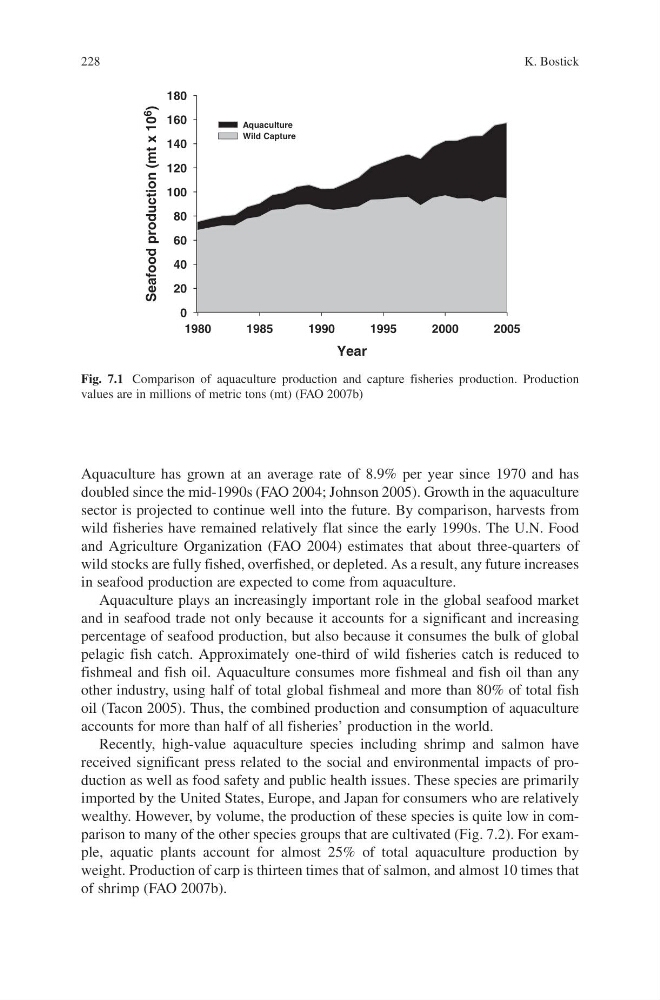
Aquaculture has grown at an average rate of 8.9% per year since 1970 and has
doubled since the mid-1990s (FAO 2004; Johnson 2005). Growth in the aquaculture
sector is projected to continue well into the future. By comparison, harvests from
wild fisheries have remained relatively flat since the early 1990s. The U.N. Food
and Agriculture Organization (FAO 2004) estimates that about three-quarters of
wild stocks are fully fished, overfished, or depleted. As a result, any future increases
in seafood production are expected to come from aquaculture.
Aquaculture plays an increasingly important role in the global seafood market
and in seafood trade not only because it accounts for a significant and increasing
percentage of seafood production, but also because it consumes the bulk of global
pelagic fish catch. Approximately one-third of wild fisheries catch is reduced to
fishmeal and fish oil. Aquaculture consumes more fishmeal and fish oil than any
other industry, using half of total global fishmeal and more than 80% of total fish
oil (Tacon 2005). Thus, the combined production and consumption of aquaculture
accounts for more than half of all fisheries’ production in the world.
Recently, high-value aquaculture species including shrimp and salmon have
received significant press related to the social and environmental impacts of production as well as food safety and public health issues. These species are primarily
imported by the United States, Europe, and Japan for consumers who are relatively
wealthy. However, by volume, the production of these species is quite low in comparison to many of the other species groups that are cultivated (Fig. 7.2). For example, aquatic plants account for almost 25% of total aquaculture production by
weight. Production of carp is thirteen times that of salmon, and almost 10 times that
of shrimp (FAO 2007b).
Fig. 7.1 Comparison of aquaculture production and capture fisheries production. Production
values are in millions of metric tons (mt) (FAO 2007b)
Year
1980
1985
1990
1995
2000
2005
Seafood production (mt x 10 6
)
0
20
40
60
80
100
120
140
160
180
Aquaculture
Wild Capture
K. Bostick
Aquaculture has grown at an average rate of 8.9% per year since 1970 and has
doubled since the mid-1990s (FAO 2004; Johnson 2005). Growth in the aquaculture
sector is projected to continue well into the future. By comparison, harvests from
wild fisheries have remained relatively flat since the early 1990s. The U.N. Food
and Agriculture Organization (FAO 2004) estimates that about three-quarters of
wild stocks are fully fished, overfished, or depleted. As a result, any future increases
in seafood production are expected to come from aquaculture.
Aquaculture plays an increasingly important role in the global seafood market
and in seafood trade not only because it accounts for a significant and increasing
percentage of seafood production, but also because it consumes the bulk of global
pelagic fish catch. Approximately one-third of wild fisheries catch is reduced to
fishmeal and fish oil. Aquaculture consumes more fishmeal and fish oil than any
other industry, using half of total global fishmeal and more than 80% of total fish
oil (Tacon 2005). Thus, the combined production and consumption of aquaculture
accounts for more than half of all fisheries’ production in the world.
Recently, high-value aquaculture species including shrimp and salmon have
received significant press related to the social and environmental impacts of production as well as food safety and public health issues. These species are primarily
imported by the United States, Europe, and Japan for consumers who are relatively
wealthy. However, by volume, the production of these species is quite low in comparison to many of the other species groups that are cultivated (Fig. 7.2). For example, aquatic plants account for almost 25% of total aquaculture production by
weight. Production of carp is thirteen times that of salmon, and almost 10 times that
of shrimp (FAO 2007b).
Fig. 7.1 Comparison of aquaculture production and capture fisheries production. Production
values are in millions of metric tons (mt) (FAO 2007b)
Year
1980
1985
1990
1995
2000
2005
Seafood production (mt x 10 6
)
0
20
40
60
80
100
120
140
160
180
Aquaculture
Wild Capture