

210
J.G. Bell and R. Waagbø
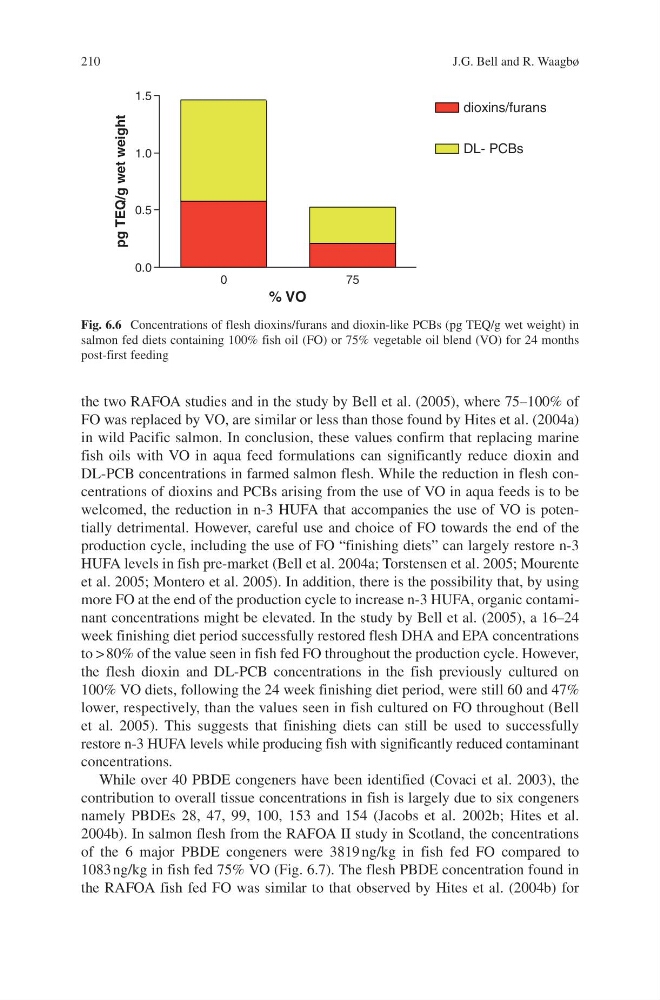
the two RAFOA studies and in the study by Bell et al. (2005), where 75–100% of
FO was replaced by VO, are similar or less than those found by Hites et al. (2004a)
in wild Pacific salmon. In conclusion, these values confirm that replacing marine
fish oils with VO in aqua feed formulations can significantly reduce dioxin and
DL-PCB concentrations in farmed salmon flesh. While the reduction in flesh concentrations of dioxins and PCBs arising from the use of VO in aqua feeds is to be
welcomed, the reduction in n-3 HUFA that accompanies the use of VO is potentially detrimental. However, careful use and choice of FO towards the end of the
production cycle, including the use of FO “finishing diets” can largely restore n-3
HUFA levels in fish pre-market (Bell et al. 2004a; Torstensen et al. 2005; Mourente
et al. 2005; Montero et al. 2005). In addition, there is the possibility that, by using
more FO at the end of the production cycle to increase n-3 HUFA, organic contaminant concentrations might be elevated. In the study by Bell et al. (2005), a 16–24
week finishing diet period successfully restored flesh DHA and EPA concentrations
to > 80% of the value seen in fish fed FO throughout the production cycle. However,
the flesh dioxin and DL-PCB concentrations in the fish previously cultured on
100% VO diets, following the 24 week finishing diet period, were still 60 and 47%
lower, respectively, than the values seen in fish cultured on FO throughout (Bell
et al. 2005). This suggests that finishing diets can still be used to successfully
restore n-3 HUFA levels while producing fish with significantly reduced contaminant
concentrations.
While over 40 PBDE congeners have been identified (Covaci et al. 2003), the
contribution to overall tissue concentrations in fish is largely due to six congeners
namely PBDEs 28, 47, 99, 100, 153 and 154 (Jacobs et al. 2002b; Hites et al.
2004b). In salmon flesh from the RAFOA II study in Scotland, the concentrations
of the 6 major PBDE congeners were 3819 ng/kg in fish fed FO compared to
1083 ng/kg in fish fed 75% VO (Fig. 6.7). The flesh PBDE concentration found in
the RAFOA fish fed FO was similar to that observed by Hites et al. (2004b) for
0
pg TEQ/g wet weight
75
0.0
0.5
1.0
1.5
dioxins/furans
DL- PCBs
% VO
Fig. 6.6 Concentrations of flesh dioxins/furans and dioxin-like PCBs (pg TEQ/g wet weight) in
salmon fed diets containing 100% fish oil (FO) or 75% vegetable oil blend (VO) for 24 months
post-first feeding
J.G. Bell and R. Waagbø
the two RAFOA studies and in the study by Bell et al. (2005), where 75–100% of
FO was replaced by VO, are similar or less than those found by Hites et al. (2004a)
in wild Pacific salmon. In conclusion, these values confirm that replacing marine
fish oils with VO in aqua feed formulations can significantly reduce dioxin and
DL-PCB concentrations in farmed salmon flesh. While the reduction in flesh concentrations of dioxins and PCBs arising from the use of VO in aqua feeds is to be
welcomed, the reduction in n-3 HUFA that accompanies the use of VO is potentially detrimental. However, careful use and choice of FO towards the end of the
production cycle, including the use of FO “finishing diets” can largely restore n-3
HUFA levels in fish pre-market (Bell et al. 2004a; Torstensen et al. 2005; Mourente
et al. 2005; Montero et al. 2005). In addition, there is the possibility that, by using
more FO at the end of the production cycle to increase n-3 HUFA, organic contaminant concentrations might be elevated. In the study by Bell et al. (2005), a 16–24
week finishing diet period successfully restored flesh DHA and EPA concentrations
to > 80% of the value seen in fish fed FO throughout the production cycle. However,
the flesh dioxin and DL-PCB concentrations in the fish previously cultured on
100% VO diets, following the 24 week finishing diet period, were still 60 and 47%
lower, respectively, than the values seen in fish cultured on FO throughout (Bell
et al. 2005). This suggests that finishing diets can still be used to successfully
restore n-3 HUFA levels while producing fish with significantly reduced contaminant
concentrations.
While over 40 PBDE congeners have been identified (Covaci et al. 2003), the
contribution to overall tissue concentrations in fish is largely due to six congeners
namely PBDEs 28, 47, 99, 100, 153 and 154 (Jacobs et al. 2002b; Hites et al.
2004b). In salmon flesh from the RAFOA II study in Scotland, the concentrations
of the 6 major PBDE congeners were 3819 ng/kg in fish fed FO compared to
1083 ng/kg in fish fed 75% VO (Fig. 6.7). The flesh PBDE concentration found in
the RAFOA fish fed FO was similar to that observed by Hites et al. (2004b) for
0
pg TEQ/g wet weight
75
0.0
0.5
1.0
1.5
dioxins/furans
DL- PCBs
% VO
Fig. 6.6 Concentrations of flesh dioxins/furans and dioxin-like PCBs (pg TEQ/g wet weight) in
salmon fed diets containing 100% fish oil (FO) or 75% vegetable oil blend (VO) for 24 months
post-first feeding