

1 Fish Farm Wastes in the Ecosystem
7
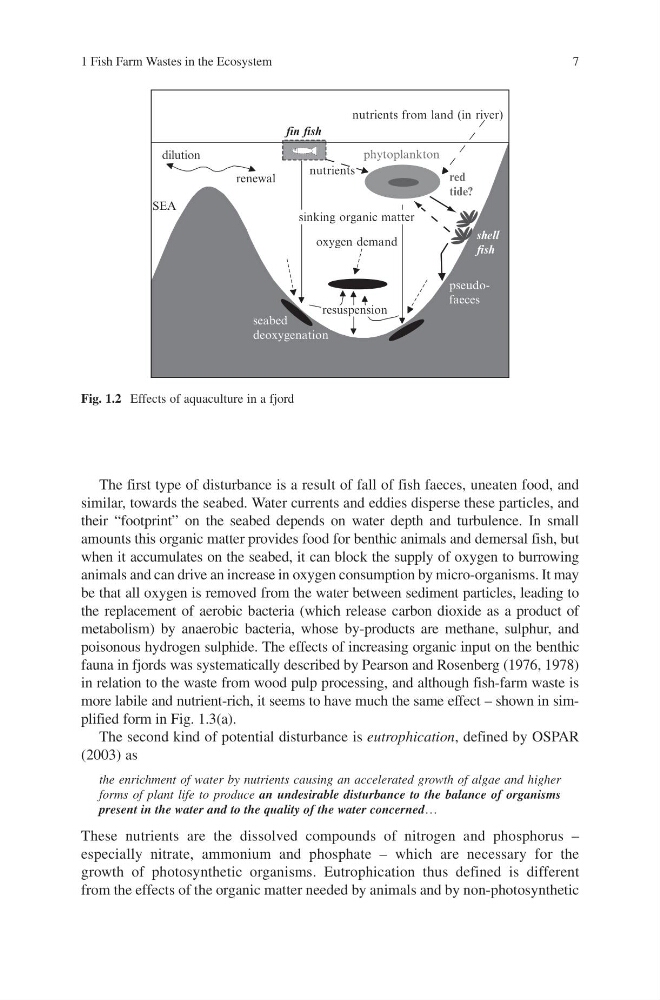
The first type of disturbance is a result of fall of fish faeces, uneaten food, and
similar, towards the seabed. Water currents and eddies disperse these particles, and
their “footprint” on the seabed depends on water depth and turbulence. In small
amounts this organic matter provides food for benthic animals and demersal fish, but
when it accumulates on the seabed, it can block the supply of oxygen to burrowing
animals and can drive an increase in oxygen consumption by micro-organisms. It may
be that all oxygen is removed from the water between sediment particles, leading to
the replacement of aerobic bacteria (which release carbon dioxide as a product of
metabolism) by anaerobic bacteria, whose by-products are methane, sulphur, and
poisonous hydrogen sulphide. The effects of increasing organic input on the benthic
fauna in fjords was systematically described by Pearson and Rosenberg (1976, 1978)
in relation to the waste from wood pulp processing, and although fish-farm waste is
more labile and nutrient-rich, it seems to have much the same effect – shown in simplified form in Fig. 1.3(a).
The second kind of potential disturbance is eutrophication, defined by OSPAR
(2003) as
the enrichment of water by nutrients causing an accelerated growth of algae and higher
forms of plant life to produce an undesirable disturbance to the balance of organisms
present in the water and to the quality of the water concerned…
These nutrients are the dissolved compounds of nitrogen and phosphorus –
especially nitrate, ammonium and phosphate – which are necessary for the
growth of photosynthetic organisms. Eutrophication thus defined is different
from the effects of the organic matter needed by animals and by non-photosynthetic
resuspension
oxygen demand
phytoplankton
nutrients
sinking organic matter
red
tide?
fin fish
dilution
renewal
nutrients from land (in river)
SEA
shell
fish
seabed
deoxygenation
pseudofaeces
Fig. 1.2 Effects of aquaculture in a fjord
7
The first type of disturbance is a result of fall of fish faeces, uneaten food, and
similar, towards the seabed. Water currents and eddies disperse these particles, and
their “footprint” on the seabed depends on water depth and turbulence. In small
amounts this organic matter provides food for benthic animals and demersal fish, but
when it accumulates on the seabed, it can block the supply of oxygen to burrowing
animals and can drive an increase in oxygen consumption by micro-organisms. It may
be that all oxygen is removed from the water between sediment particles, leading to
the replacement of aerobic bacteria (which release carbon dioxide as a product of
metabolism) by anaerobic bacteria, whose by-products are methane, sulphur, and
poisonous hydrogen sulphide. The effects of increasing organic input on the benthic
fauna in fjords was systematically described by Pearson and Rosenberg (1976, 1978)
in relation to the waste from wood pulp processing, and although fish-farm waste is
more labile and nutrient-rich, it seems to have much the same effect – shown in simplified form in Fig. 1.3(a).
The second kind of potential disturbance is eutrophication, defined by OSPAR
(2003) as
the enrichment of water by nutrients causing an accelerated growth of algae and higher
forms of plant life to produce an undesirable disturbance to the balance of organisms
present in the water and to the quality of the water concerned…
These nutrients are the dissolved compounds of nitrogen and phosphorus –
especially nitrate, ammonium and phosphate – which are necessary for the
growth of photosynthetic organisms. Eutrophication thus defined is different
from the effects of the organic matter needed by animals and by non-photosynthetic
resuspension
oxygen demand
phytoplankton
nutrients
sinking organic matter
red
tide?
fin fish
dilution
renewal
nutrients from land (in river)
SEA
shell
fish
seabed
deoxygenation
pseudofaeces
Fig. 1.2 Effects of aquaculture in a fjord