

100
T. Dempster and P. Sanchez-Jerez
have both been shown to feed predominantly on lost feed from farms when in their
vicinity, compared to wild fish taken from control locations which fed mainly upon
fish and invertebrates. Fernandez-Jover et al. (2007b) demonstrated that the modified diet in farm-associated T. Mediterraneus resulted in significantly higher body
condition and significantly different fatty acid composition in their tissues compared to control fish that fed on natural diets. The higher body condition of farmassociated fish may translate to greater production of reproductive products and
ultimately lead to improved spawning success, if egg quality is not adversely
affected by the modified fatty acid composition of the fish (Fernandez-Jover et al.
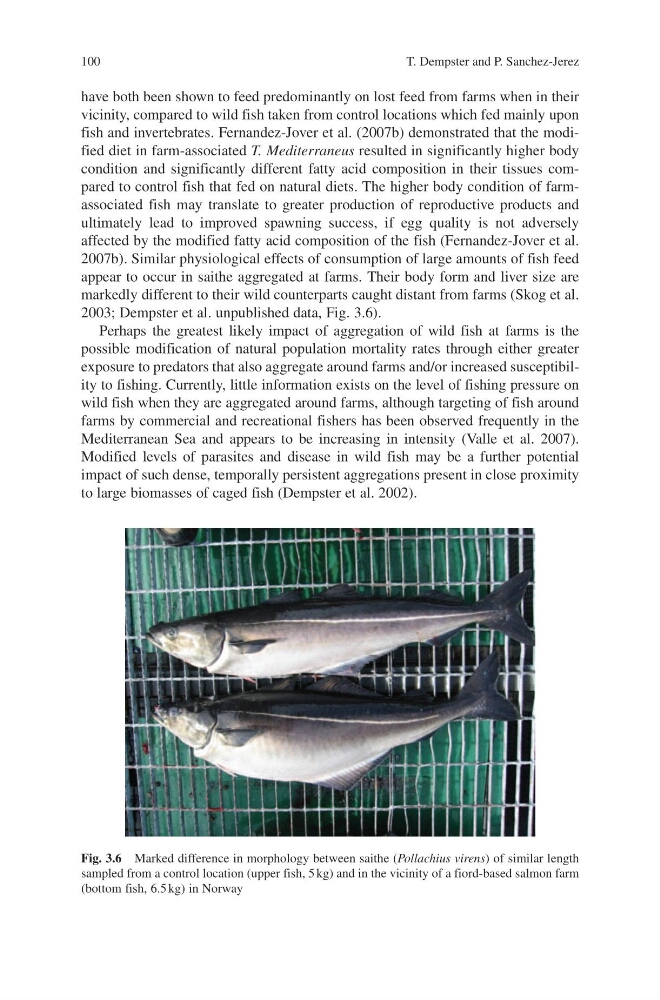
2007b). Similar physiological effects of consumption of large amounts of fish feed
appear to occur in saithe aggregated at farms. Their body form and liver size are
markedly different to their wild counterparts caught distant from farms (Skog et al.
2003; Dempster et al. unpublished data, Fig. 3.6).
Perhaps the greatest likely impact of aggregation of wild fish at farms is the
possible modification of natural population mortality rates through either greater
exposure to predators that also aggregate around farms and/or increased susceptibility to fishing. Currently, little information exists on the level of fishing pressure on
wild fish when they are aggregated around farms, although targeting of fish around
farms by commercial and recreational fishers has been observed frequently in the
Mediterranean Sea and appears to be increasing in intensity (Valle et al. 2007).
Modified levels of parasites and disease in wild fish may be a further potential
impact of such dense, temporally persistent aggregations present in close proximity
to large biomasses of caged fish (Dempster et al. 2002).
Fig. 3.6 Marked difference in morphology between saithe (Pollachius virens) of similar length
sampled from a control location (upper fish, 5 kg) and in the vicinity of a fiord-based salmon farm
(bottom fish, 6.5 kg) in Norway
T. Dempster and P. Sanchez-Jerez
have both been shown to feed predominantly on lost feed from farms when in their
vicinity, compared to wild fish taken from control locations which fed mainly upon
fish and invertebrates. Fernandez-Jover et al. (2007b) demonstrated that the modified diet in farm-associated T. Mediterraneus resulted in significantly higher body
condition and significantly different fatty acid composition in their tissues compared to control fish that fed on natural diets. The higher body condition of farmassociated fish may translate to greater production of reproductive products and
ultimately lead to improved spawning success, if egg quality is not adversely
affected by the modified fatty acid composition of the fish (Fernandez-Jover et al.
2007b). Similar physiological effects of consumption of large amounts of fish feed
appear to occur in saithe aggregated at farms. Their body form and liver size are
markedly different to their wild counterparts caught distant from farms (Skog et al.
2003; Dempster et al. unpublished data, Fig. 3.6).
Perhaps the greatest likely impact of aggregation of wild fish at farms is the
possible modification of natural population mortality rates through either greater
exposure to predators that also aggregate around farms and/or increased susceptibility to fishing. Currently, little information exists on the level of fishing pressure on
wild fish when they are aggregated around farms, although targeting of fish around
farms by commercial and recreational fishers has been observed frequently in the
Mediterranean Sea and appears to be increasing in intensity (Valle et al. 2007).
Modified levels of parasites and disease in wild fish may be a further potential
impact of such dense, temporally persistent aggregations present in close proximity
to large biomasses of caged fish (Dempster et al. 2002).
Fig. 3.6 Marked difference in morphology between saithe (Pollachius virens) of similar length
sampled from a control location (upper fish, 5 kg) and in the vicinity of a fiord-based salmon farm
(bottom fish, 6.5 kg) in Norway