

3 Aquaculture and Coastal Space Management
99
are temporally stable over the scale of several weeks to months, both in relative size
and species composition, indicating some degree of residency of wild fish at farms
(Dempster et al. 2002). However, large seasonal differences in the species composition and biomass of wild fish assemblages have been noted around farms in the
Spanish Mediterranean (Fernandez-Jover et al. 2007b; Valle et al. 2007), yet this
pattern is not consistent for all locations since such strong seasonal differences have
not been recorded from farms in the Canary Islands (Boyra et al. 2004).
3.5.4 Coastal Aquaculture Sites as Artificial Habitats
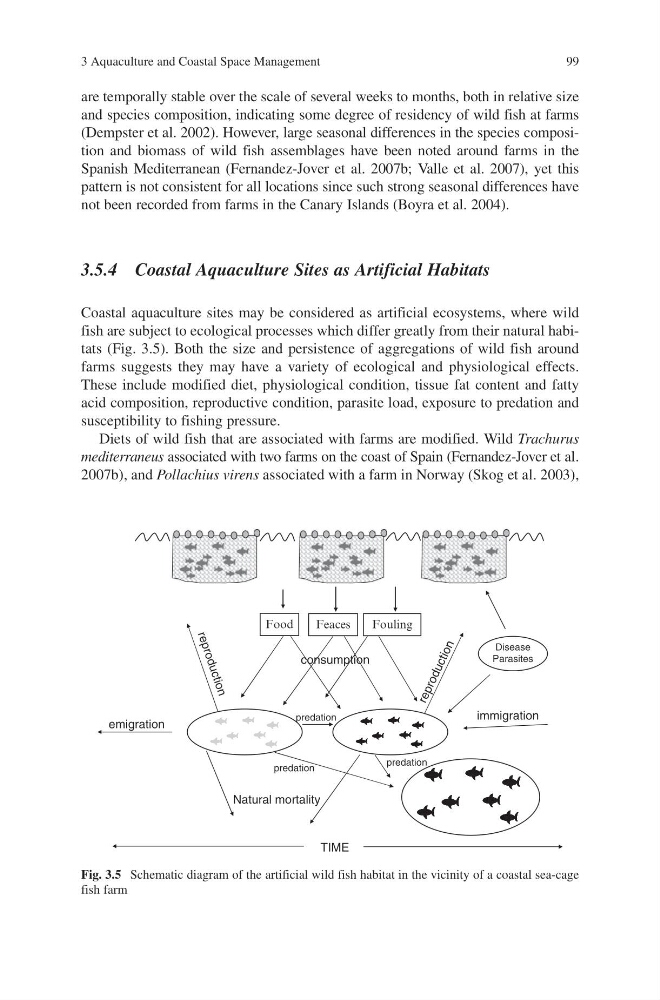
Coastal aquaculture sites may be considered as artificial ecosystems, where wild
fish are subject to ecological processes which differ greatly from their natural habitats (Fig. 3.5). Both the size and persistence of aggregations of wild fish around
farms suggests they may have a variety of ecological and physiological effects.
These include modified diet, physiological condition, tissue fat content and fatty
acid composition, reproductive condition, parasite load, exposure to predation and
susceptibility to fishing pressure.
Diets of wild fish that are associated with farms are modified. Wild Trachurus
mediterraneus associated with two farms on the coast of Spain (Fernandez-Jover et al.
2007b), and Pollachius virens associated with a farm in Norway (Skog et al. 2003),
Feaces
predation
Food
r e p r o d u c ti o n
immigration
emigration
Natural mortality
predation
predation
Fouling
TIME
consumption
Disease
Parasites
re
p
ro
d
u
c
ti
o
n
Fig. 3.5 Schematic diagram of the artificial wild fish habitat in the vicinity of a coastal sea-cage
fish farm
99
are temporally stable over the scale of several weeks to months, both in relative size
and species composition, indicating some degree of residency of wild fish at farms
(Dempster et al. 2002). However, large seasonal differences in the species composition and biomass of wild fish assemblages have been noted around farms in the
Spanish Mediterranean (Fernandez-Jover et al. 2007b; Valle et al. 2007), yet this
pattern is not consistent for all locations since such strong seasonal differences have
not been recorded from farms in the Canary Islands (Boyra et al. 2004).
3.5.4 Coastal Aquaculture Sites as Artificial Habitats
Coastal aquaculture sites may be considered as artificial ecosystems, where wild
fish are subject to ecological processes which differ greatly from their natural habitats (Fig. 3.5). Both the size and persistence of aggregations of wild fish around
farms suggests they may have a variety of ecological and physiological effects.
These include modified diet, physiological condition, tissue fat content and fatty
acid composition, reproductive condition, parasite load, exposure to predation and
susceptibility to fishing pressure.
Diets of wild fish that are associated with farms are modified. Wild Trachurus
mediterraneus associated with two farms on the coast of Spain (Fernandez-Jover et al.
2007b), and Pollachius virens associated with a farm in Norway (Skog et al. 2003),
Feaces
predation
Food
r e p r o d u c ti o n
immigration
emigration
Natural mortality
predation
predation
Fouling
TIME
consumption
Disease
Parasites
re
p
ro
d
u
c
ti
o
n
Fig. 3.5 Schematic diagram of the artificial wild fish habitat in the vicinity of a coastal sea-cage
fish farm