

3 Aquaculture and Coastal Space Management
93
Organic waste products from aquaculture can be particulate or dissolved.
Dissolved products include ammonia, phosphorus, dissolved organic carbon and
lipids. The environmental impact of these dissolved products depends on the rate
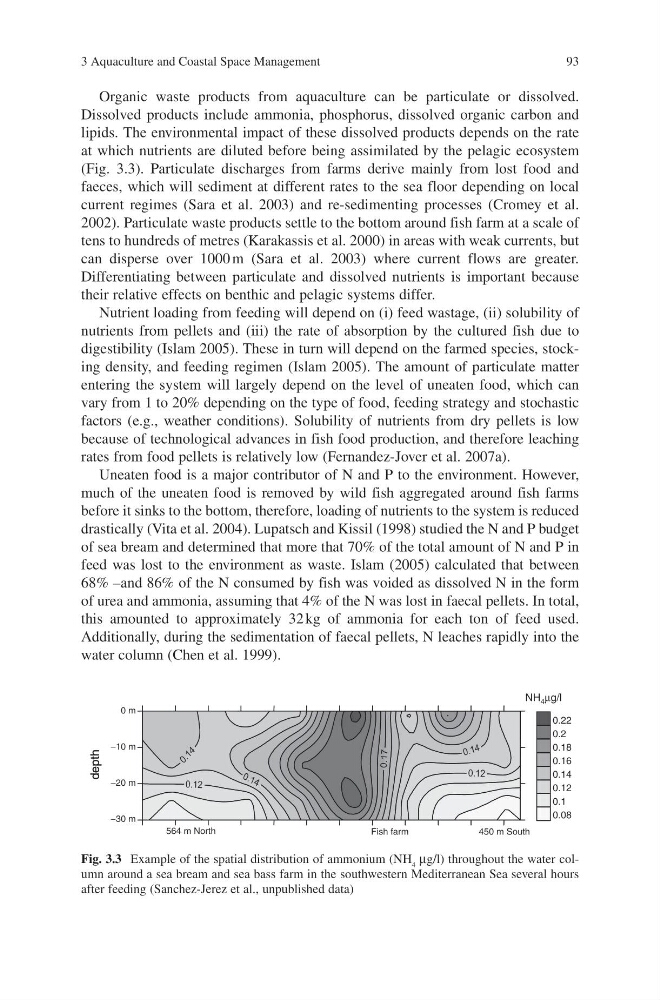
at which nutrients are diluted before being assimilated by the pelagic ecosystem
(Fig. 3.3). Particulate discharges from farms derive mainly from lost food and
faeces, which will sediment at different rates to the sea floor depending on local
current regimes (Sara et al. 2003) and re-sedimenting processes (Cromey et al.
2002). Particulate waste products settle to the bottom around fish farm at a scale of
tens to hundreds of metres (Karakassis et al. 2000) in areas with weak currents, but
can disperse over 1000 m (Sara et al. 2003) where current flows are greater.
Differentiating between particulate and dissolved nutrients is important because
their relative effects on benthic and pelagic systems differ.
Nutrient loading from feeding will depend on (i) feed wastage, (ii) solubility of
nutrients from pellets and (iii) the rate of absorption by the cultured fish due to
digestibility (Islam 2005). These in turn will depend on the farmed species, stocking density, and feeding regimen (Islam 2005). The amount of particulate matter
entering the system will largely depend on the level of uneaten food, which can
vary from 1 to 20% depending on the type of food, feeding strategy and stochastic
factors (e.g., weather conditions). Solubility of nutrients from dry pellets is low
because of technological advances in fish food production, and therefore leaching
rates from food pellets is relatively low (Fernandez-Jover et al. 2007a).
Uneaten food is a major contributor of N and P to the environment. However,
much of the uneaten food is removed by wild fish aggregated around fish farms
before it sinks to the bottom, therefore, loading of nutrients to the system is reduced
drastically (Vita et al. 2004). Lupatsch and Kissil (1998) studied the N and P budget
of sea bream and determined that more that 70% of the total amount of N and P in
feed was lost to the environment as waste. Islam (2005) calculated that between
68% –and 86% of the N consumed by fish was voided as dissolved N in the form
of urea and ammonia, assuming that 4% of the N was lost in faecal pellets. In total,
this amounted to approximately 32 kg of ammonia for each ton of feed used.
Additionally, during the sedimentation of faecal pellets, N leaches rapidly into the
water column (Chen et al. 1999).
depth
0.22
depth
0.2
0.18
0.16
0.14
0.12
0.1
0.08
450 m South
Fish farm
564 m North
−30 m
−20 m
−10 m
0 m
NH 4 µg/l
Fig. 3.3 Example of the spatial distribution of ammonium (NH 4 µg/l) throughout the water column around a sea bream and sea bass farm in the southwestern Mediterranean Sea several hours
after feeding (Sanchez-Jerez et al., unpublished data)
93
Organic waste products from aquaculture can be particulate or dissolved.
Dissolved products include ammonia, phosphorus, dissolved organic carbon and
lipids. The environmental impact of these dissolved products depends on the rate
at which nutrients are diluted before being assimilated by the pelagic ecosystem
(Fig. 3.3). Particulate discharges from farms derive mainly from lost food and
faeces, which will sediment at different rates to the sea floor depending on local
current regimes (Sara et al. 2003) and re-sedimenting processes (Cromey et al.
2002). Particulate waste products settle to the bottom around fish farm at a scale of
tens to hundreds of metres (Karakassis et al. 2000) in areas with weak currents, but
can disperse over 1000 m (Sara et al. 2003) where current flows are greater.
Differentiating between particulate and dissolved nutrients is important because
their relative effects on benthic and pelagic systems differ.
Nutrient loading from feeding will depend on (i) feed wastage, (ii) solubility of
nutrients from pellets and (iii) the rate of absorption by the cultured fish due to
digestibility (Islam 2005). These in turn will depend on the farmed species, stocking density, and feeding regimen (Islam 2005). The amount of particulate matter
entering the system will largely depend on the level of uneaten food, which can
vary from 1 to 20% depending on the type of food, feeding strategy and stochastic
factors (e.g., weather conditions). Solubility of nutrients from dry pellets is low
because of technological advances in fish food production, and therefore leaching
rates from food pellets is relatively low (Fernandez-Jover et al. 2007a).
Uneaten food is a major contributor of N and P to the environment. However,
much of the uneaten food is removed by wild fish aggregated around fish farms
before it sinks to the bottom, therefore, loading of nutrients to the system is reduced
drastically (Vita et al. 2004). Lupatsch and Kissil (1998) studied the N and P budget
of sea bream and determined that more that 70% of the total amount of N and P in
feed was lost to the environment as waste. Islam (2005) calculated that between
68% –and 86% of the N consumed by fish was voided as dissolved N in the form
of urea and ammonia, assuming that 4% of the N was lost in faecal pellets. In total,
this amounted to approximately 32 kg of ammonia for each ton of feed used.
Additionally, during the sedimentation of faecal pellets, N leaches rapidly into the
water column (Chen et al. 1999).
depth
0.22
depth
0.2
0.18
0.16
0.14
0.12
0.1
0.08
450 m South
Fish farm
564 m North
−30 m
−20 m
−10 m
0 m
NH 4 µg/l
Fig. 3.3 Example of the spatial distribution of ammonium (NH 4 µg/l) throughout the water column around a sea bream and sea bass farm in the southwestern Mediterranean Sea several hours
after feeding (Sanchez-Jerez et al., unpublished data)