

92
T. Dempster and P. Sanchez-Jerez
3.4 Nutrient Loading in Coastal Areas – Interactions
Between Aquaculture and Other Activities
The European Community has a total shoreline of 90,000 km. More than 20% of
the population is economically dependent on the coastal zone, which is intensively
used and settled by humans. Because of population pressure and economic development, water quality is declining throughout coastal areas due to an increase in
nutrient loading, which can be attributed to several sources. Population increases
over the last two centuries in coastal cities has lead to increased discharges from
sewage treatment plants to the marine environment. Over the last 20 years, in addition to other anthropogenic pressures, marine aquaculture has expanded in many
European coastal areas, increasing pressure on marine ecosystems.
In addition to the more traditional, extensive aquaculture of mussels and
oysters, which use primary production from the marine ecosystem, intensive
production of fish within sea-cages is increasingly occupying more coastal
space. Sea-cage aquaculture in Europe produces mainly carnivorous species
(salmonids, sea bass, sea bream) because of market demands. Cage aquaculture
uses high protein pellets to feed these carnivorous species. The nutrients unassimilated by the caged fish introduce a large source of nutrients to coastal areas.
For example, more than 800,000 t of feed was used to produces the 600,000 t of
salmonids in sea-cages in Norway in 2004 (Norwegian Fisheries Directorate
2005). Occasionally, nutrient inputs from aquaculture can exceed the assimilative capacity of the local marine environment, leading to coastal eutrophication
(Naylor et al. 2000). Fish production can generate considerable amounts of
effluent, such as waste feed, faeces, medicinal substances, heavy metals and
persistent organic pollutants, which can pollute the marine environment with a
range of negative impacts varying in severity (Black 2001; Read and Fernandes
2003; Mendiguchia et al. 2006; Sather et al. 2006).
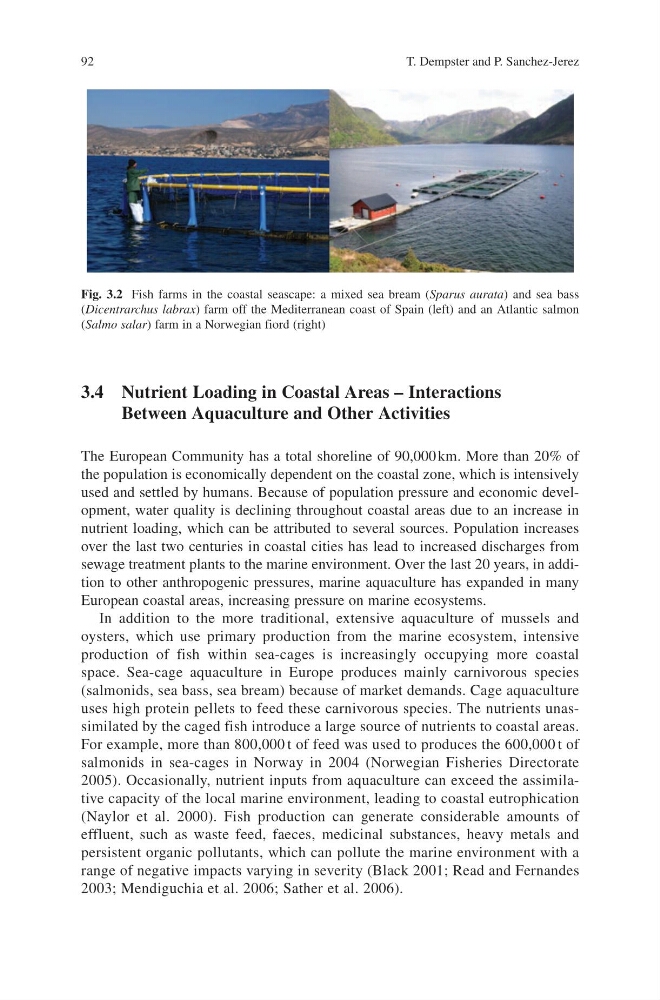
Fig. 3.2 Fish farms in the coastal seascape: a mixed sea bream (Sparus aurata) and sea bass
(Dicentrarchus labrax) farm off the Mediterranean coast of Spain (left) and an Atlantic salmon
(Salmo salar) farm in a Norwegian fiord (right)
T. Dempster and P. Sanchez-Jerez
3.4 Nutrient Loading in Coastal Areas – Interactions
Between Aquaculture and Other Activities
The European Community has a total shoreline of 90,000 km. More than 20% of
the population is economically dependent on the coastal zone, which is intensively
used and settled by humans. Because of population pressure and economic development, water quality is declining throughout coastal areas due to an increase in
nutrient loading, which can be attributed to several sources. Population increases
over the last two centuries in coastal cities has lead to increased discharges from
sewage treatment plants to the marine environment. Over the last 20 years, in addition to other anthropogenic pressures, marine aquaculture has expanded in many
European coastal areas, increasing pressure on marine ecosystems.
In addition to the more traditional, extensive aquaculture of mussels and
oysters, which use primary production from the marine ecosystem, intensive
production of fish within sea-cages is increasingly occupying more coastal
space. Sea-cage aquaculture in Europe produces mainly carnivorous species
(salmonids, sea bass, sea bream) because of market demands. Cage aquaculture
uses high protein pellets to feed these carnivorous species. The nutrients unassimilated by the caged fish introduce a large source of nutrients to coastal areas.
For example, more than 800,000 t of feed was used to produces the 600,000 t of
salmonids in sea-cages in Norway in 2004 (Norwegian Fisheries Directorate
2005). Occasionally, nutrient inputs from aquaculture can exceed the assimilative capacity of the local marine environment, leading to coastal eutrophication
(Naylor et al. 2000). Fish production can generate considerable amounts of
effluent, such as waste feed, faeces, medicinal substances, heavy metals and
persistent organic pollutants, which can pollute the marine environment with a
range of negative impacts varying in severity (Black 2001; Read and Fernandes
2003; Mendiguchia et al. 2006; Sather et al. 2006).
Fig. 3.2 Fish farms in the coastal seascape: a mixed sea bream (Sparus aurata) and sea bass
(Dicentrarchus labrax) farm off the Mediterranean coast of Spain (left) and an Atlantic salmon
(Salmo salar) farm in a Norwegian fiord (right)