

70
P.P. Molloy et al.
disproportionately kill males and drive a highly female-biased sex ratio (e.g. Vincent
and Sadovy 1998 Fig. 9–10, Alonzo and Mangel 2004 ) . Future studies on fertilisation rates in spawning aggregations should test sex-ratio effects more specifi cally.
If pair-spawning is associated with sperm limitation, females may suffer a cost
from spawning with territorial males and a sexual confl ict may arise: females prefer
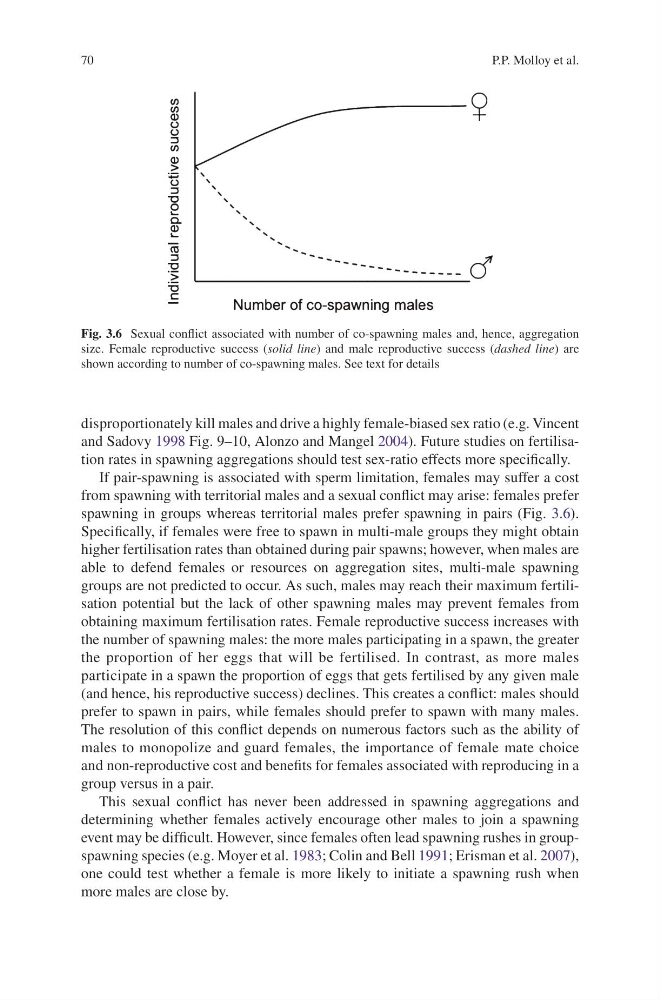
spawning in groups whereas territorial males prefer spawning in pairs (Fig. 3.6 ).
Specifi cally, if females were free to spawn in multi-male groups they might obtain
higher fertilisation rates than obtained during pair spawns; however, when males are
able to defend females or resources on aggregation sites, multi-male spawning
groups are not predicted to occur. As such, males may reach their maximum fertilisation potential but the lack of other spawning males may prevent females from
obtaining maximum fertilisation rates. Female reproductive success increases with
the number of spawning males: the more males participating in a spawn, the greater
the proportion of her eggs that will be fertilised. In contrast, as more males
participate in a spawn the proportion of eggs that gets fertilised by any given male
(and hence, his reproductive success) declines. This creates a confl ict: males should
prefer to spawn in pairs, while females should prefer to spawn with many males.
The resolution of this confl ict depends on numerous factors such as the ability of
males to monopolize and guard females, the importance of female mate choice
and non-reproductive cost and benefi ts for females associated with reproducing in a
group versus in a pair.
This sexual confl ict has never been addressed in spawning aggregations and
determining whether females actively encourage other males to join a spawning
event may be diffi cult. However, since females often lead spawning rushes in groupspawning species (e.g. Moyer et al. 1983 ; Colin and Bell 1991 ; Erisman et al. 2007 ) ,
one could test whether a female is more likely to initiate a spawning rush when
more males are close by.
Fig. 3.6 Sexual confl ict associated with number of co-spawning males and, hence, aggregation
size. Female reproductive success ( solid line ) and male reproductive success ( dashed line ) are
shown according to number of co-spawning males. See text for details
P.P. Molloy et al.
disproportionately kill males and drive a highly female-biased sex ratio (e.g. Vincent
and Sadovy 1998 Fig. 9–10, Alonzo and Mangel 2004 ) . Future studies on fertilisation rates in spawning aggregations should test sex-ratio effects more specifi cally.
If pair-spawning is associated with sperm limitation, females may suffer a cost
from spawning with territorial males and a sexual confl ict may arise: females prefer
spawning in groups whereas territorial males prefer spawning in pairs (Fig. 3.6 ).
Specifi cally, if females were free to spawn in multi-male groups they might obtain
higher fertilisation rates than obtained during pair spawns; however, when males are
able to defend females or resources on aggregation sites, multi-male spawning
groups are not predicted to occur. As such, males may reach their maximum fertilisation potential but the lack of other spawning males may prevent females from
obtaining maximum fertilisation rates. Female reproductive success increases with
the number of spawning males: the more males participating in a spawn, the greater
the proportion of her eggs that will be fertilised. In contrast, as more males
participate in a spawn the proportion of eggs that gets fertilised by any given male
(and hence, his reproductive success) declines. This creates a confl ict: males should
prefer to spawn in pairs, while females should prefer to spawn with many males.
The resolution of this confl ict depends on numerous factors such as the ability of
males to monopolize and guard females, the importance of female mate choice
and non-reproductive cost and benefi ts for females associated with reproducing in a
group versus in a pair.
This sexual confl ict has never been addressed in spawning aggregations and
determining whether females actively encourage other males to join a spawning
event may be diffi cult. However, since females often lead spawning rushes in groupspawning species (e.g. Moyer et al. 1983 ; Colin and Bell 1991 ; Erisman et al. 2007 ) ,
one could test whether a female is more likely to initiate a spawning rush when
more males are close by.
Fig. 3.6 Sexual confl ict associated with number of co-spawning males and, hence, aggregation
size. Female reproductive success ( solid line ) and male reproductive success ( dashed line ) are
shown according to number of co-spawning males. See text for details