

69
3 Why Spawn in Aggregations?
Despite the strong selection for abundant sperm production when spawning in a
group, sperm limitation can occur. The large amount of sperm released by males to
compete for access to eggs, in addition to the potential for mating with multiple
females in quick succession (particularly by the most preferred males), can lead to
sperm depletion in some individuals. For example, pair-spawning, territorial male
bluehead wrasse, Thalassoma bifasciatum , that have high spawning rates showed
lower fertilisation rates than males with lower spawning rates (Warner et al. 1995 ,
Chap. 12.14 ). Although these males are not aggregative spawners, this example
neatly demonstrates the potential for sperm limitation in fi sh that spawn repeatedly.
For females, spawning in groups with several males may overcome this risk of
sperm limitation and instead yield increased fertilisation rates where total sperm
availability is greater. Evidence for such a fertilisation benefi t to females through
spawning in groups is variable. In Atlantic cod ( Gadus morhua ), fertilisation rates
increase with the number of spawning males (Rowe et al. 2004 ) ; however, fertilisation rates in bluehead wrasse were similar between multi-male group spawns and
pair spawns (Petersen et al. 1992 ) , despite an ~80 times increase in the amount of
sperm released by group- than pair-spawning males (Fig. 12.38). In brown surgeonfi sh (Acanthuridae), Acanthurus nigrofuscus , fertilisation rates were similar between
large and small spawning groups (Kifl awi et al. 1998 ) . However, group size per se
may not be associated with increased fertilisation rates if the number of males per
female remains constant in all groups; rather, fertilisation rates should increase with
male:female sex ratio. Group size will only correlate with fertilisation rates if it also
correlates with sex ratio. Indeed, studies of aggregation fi shing predict that sperm
limitation, and thus reduced fertilisation rates, are most likely when fi sheries
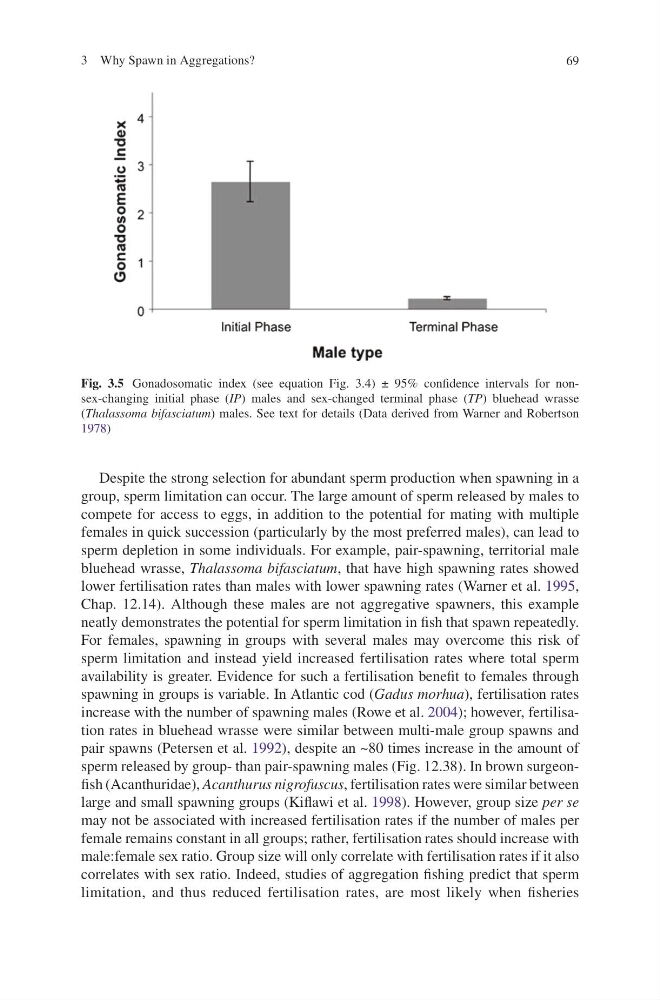
Fig. 3.5 Gonadosomatic index (see equation Fig. 3.4) ± 95% confi dence intervals for nonsex-changing initial phase ( IP ) males and sex-changed terminal phase ( TP ) bluehead wrasse
( Thalassoma bifasciatum ) males. See text for details (Data derived from Warner and Robertson
1978 )
3 Why Spawn in Aggregations?
Despite the strong selection for abundant sperm production when spawning in a
group, sperm limitation can occur. The large amount of sperm released by males to
compete for access to eggs, in addition to the potential for mating with multiple
females in quick succession (particularly by the most preferred males), can lead to
sperm depletion in some individuals. For example, pair-spawning, territorial male
bluehead wrasse, Thalassoma bifasciatum , that have high spawning rates showed
lower fertilisation rates than males with lower spawning rates (Warner et al. 1995 ,
Chap. 12.14 ). Although these males are not aggregative spawners, this example
neatly demonstrates the potential for sperm limitation in fi sh that spawn repeatedly.
For females, spawning in groups with several males may overcome this risk of
sperm limitation and instead yield increased fertilisation rates where total sperm
availability is greater. Evidence for such a fertilisation benefi t to females through
spawning in groups is variable. In Atlantic cod ( Gadus morhua ), fertilisation rates
increase with the number of spawning males (Rowe et al. 2004 ) ; however, fertilisation rates in bluehead wrasse were similar between multi-male group spawns and
pair spawns (Petersen et al. 1992 ) , despite an ~80 times increase in the amount of
sperm released by group- than pair-spawning males (Fig. 12.38). In brown surgeonfi sh (Acanthuridae), Acanthurus nigrofuscus , fertilisation rates were similar between
large and small spawning groups (Kifl awi et al. 1998 ) . However, group size per se
may not be associated with increased fertilisation rates if the number of males per
female remains constant in all groups; rather, fertilisation rates should increase with
male:female sex ratio. Group size will only correlate with fertilisation rates if it also
correlates with sex ratio. Indeed, studies of aggregation fi shing predict that sperm
limitation, and thus reduced fertilisation rates, are most likely when fi sheries
Fig. 3.5 Gonadosomatic index (see equation Fig. 3.4) ± 95% confi dence intervals for nonsex-changing initial phase ( IP ) males and sex-changed terminal phase ( TP ) bluehead wrasse
( Thalassoma bifasciatum ) males. See text for details (Data derived from Warner and Robertson
1978 )