

63
3 Why Spawn in Aggregations?
signifi cant number of fertilisations to neighbours (Brown and Brown 1989 ; Jennings
and Philipp 1992 ) . In European starlings, Sturnus vulgaris , denser groups breed
more synchronously and breeding synchrony, in turn, is linked to greater fl edging
success (Evans et al. 2009 ) .
Predation may be reduced in a breeding group because of a dilution effect,
whereby the likelihood of any individual being the target of a predator decreases as
group size increases (Hamilton 1971 ) . Breeding group members may detect predators
earlier than solitary animals, thus increasing their probability of escape (e.g. Heard
1992 ) . They may also be more successful in deterring or confusing predators
through cooperative efforts with other group members (Wittenberger and Hunt
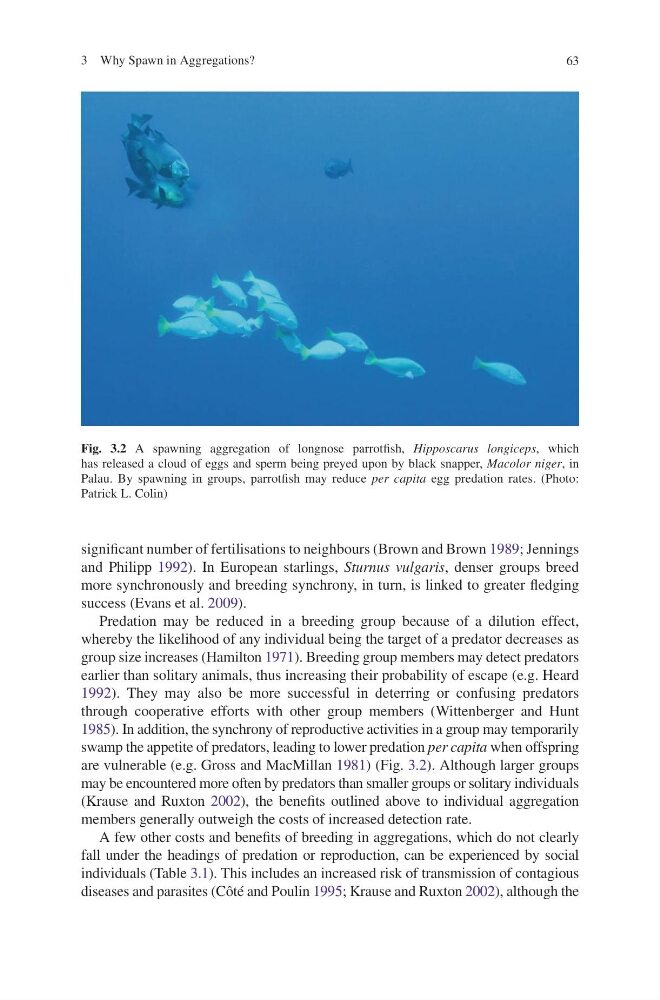
1985 ) . In addition, the synchrony of reproductive activities in a group may temporarily
swamp the appetite of predators, leading to lower predation per capita when offspring
are vulnerable (e.g. Gross and MacMillan 1981 ) (Fig. 3.2 ). Although larger groups
may be encountered more often by predators than smaller groups or solitary individuals
(Krause and Ruxton 2002 ) , the benefi ts outlined above to individual aggregation
members generally outweigh the costs of increased detection rate.
A few other costs and benefi ts of breeding in aggregations, which do not clearly
fall under the headings of predation or reproduction, can be experienced by social
individuals (Table 3.1 ). This includes an increased risk of transmission of contagious
diseases and parasites (Côté and Poulin 1995 ; Krause and Ruxton 2002 ) , although the
Fig. 3.2 A spawning aggregation of longnose parrotfi sh, Hipposcarus longiceps , which
has released a cloud of eggs and sperm being preyed upon by black snapper, Macolor niger , in
Palau. By spawning in groups, parrotfi sh may reduce per capita egg predation rates. (Photo:
Patrick L. Colin)
3 Why Spawn in Aggregations?
signifi cant number of fertilisations to neighbours (Brown and Brown 1989 ; Jennings
and Philipp 1992 ) . In European starlings, Sturnus vulgaris , denser groups breed
more synchronously and breeding synchrony, in turn, is linked to greater fl edging
success (Evans et al. 2009 ) .
Predation may be reduced in a breeding group because of a dilution effect,
whereby the likelihood of any individual being the target of a predator decreases as
group size increases (Hamilton 1971 ) . Breeding group members may detect predators
earlier than solitary animals, thus increasing their probability of escape (e.g. Heard
1992 ) . They may also be more successful in deterring or confusing predators
through cooperative efforts with other group members (Wittenberger and Hunt
1985 ) . In addition, the synchrony of reproductive activities in a group may temporarily
swamp the appetite of predators, leading to lower predation per capita when offspring
are vulnerable (e.g. Gross and MacMillan 1981 ) (Fig. 3.2 ). Although larger groups
may be encountered more often by predators than smaller groups or solitary individuals
(Krause and Ruxton 2002 ) , the benefi ts outlined above to individual aggregation
members generally outweigh the costs of increased detection rate.
A few other costs and benefi ts of breeding in aggregations, which do not clearly
fall under the headings of predation or reproduction, can be experienced by social
individuals (Table 3.1 ). This includes an increased risk of transmission of contagious
diseases and parasites (Côté and Poulin 1995 ; Krause and Ruxton 2002 ) , although the
Fig. 3.2 A spawning aggregation of longnose parrotfi sh, Hipposcarus longiceps , which
has released a cloud of eggs and sperm being preyed upon by black snapper, Macolor niger , in
Palau. By spawning in groups, parrotfi sh may reduce per capita egg predation rates. (Photo:
Patrick L. Colin)