

61
3 Why Spawn in Aggregations?
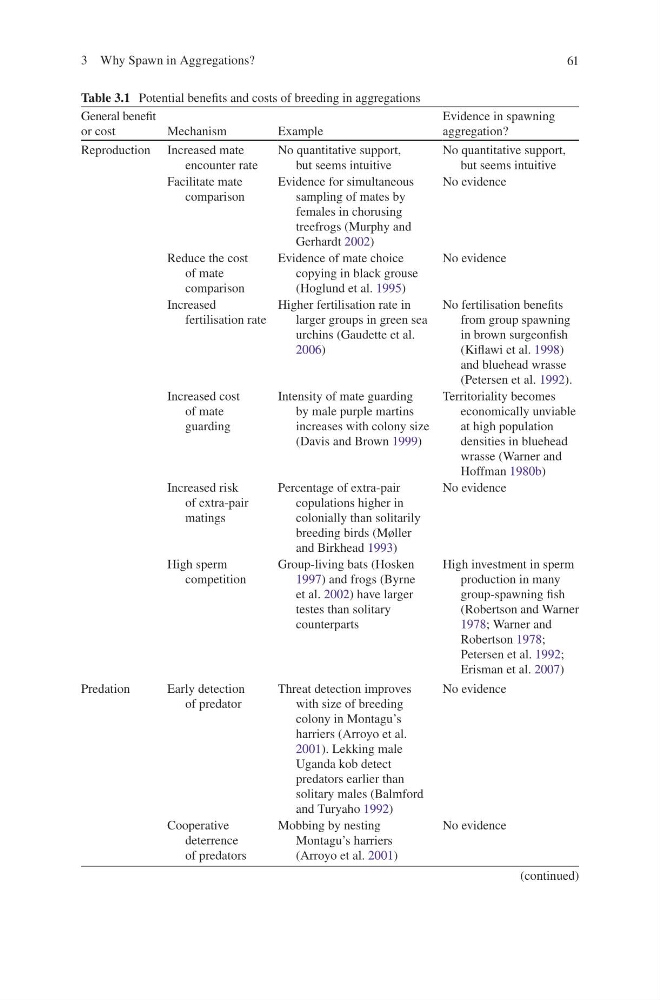
Table 3.1 Potential benefi ts and costs of breeding in aggregations
General benefi t
or cost
Mechanism
Example
Evidence in spawning
aggregation?
Reproduction Increased mate
encounter rate
No quantitative support,
but seems intuitive
No quantitative support,
but seems intuitive
Facilitate mate
comparison
Evidence for simultaneous
sampling of mates by
females in chorusing
treefrogs (Murphy and
Gerhardt 2002 )
No evidence
Reduce the cost
of mate
comparison
Evidence of mate choice
copying in black grouse
(Hoglund et al. 1995 )
No evidence
Increased
fertilisation rate
Higher fertilisation rate in
larger groups in green sea
urchins (Gaudette et al.
2006 )
No fertilisation benefi ts
from group spawning
in brown surgeonfi sh
(Kifl awi et al. 1998 )
and bluehead wrasse
(Petersen et al. 1992 ) .
Increased cost
of mate
guarding
Intensity of mate guarding
by male purple martins
increases with colony size
(Davis and Brown 1999 )
Territoriality becomes
economically unviable
at high population
densities in bluehead
wrasse (Warner and
Hoffman 1980b )
Increased risk
of extra-pair
matings
Percentage of extra-pair
copulations higher in
colonially than solitarily
breeding birds (Møller
and Birkhead 1993 )
No evidence
High sperm
competition
Group-living bats (Hosken
1997 ) and frogs (Byrne
et al. 2002 ) have larger
testes than solitary
counterparts
High investment in sperm
production in many
group-spawning fi sh
(Robertson and Warner
1978 ; Warner and
Robertson 1978 ;
Petersen et al. 1992 ;
Erisman et al. 2007 )
Predation
Early detection
of predator
Threat detection improves
with size of breeding
colony in Montagu’s
harriers (Arroyo et al.
2001 ) . Lekking male
Uganda kob detect
predators earlier than
solitary males (Balmford
and Turyaho 1992 )
No evidence
Cooperative
deterrence
of predators
Mobbing by nesting
Montagu’s harriers
(Arroyo et al. 2001 )
No evidence
(continued)
3 Why Spawn in Aggregations?
Table 3.1 Potential benefi ts and costs of breeding in aggregations
General benefi t
or cost
Mechanism
Example
Evidence in spawning
aggregation?
Reproduction Increased mate
encounter rate
No quantitative support,
but seems intuitive
No quantitative support,
but seems intuitive
Facilitate mate
comparison
Evidence for simultaneous
sampling of mates by
females in chorusing
treefrogs (Murphy and
Gerhardt 2002 )
No evidence
Reduce the cost
of mate
comparison
Evidence of mate choice
copying in black grouse
(Hoglund et al. 1995 )
No evidence
Increased
fertilisation rate
Higher fertilisation rate in
larger groups in green sea
urchins (Gaudette et al.
2006 )
No fertilisation benefi ts
from group spawning
in brown surgeonfi sh
(Kifl awi et al. 1998 )
and bluehead wrasse
(Petersen et al. 1992 ) .
Increased cost
of mate
guarding
Intensity of mate guarding
by male purple martins
increases with colony size
(Davis and Brown 1999 )
Territoriality becomes
economically unviable
at high population
densities in bluehead
wrasse (Warner and
Hoffman 1980b )
Increased risk
of extra-pair
matings
Percentage of extra-pair
copulations higher in
colonially than solitarily
breeding birds (Møller
and Birkhead 1993 )
No evidence
High sperm
competition
Group-living bats (Hosken
1997 ) and frogs (Byrne
et al. 2002 ) have larger
testes than solitary
counterparts
High investment in sperm
production in many
group-spawning fi sh
(Robertson and Warner
1978 ; Warner and
Robertson 1978 ;
Petersen et al. 1992 ;
Erisman et al. 2007 )
Predation
Early detection
of predator
Threat detection improves
with size of breeding
colony in Montagu’s
harriers (Arroyo et al.
2001 ) . Lekking male
Uganda kob detect
predators earlier than
solitary males (Balmford
and Turyaho 1992 )
No evidence
Cooperative
deterrence
of predators
Mobbing by nesting
Montagu’s harriers
(Arroyo et al. 2001 )
No evidence
(continued)