

544
12 Species Case Studies
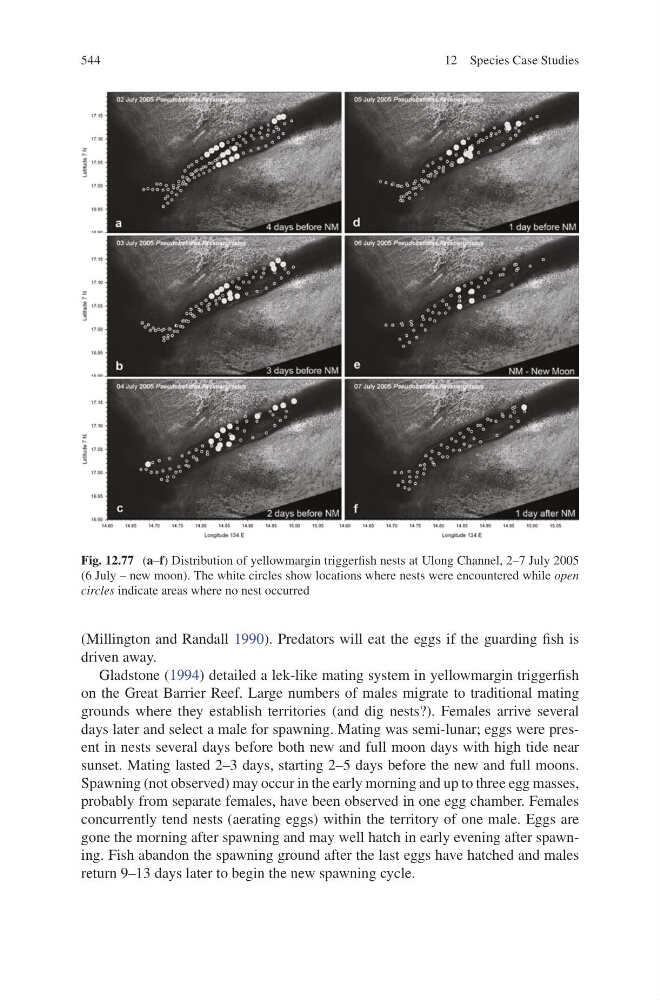
Fig. 12.77 ( a – f ) Distribution of yellowmargin triggerfi sh nests at Ulong Channel, 2–7 July 2005
(6 July – new moon). The white circles show locations where nests were encountered while open
circles indicate areas where no nest occurred
(Millington and Randall 1990 ) . Predators will eat the eggs if the guarding fi sh is
driven away.
Gladstone ( 1994 ) detailed a lek-like mating system in yellowmargin triggerfi sh
on the Great Barrier Reef. Large numbers of males migrate to traditional mating
grounds where they establish territories (and dig nests?). Females arrive several
days later and select a male for spawning. Mating was semi-lunar; eggs were present in nests several days before both new and full moon days with high tide near
sunset. Mating lasted 2–3 days, starting 2–5 days before the new and full moons.
Spawning (not observed) may occur in the early morning and up to three egg masses,
probably from separate females, have been observed in one egg chamber. Females
concurrently tend nests (aerating eggs) within the territory of one male. Eggs are
gone the morning after spawning and may well hatch in early evening after spawning. Fish abandon the spawning ground after the last eggs have hatched and males
return 9–13 days later to begin the new spawning cycle.
12 Species Case Studies
Fig. 12.77 ( a – f ) Distribution of yellowmargin triggerfi sh nests at Ulong Channel, 2–7 July 2005
(6 July – new moon). The white circles show locations where nests were encountered while open
circles indicate areas where no nest occurred
(Millington and Randall 1990 ) . Predators will eat the eggs if the guarding fi sh is
driven away.
Gladstone ( 1994 ) detailed a lek-like mating system in yellowmargin triggerfi sh
on the Great Barrier Reef. Large numbers of males migrate to traditional mating
grounds where they establish territories (and dig nests?). Females arrive several
days later and select a male for spawning. Mating was semi-lunar; eggs were present in nests several days before both new and full moon days with high tide near
sunset. Mating lasted 2–3 days, starting 2–5 days before the new and full moons.
Spawning (not observed) may occur in the early morning and up to three egg masses,
probably from separate females, have been observed in one egg chamber. Females
concurrently tend nests (aerating eggs) within the territory of one male. Eggs are
gone the morning after spawning and may well hatch in early evening after spawning. Fish abandon the spawning ground after the last eggs have hatched and males
return 9–13 days later to begin the new spawning cycle.