

543
12 Species Case Studies
most sub-tropical waters where they are common members of reef associated
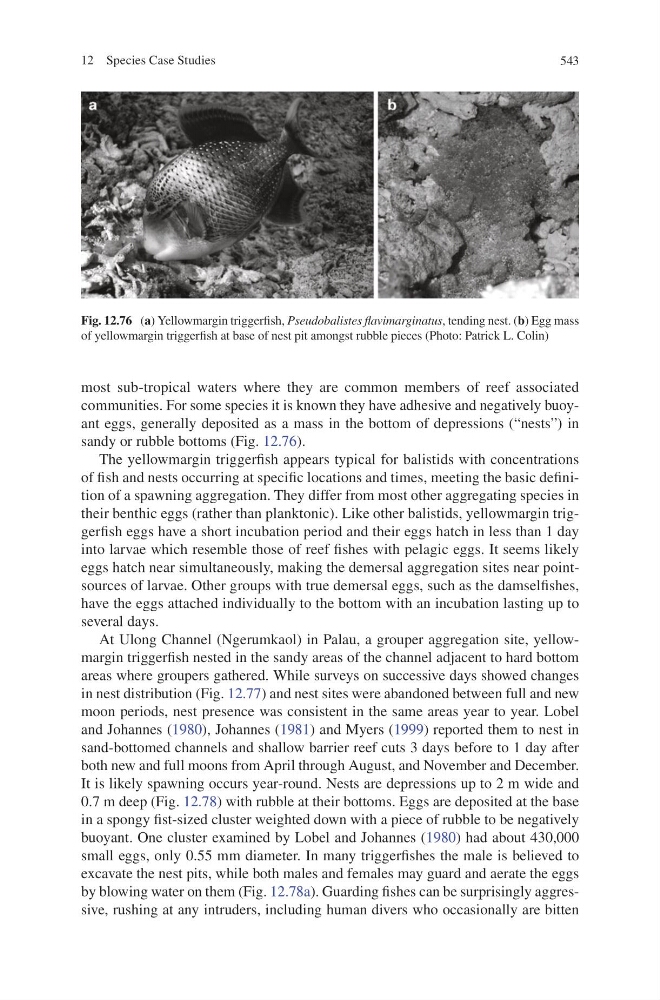
communities. For some species it is known they have adhesive and negatively buoyant eggs, generally deposited as a mass in the bottom of depressions (“nests”) in
sandy or rubble bottoms (Fig. 12.76 ).
The yellowmargin triggerfi sh appears typical for balistids with concentrations
of fi sh and nests occurring at specifi c locations and times, meeting the basic defi nition of a spawning aggregation. They differ from most other aggregating species in
their benthic eggs (rather than planktonic). Like other balistids, yellowmargin triggerfi sh eggs have a short incubation period and their eggs hatch in less than 1 day
into larvae which resemble those of reef fi shes with pelagic eggs. It seems likely
eggs hatch near simultaneously, making the demersal aggregation sites near pointsources of larvae. Other groups with true demersal eggs, such as the damselfi shes,
have the eggs attached individually to the bottom with an incubation lasting up to
several days.
At Ulong Channel (Ngerumkaol) in Palau, a grouper aggregation site, yellowmargin triggerfi sh nested in the sandy areas of the channel adjacent to hard bottom
areas where groupers gathered. While surveys on successive days showed changes
in nest distribution (Fig. 12.77 ) and nest sites were abandoned between full and new
moon periods, nest presence was consistent in the same areas year to year. Lobel
and Johannes ( 1980 ) , Johannes ( 1981 ) and Myers ( 1999 ) reported them to nest in
sand-bottomed channels and shallow barrier reef cuts 3 days before to 1 day after
both new and full moons from April through August, and November and December.
It is likely spawning occurs year-round. Nests are depressions up to 2 m wide and
0.7 m deep (Fig. 12.78 ) with rubble at their bottoms. Eggs are deposited at the base
in a spongy fi st-sized cluster weighted down with a piece of rubble to be negatively
buoyant. One cluster examined by Lobel and Johannes ( 1980 ) had about 430,000
small eggs, only 0.55 mm diameter. In many triggerfi shes the male is believed to
excavate the nest pits, while both males and females may guard and aerate the eggs
by blowing water on them (Fig. 12.78a ). Guarding fi shes can be surprisingly aggressive, rushing at any intruders, including human divers who occasionally are bitten
Fig. 12.76 ( a ) Yellowmargin triggerfi sh, Pseudobalistes fl avimarginatus , tending nest. ( b ) Egg mass
of yellowmargin triggerfi sh at base of nest pit amongst rubble pieces (Photo: Patrick L. Colin)
12 Species Case Studies
most sub-tropical waters where they are common members of reef associated
communities. For some species it is known they have adhesive and negatively buoyant eggs, generally deposited as a mass in the bottom of depressions (“nests”) in
sandy or rubble bottoms (Fig. 12.76 ).
The yellowmargin triggerfi sh appears typical for balistids with concentrations
of fi sh and nests occurring at specifi c locations and times, meeting the basic defi nition of a spawning aggregation. They differ from most other aggregating species in
their benthic eggs (rather than planktonic). Like other balistids, yellowmargin triggerfi sh eggs have a short incubation period and their eggs hatch in less than 1 day
into larvae which resemble those of reef fi shes with pelagic eggs. It seems likely
eggs hatch near simultaneously, making the demersal aggregation sites near pointsources of larvae. Other groups with true demersal eggs, such as the damselfi shes,
have the eggs attached individually to the bottom with an incubation lasting up to
several days.
At Ulong Channel (Ngerumkaol) in Palau, a grouper aggregation site, yellowmargin triggerfi sh nested in the sandy areas of the channel adjacent to hard bottom
areas where groupers gathered. While surveys on successive days showed changes
in nest distribution (Fig. 12.77 ) and nest sites were abandoned between full and new
moon periods, nest presence was consistent in the same areas year to year. Lobel
and Johannes ( 1980 ) , Johannes ( 1981 ) and Myers ( 1999 ) reported them to nest in
sand-bottomed channels and shallow barrier reef cuts 3 days before to 1 day after
both new and full moons from April through August, and November and December.
It is likely spawning occurs year-round. Nests are depressions up to 2 m wide and
0.7 m deep (Fig. 12.78 ) with rubble at their bottoms. Eggs are deposited at the base
in a spongy fi st-sized cluster weighted down with a piece of rubble to be negatively
buoyant. One cluster examined by Lobel and Johannes ( 1980 ) had about 430,000
small eggs, only 0.55 mm diameter. In many triggerfi shes the male is believed to
excavate the nest pits, while both males and females may guard and aerate the eggs
by blowing water on them (Fig. 12.78a ). Guarding fi shes can be surprisingly aggressive, rushing at any intruders, including human divers who occasionally are bitten
Fig. 12.76 ( a ) Yellowmargin triggerfi sh, Pseudobalistes fl avimarginatus , tending nest. ( b ) Egg mass
of yellowmargin triggerfi sh at base of nest pit amongst rubble pieces (Photo: Patrick L. Colin)