

529
12 Species Case Studies
Atoll, Indian Ocean with fi sh migrating at least 300 m to that site. Along with its
great geographic distribution, the species spawns at a wide range of temperatures.
In the Red Sea spawning was limited to summer months, with temperatures of
24–25
o C, and only 18.5–20
o
C during winter (Myrberg et al. 1988 ) . In Palau spawning occurs year-round over the annual temperature range of 28.0–29.5°C (PLC
unpublished data).
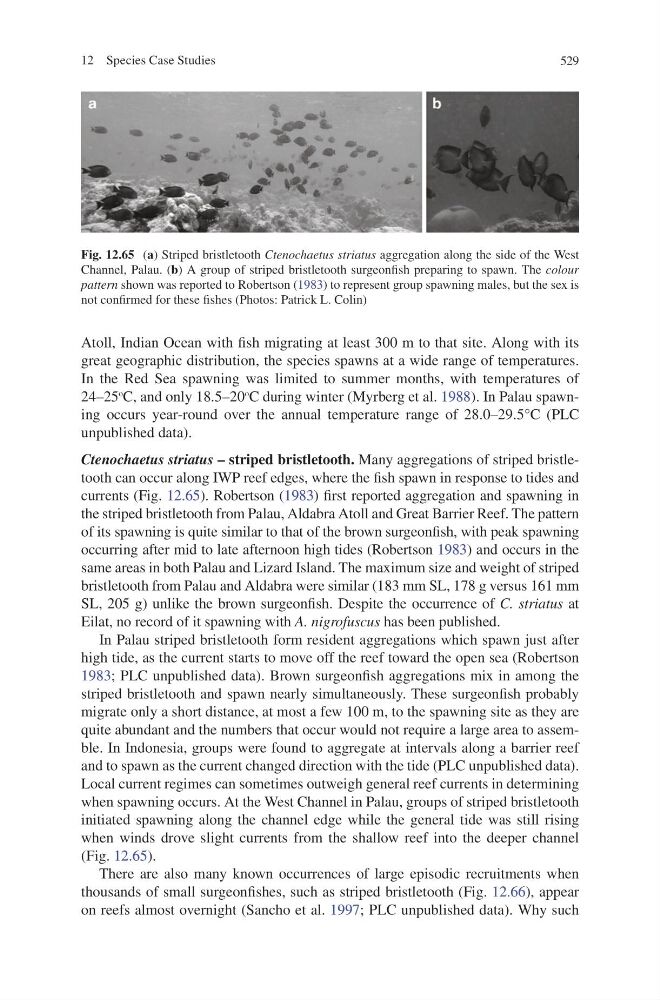
Ctenochaetus striatus – striped bristletooth. Many aggregations of striped bristletooth can occur along IWP reef edges, where the fi sh spawn in response to tides and
currents (Fig. 12.65 ). Robertson ( 1983 ) fi rst reported aggregation and spawning in
the striped bristletooth from Palau, Aldabra Atoll and Great Barrier Reef. The pattern
of its spawning is quite similar to that of the brown surgeonfi sh, with peak spawning
occurring after mid to late afternoon high tides (Robertson 1983 ) and occurs in the
same areas in both Palau and Lizard Island. The maximum size and weight of striped
bristletooth from Palau and Aldabra were similar (183 mm SL, 178 g versus 161 mm
SL, 205 g) unlike the brown surgeonfi sh. Despite the occurrence of C. striatus at
Eilat, no record of it spawning with A. nigrofuscus has been published.
In Palau striped bristletooth form resident aggregations which spawn just after
high tide, as the current starts to move off the reef toward the open sea (Robertson
1983 ; PLC unpublished data). Brown surgeonfi sh aggregations mix in among the
striped bristletooth and spawn nearly simultaneously. These surgeonfi sh probably
migrate only a short distance, at most a few 100 m, to the spawning site as they are
quite abundant and the numbers that occur would not require a large area to assemble. In Indonesia, groups were found to aggregate at intervals along a barrier reef
and to spawn as the current changed direction with the tide (PLC unpublished data).
Local current regimes can sometimes outweigh general reef currents in determining
when spawning occurs. At the West Channel in Palau, groups of striped bristletooth
initiated spawning along the channel edge while the general tide was still rising
when winds drove slight currents from the shallow reef into the deeper channel
(Fig. 12.65 ).
There are also many known occurrences of large episodic recruitments when
thousands of small surgeonfi shes, such as striped bristletooth (Fig. 12.66 ), appear
on reefs almost overnight (Sancho et al. 1997 ; PLC unpublished data). Why such
Fig. 12.65 ( a ) Striped bristletooth Ctenochaetus striatus aggregation along the side of the West
Channel, Palau. ( b ) A group of striped bristletooth surgeonfi sh preparing to spawn. The colour
pattern shown was reported to Robertson ( 1983 ) to represent group spawning males, but the sex is
not confi rmed for these fi shes (Photos: Patrick L. Colin)
12 Species Case Studies
Atoll, Indian Ocean with fi sh migrating at least 300 m to that site. Along with its
great geographic distribution, the species spawns at a wide range of temperatures.
In the Red Sea spawning was limited to summer months, with temperatures of
24–25
o C, and only 18.5–20
o
C during winter (Myrberg et al. 1988 ) . In Palau spawning occurs year-round over the annual temperature range of 28.0–29.5°C (PLC
unpublished data).
Ctenochaetus striatus – striped bristletooth. Many aggregations of striped bristletooth can occur along IWP reef edges, where the fi sh spawn in response to tides and
currents (Fig. 12.65 ). Robertson ( 1983 ) fi rst reported aggregation and spawning in
the striped bristletooth from Palau, Aldabra Atoll and Great Barrier Reef. The pattern
of its spawning is quite similar to that of the brown surgeonfi sh, with peak spawning
occurring after mid to late afternoon high tides (Robertson 1983 ) and occurs in the
same areas in both Palau and Lizard Island. The maximum size and weight of striped
bristletooth from Palau and Aldabra were similar (183 mm SL, 178 g versus 161 mm
SL, 205 g) unlike the brown surgeonfi sh. Despite the occurrence of C. striatus at
Eilat, no record of it spawning with A. nigrofuscus has been published.
In Palau striped bristletooth form resident aggregations which spawn just after
high tide, as the current starts to move off the reef toward the open sea (Robertson
1983 ; PLC unpublished data). Brown surgeonfi sh aggregations mix in among the
striped bristletooth and spawn nearly simultaneously. These surgeonfi sh probably
migrate only a short distance, at most a few 100 m, to the spawning site as they are
quite abundant and the numbers that occur would not require a large area to assemble. In Indonesia, groups were found to aggregate at intervals along a barrier reef
and to spawn as the current changed direction with the tide (PLC unpublished data).
Local current regimes can sometimes outweigh general reef currents in determining
when spawning occurs. At the West Channel in Palau, groups of striped bristletooth
initiated spawning along the channel edge while the general tide was still rising
when winds drove slight currents from the shallow reef into the deeper channel
(Fig. 12.65 ).
There are also many known occurrences of large episodic recruitments when
thousands of small surgeonfi shes, such as striped bristletooth (Fig. 12.66 ), appear
on reefs almost overnight (Sancho et al. 1997 ; PLC unpublished data). Why such
Fig. 12.65 ( a ) Striped bristletooth Ctenochaetus striatus aggregation along the side of the West
Channel, Palau. ( b ) A group of striped bristletooth surgeonfi sh preparing to spawn. The colour
pattern shown was reported to Robertson ( 1983 ) to represent group spawning males, but the sex is
not confi rmed for these fi shes (Photos: Patrick L. Colin)